
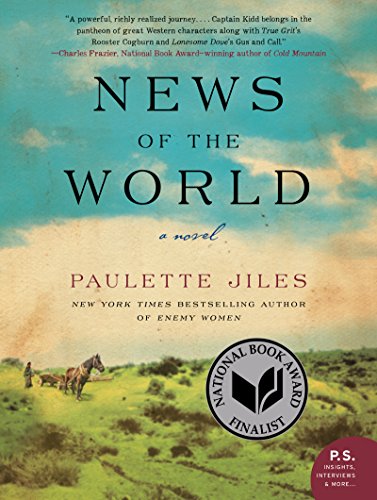
News of the World
If historical fiction is to be written, it should be like this: full of gorgeous details that are as much about the scenes as about the emotions of the people inhabiting the scenes. The word painting is so vivid that it feels like a motion picture. I am so much the richer for having read this book.
Captain Jefferson Kyle Kidd rides from town to town in North Texas of the 1870s, reading from newspapers from the east and as far away as London. For a dime, people flock to hear the stories, real and fantastical, with which he entertains them. The captain wears his seventy-one years very lightly and is spry with his mental acuity intact.
One day after a reading, a freight driver approaches him with a freed captive. She was a German American girl who had been captured by the Kiowa when she was six, her family butchered in front of her eyes. Four years later, the U.S. army has ransomed her back, and she needs to be returned to her family near San Antonio, four hundred miles to the south. The freight driver refuses to do the duty, he being a recently freed African-American slave and not wanting to drive down to a part of the country where there are still enslaved black people. Given his advanced years and stellar reputation, the Captain seems like the safest bet to take the girl home.
It is a heavy burden for Kidd to take on. He and his beloved late wife raised their two daughters into their twenties. Now, widowed and at his advanced age, to take on the burden of a ten-year-old girl alone on a perilous journey dealing with warring Native Americans and lawless Texan brigands seems almost too much. But as the freight driver knows, the Captain will not spurn the charge laid upon him.
Constant vigilance against danger must be so fatiguing yet Kidd’s energy never flags and he does not complain. Once he takes on his duty he takes it on wholeheartedly, and I liked him enormously for it.
And so off they go, this aged ex-army Captain and a feral woman-child who to all intents and purposes is now Kiowa, with nary a language in common, nor mannerism, nor compassion. They’re yoked together on a journey that’s more than four hundred miles. They’re yoked together on a journey into trust, into responsibility, into loyalty, and yes, into affection.
While he learns Kiowa, she learns English; while he teaches her to dress and behave like a lady, she teaches him to laugh and find joy in the ordinary; when they stumble across a Kiowa hunting party in the night, she keeps silent to save the Captain’s life though her heart yearns to return to her people; when he is involved in an unequal battle with human traffickers, she evens the score by crafting deadly shot out of coins and gunpowder and together they defeat their enemy.
Before meeting Johanna:
His life seemed to him thin and sour, a bit spoiled, and it was something that had only come upon his lately. A slow dullness had seeped into him like coal gas and he did not know what to do about it except seek out quiet and solitude. He was always impatient to get the readings over with.
After having traveled with her:
Joy and liveliness had come back to his readings now. His voice had its old vibrancy again and he smiles as he read the amusing things, and he recalled how dull his life had seems before he had come upon her in Wichita Falls. He saw her bright, fierce little face break into laughter when the crowd laughed. It was good. Laughter is good for the soul and all your interior works.
The Captain considers himself her grandfather and she calls him as such. To all intents and purposes, he treats her as Kiowa and never tries to remake her into anyone else.
He could have liked to kiss her on the cheek but he had no idea if the Kiowas kissed one another or if so, did grandfathers kiss granddaughters. You never knew. Cultures were minefields.
This is a luxurious book, slow-moving in its beauty, but not boring by any means. There’s too much going on on the page for it to not engage the reader’s interest. There’s even a swift rousing gunfire battle scene, where at one point I stood up and cheered loudly and at another point, I scrunched my eyes closed with my hands covering my mouth. The book is visceral at every turn.
If at all there’s a fault in the book, it is that it suffers from a surfeit of exposition bogging down the through-line of the narrative. Too much detail can be fatiguing. Another quibble is the stylistic choice of mixing up the unquoted dialogue with the narrative in the same paragraph, an affectation that is needlessly confusing.
Some books are like potato chips – you read them and forget them. And then there are books like this one that stay with you long after you put them down. I want to tarry with the characters a little longer, linger in the North Texas of the late 19th century a little longer, and just bask in the natural beauty a little longer. I hope you will pick up News of the World and discover the same joy it brought me.
Buy it at Amazon/Apple Books/Barnes and Noble/Kobo
Recent Comments





Just saw the preview for the movie with Tom Hanks for this!
I just started listening to the audio for this. In case anyone is interested, Britt, the freight driver who brings the girl to Captain Kidd, is one of the main characters in The Color of Lightning, which was a nice little surprise for me.
I just went on Amazon to read about it. Thank you so much for mentioning it. It definitely sounds like something I would love to read. Reviewer after reviewer on AMZ comments on Ms. Jiles’s wonderful writing.
This got a very good review in today’s Washington Post. Now having read two such positive reviews, I need to search for it — here’s hoping the library has it or my book budget will take another hit.
Susan, hope your library has a few copies or is amenable to reader suggestions to buy a copy. :) It’s a book to be savored.