
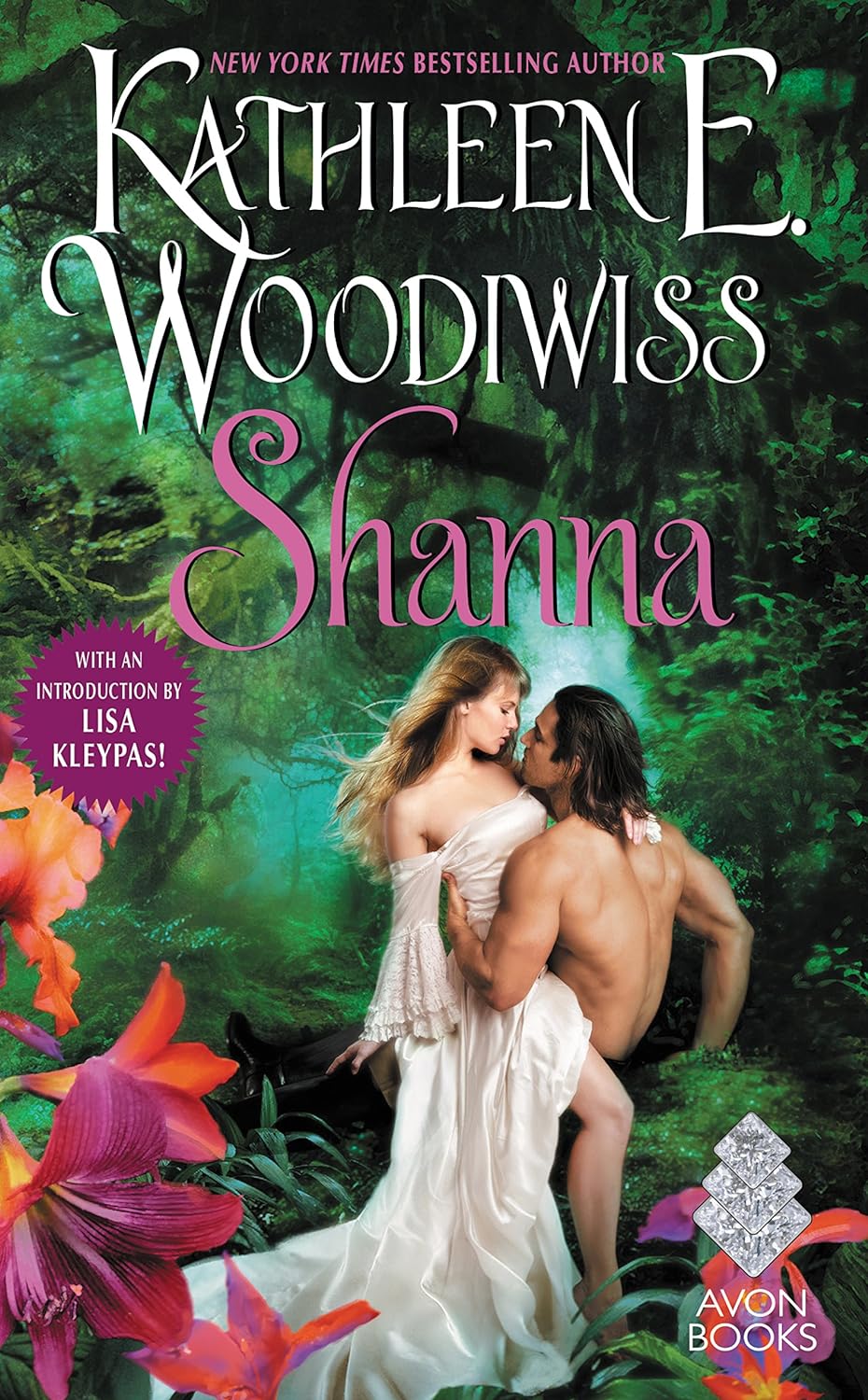
Shanna
I’m aghast at my temerity in attempting to comment on a Woodiwiss novel, particularly since this is the first one I’ve read. Scads of lines have been written by readers, bloggers, fans, and academic scholars on Woodiwiss’s stories, characters, themes, and her place in the evolution of the romance novel. Here’s my piddling offering.
Shanna Trahern is the pampered and petted daughter of an extremely wealthy cit Orlan Trahern who owns a sugar plantation island in the Caribbean and is called Lord Trahern over there. Shanna is used to getting her willful way in everything. And the first time her father thwarts her, her angry and rebellious actions set the entire story in motion.
Lord Trahern is widely known throughout English society for his wealth, but his lack of breeding means that the ton reluctantly and with bare civility welcomes Shanna at their routs and balls. She’s been sent to London by her father to catch a husband to her liking, preferably an aristocratic one. Shanna is not only outlandishly wealthy, she’s also outlandishly beautiful and her presence causes a stir in London. But she finds that she attracts impoverished aristocrats, who want her money, or degenerate roués, who want her body but not her hand in marriage. And she wants none of them. This is the Caribbean all over again, where there’s no one whom she could love and who will love her for herself. Her father, fed up with her fecklessness, issues her a year’s reprieve after which he will marry her off to a man of his choosing.
The year is almost up. So what does Shanna do? She hies off with her trusty bodyguard, Pitney, to the bowels of Newgate (yes, really!) to marry a murderer condemned to hang. She thinks she can splash her wealthy clothes and her enticing bosom in front of his eyes and he’ll salivate to do her bidding. She hadn’t bargained on finding someone who would insist on negotiating with her despite his circumstances. In return for marrying Shanna, giving her his name and making her a quick widow, the prisoner wants to consummate the marriage in a night of passion. He fills her with hatred, outrage and contempt, but she agrees because she’s in a bind.
The wedding day arrives, and her hefty bribe to the prison warden sees Ruark Beauchamp taken from the gaol and to the church. He is instructed to stop on the way to bathe and get himself rigged out in spiffy togs. For a man who had been counting the minutes till his neck was stretched, he finds this entire experience mindboggling. And that sense of unreality sharpens when he sees the gorgeous Shanna in her finery. She, in turn, is completely taken aback at this young lord now standing before her. Ruark might be a Beauchamp but he can’t possibly be related to the Marquess of Beauchamp; after all, he’s a condemned murderer from the Colonies!
After the wedding is over and the wedding breakfast is consumed, complete with some kisses and suggestive comments, the couple gets into the carriage. Ruark refuses to allow Pitney to get in with them, and seeing Ruark’s face like he’s spoiling for a fight, Shanna allows him to get his way. There, in the close confines of the expensive carriage, Ruark introduces Shanna to passionate kisses. She takes to them with abandon.
What follows next is the Forced Seduction scene. Sigh! I had heard these were popular in romance novels written in the 1970s. I couldn’t read that scene without seeing it as anything but a rape. Her struggles, her refusals, the pain, his utter disregard for her other than as a warm female body… it doesn’t feel anything like a seduction. It’s rape.
Just as he breaches her, the carriage comes to a sudden stop and Ruark is forced outside by prison guards. When he realizes that Shanna never had any intention of holding up her end of the bargain and spending a night with him, his very last hopes and dreams are dashed to pieces, and he’s enraged. He fights the prison guards and Pitney like a madman and is beaten and captured. As he’s being driven away, his screams of agony and utter despair rent the air.
Shanna, while disturbed, justifies her actions to herself and makes preparations to go home to her father to tell him that she’s now Madame Beauchamp, married and widowed. It is only a few days later when she realizes that Ruark Beauchamp – now calling himself John Ruark – has been liberated from Newgate, and far from being dead is now her father’s bondsman.
And so starts their push and pull story as they learn to tolerate each other, understand and deal with each other, and ultimately to trust and love each other. For two such strong-headed people, the HEA is justifiably earned.
So what are my overall impressions of the story?
I simply never warmed to Shanna, mostly because I couldn’t follow her motivations. Her highly emotional reactions to everything were tiresome to read, and over time, I felt they sprang not from real difficulties, but rather from imagined issues and a spoiled upbringing.
Other than that reprehensible rape of Shanna, Ruark never wavers in his desire for her or the courtesy and kindliness with which he treats her despite her brutal betrayal. He allows her to abuse him over and over again. She rants and rails at him, calls him hateful things, and once even hits him with her quirt (riding whip) across his bare chest and slaps him hard on his cheeks. And all he does is kiss her. How is that possible? I know she’s beautiful, but why take this abuse from her, all in the hope that she will fulfill her bargain and spend a night with him?
But this is not all there is to Ruark or to Shanna. Ms. Woodiwiss has done a wonderful job of bringing forth the complexity of their characters. She allows her characters to really live on that verdant Caribbean isle, to imbibe of the place and people and to influence them in return. The historical detail and world-building is superb. The book after all is 660+ pages long, and Ms. Woodiwiss has used that space to tell a fast-paced story within the structure of a detailed saga.
If you’re interested in reading a seminal book that has made romance genre history, written by an author at the top of her game, you might consider reading Shanna. But the foot-stamping, curl-tossing nature of the heroine renders her unsympathetic to the modern reader, and the forced seduction/rape scene is certainly something that doesn’t stand the test of time. While there are definitely aspects of the book that I liked, those things meant I wasn’t able to rate it more highly.
Recent Comments


“What follows next is the Forced Seduction scene. Sigh! I had heard these were popular in romance novels written in the 1970s. I couldn’t read that scene without seeing it as anything but a rape. Her struggles, her refusals, the pain, his utter disregard for her other than as a warm female body… it doesn’t feel anything like a seduction. It’s rape”
This captivating novel brims with suspense, excitement, and romance, inviting readers to immerse themselves in a world that sparks their imagination. While your commentary on the carriage scene may seem a bit exaggerated, I understand that societal values have evolved since the novel’s 1977 inception. I appreciate your insightful evaluation. Regards, Tim from Colorado.
This argument is as old as bodice rippers themselves.
Forced seduction sold and still sells well for many reasons not the least of which is there are those who find the fantasy of not having to take any control alluring. If it’s your jam, you go.
If it’s not and you find it rape, that’s fine too. Not all love stories work for all people.
The description in Shanna is like color photography.
I have read Shanna 3x since the 80’s and I love it! Woodiwiss details bring you right into the moment as if you were there. She is my Favorite Author and I have all of her books.
I read Shanna in about 1982. I loved the main character so much that I named my daughter “Shanna” after her. As it turned out, my daughter is blonde with blue eyes and very much like Shanna–after she settled down. I loved the fire and then her loveliness at the end. My daughter is now 33.
This is such a lovely story, Janette! Has your Shanna read Shanna? What did she think about it? This book is, without a doubt, much lauded, but I think I just came to it too late in my reading life. I do believe if I read it early on before I read too many modern voiced books, it would’ve appealed to me.
“how times have changed”
And I’m so, so glad they have. I’m thankful romance has evolved so much over the years. I realize these books were romance as we know it today during its infancy. I’m glad that now women own their own sexuality rather than having it taken from them. I’m glad that heroes are now written differently with compassion a key feature of how they have changed throughout the years. And I’m glad that heroines are on equal footing with heroes and relationships are better balanced.
So while not a reader of earlier romances like this one, I am grateful that they were the forbearers of the romance genre today.
Yes, Woodiwiss was part of Romance’s rite of passage. She, among a few others, gave the genre its definition that is mostly true even today. I’m glad what was fashionable then is no longer fashionable. I wonder how we’ll think about the genre 20 years down the road and 40, and what we’ll be glad stayed in the 2010s.
I remember reading this as a teenager and it was considered very daring compared to the Victoria Holt/Mary Stewart/Barbara Cartland type books I was used to reading. I never warmed up to the heroine who seemed pretty cold blooded to me even back then. (I was mentally comparing it to much superior Moonraker’s Bride where the hero there was trying to do everything to save the imprisoned heroine from harm even though he was facing execution himself.) The idea of just plucking up and using some strange guy on the 18th century equivalent of death row and dumping him again to his fate seemed beyond creepy and entitled (although I certainly wouldn’t have used that term for it back then). The forced seduction, sadly, was the norm for a lot of romance books back then. (It was one reason I liked Laurie McBain when I found her because although there are problematic elements in some of her books, there was no (that I recall) forced seduction in any of them- unlike her contemporaries Woodiwiss and Rogers). In fact in one- Wild Bells to The Wild Sky, really stuck out to me at the time because the hero literally asks the heroine if having been his friend, she will now become his lover before things get physical. Let’s just say that kind of talk was few and far between in the books of the 1980’s where even writers like Victoria Holt made men who literally drug and rape the heroine the hero. (Not forced seduction but literally roofied and raped while drugged or unconscious). Reading this review was like a blast from the past and it brought back how much I disliked the bratty and “perfect” heroines of the time and how different the reading choices were then. How times have changed!
Yes, you’re right. It is very cold-blooded and calculating, not to mention highly entitled, to sweep into a prison, assume that a man condemned to a hanging would only be utterly grateful to do her behest, proceed to act on that self-serving plan, and then throw him back where she found him the minute she was done using him. I hated that scene where he realizes her betrayal and acts like a wild man to escape, only to be thwarted, and howls in agony. HOW could she not have been horrified with guilt over that. Until then, she was only willful and spoiled. With that she became cruel.
I read this long ago and, ironically, it’s not the forced seduction scene that I still remember, but Shana’s appalling behaviour. I remember feeling highly irritated with the childish heroine and couldn’t bring myself to read another Woodiwiss again after that.
Heyer does willful heroines as well but I have never felt the impatience and annoyance I felt when I read Shanna. Ruark’s attraction to her is unfathomable.
I have never been able to bring myself to read a Woodiwiss novel but she has a reputation for dominating men and rape, which is not something I enjoy for entertainment.
As someone who read Shanna as a teen and again as an adult, I’ll say it does nothing for me. Not because it’s got a bad hero–I’m unbothered by forced seduction in the novels of my youth–but because Shanna is such a brat. The only Woodiwiss book I love is The Wolf and the Dove–Aislinn is no Shanna.
I recently attended the Romance area talks at the Popular Cultural Association’s annual academic conference. Woodiwiss is widely studied, and I heard about the forced seduction scene there, so I was curious to see how it plays out in Shanna. And I’ve now discovered that it’s totally not my cuppa tea. I wouldn’t be able to study it objectively given my subjective rejection of it.
Woodiwiss is studied. I actually studied her just a bit in a grad course years ago when we read Janice Radway’s book on romance genre writing. I would actually be able to study her and the subject of rape in romance writing because there I can be analytical and interrogate writing. For entertainment though, I have no interest conflating rape with love.
I’ve been contemplating reading Radway, Krentz, Regis, and Roach as a study of the study of the genre. Perhaps next summer I might make a concerted effort. I’m a non-academic, so it was really interesting for me to be able to listen to the papers on romance–to see how they view romance novels. If you’re interested, I have summarized the sessions I attended on my blog.
Thanks, Keira! I will definitely check them out!
Where was that held?
Dabney, it was in Seattle in March. I was supposed to go and gutted I missed it (hoping to go next year to present). Just saw your summaries now, Keira, and thanks for them! Fascinating stuff.
I loved the conference for all the information I learned and the conversations I was able to participate in. Initially, stepping into my first session, I was intimidated that it would go over my head. But it’s surprising how much information we absorb by reading the books and hanging around in Romancelandia.
“Shanna” always seemed to me to be a role-reversal romance –it was Shanna who needed redemption, and Ruark was the good-hearted hero who made it possible. More or less. That said, Shanna was like Scarlett, Amber, and Becky Sharp — basically unlikable. Spoiled, selfish, and self-absorbed. And any “romance” heroine with those qualities will never be a favorite with me …
Yes! Shanna is the one who needs the redemption, however, the way both Ruark and Shanna are portrayed in the book is that they’re both good as is. She does soften towards him but that is because she’s in love, not necessarily as an independent change in character, which is what I’d have liked to have seen.
Forceful, masterful sex on the part of the hero IS only tolerated (for me, as a reader and writer) when the heroine gives complete consent. “Bodice-ripping” can be fun, but yes, only between two consenting adults.
I’m curious, how do you define consent? A verbal yes only?
I agree. With consent from both adults, it becomes a game, rather than as a punishing (in their minds, necessary) act that is currently is.
But what is consent? Is it our definition in 2016? Do we apply our standards–yes means yes–to earlier eras? I always think of Rhett sweeping Scarlett up the stairs and her saying no the whole way and then when we see her in his bed the next morning, she’s beaming with bliss. Is consent something women can retroactively give?
My definition of consent is very 2016. You either give consent at the outset or there’s no consent. It certainly cannot be retroactively given.
The GWTW scene is of similar mindset to the forced seduction scene in Shanna IMO. The heroine’s clearly saying no, but the man’s overpowering her. The thinking in society was that virgins could not possibly agree to enjoying sex and they have to be coerced into it against their will. This was seen as virtuous behavior for virgins. Once they’re fallen women, then naturally they enjoy sex with impunity.
You say tomato, I say I see it differently.
Dabney, it certainly is a case where you consider if it is anachronistic to apply modern-day values to books that were written in a different era. Should we judge books and society with our eyes or with their eyes.
Yes, I see it the same way, Kiera, and for me it’s a contrivance in romance writing or films to create female characters that say no but then later suggest what they really meant was yes. It’s a dangerous construction. It implies that men know more about a woman’s mindset than a woman or that a man knows more about female sexual pleasure than a woman. It suggests that what women want and what is sexy is a dominant man that takes charge. It did though create the “no means no” social movement, and I hope more men today understand that this is not ambiguous territory. Date rape is still a common phenomena on college campuses where I teach and I unfortunately still hear the same old stories from victims.
You sometimes have to wonder if Woodiwiss put in that non-con scene in there because it was the norm in the society (to consider women who enjoyed sex without being coerced into it as being “loose”) or because it was the norm in romance novels and movies of those times. Either way, it’s a no-go for me. Women for eons have said ‘no’ and have been overpowered by men who cared nothing for their wishes. I don’t wish to read books that buy into that mentality.
So this ancient thread randomly sparked a Jerry McGuire moment that has been percolating in my head for awhile. This thread is one of the better, nicer ones I’ve seen, no one post here drew out my keyboard. It’s an observation of a pattern I’ve noticed since I’ve returned from a long hiatus from romance. It’s relevant to note that romance novels are fictional stories, not conduct manuals. It is also important that they are still predominantly authored and read by women. Yes, it’s likely that the social mores of the time influenced author decisions that led to frequent use of this trope and we could say a lot about that alone. And all due respect for reader preference. I’m speaking to a consistent pattern I’ve noticed wherever and whenever vintage romance books in particular are discussed. Regarding Shanna: Subjectively speaking, she is a brat and it is annoying, But I don’t consider Ruark a bad hero. If Ruark’s actions in the coach were not admirable, they were understandable in context, and not worse than what she did to him, in my opinion. Because of the reasons typically given for condemning this trope, seemingly on autopilot, I would be curious to know the numbers on romance readers and reviewers across the internet who also enjoy what is now called dark romance. Or who are fans of misogynistic shows like Game of Thrones. If there is any criticism of these other genres, it tends to be reversed – unambiguously violent rape – and more – is excused because of other elements considered favorable. There are some contemporary best sellers that feature brutal rape in vivid detail, not necessarily by the man the woman ends up with, but these are falsely marketed as romance and fans – mostly women – rave about the importance of showing this abuse for catharsis or awareness.The same readers will condemn rape and forced seduction tropes in romance novels, especially vintage ones. Kink is widely accepted today. That’s all about enacting non-consent fantasies even though consent is presumed to be part of it. It’s not only a part time kink but can be a full time lifestyle. Some kinks are extreme and brutal, yet kink is generally defended as a right and kink shaming is frowned upon. When it comes to kink, people tend to accept that just because they don’t understand something, it’s not cool to condemn its existence or others for enjoying it. And I reiterate the general social acceptance of male-authored rape entertainment. Given all that, the motivation for ubiquitous concern about what is written in romance novels seems (perhaps unconsciously when it comes from women) rooted in patriarchy. The problem is not in an inherent dislike of this trope. We like what we like. But criticism has predominantly been not just that someone didn’t like it because they just didn’t, or to support an analysis of story or form, but because it is “wrong.” Historically, this has been a dangerous approach to the arts. But it’s not happening across the arts, only in romance. As with anything, some vintage romance novels are horrible. Some contemporary novels are horrible, while we’re here. This is not a blanket endorsement for any and all uses of the trope or every single book in the genre. But this particular trope is sometimes misunderstood or unfairly attacked. ( no pun intended) As an overly simplified synopsis of Shanna, Ruark is unusual for a romance hero of that era in that he was a well adjusted, (if fantastically perfect) emotionally stable guy who knew what he wanted and pursued his dream girl until he got her or, we could assume, until she proved not to be worthy in his eyes, which never happened in the story. That was his whole deal. Yes, the catalyst for his obsession was a side trip to demand Shanna honor her promise to fulfill his base desires, but that doesn’t change his character in the plot, and it makes the story more interesting. I’m fully on board with fair, text-based criticism. I’m not mad that some people don’t like a thing that I like. It does feel reasonable to suggest a change in the critique of vintage romance and the rape trope – with all it’s iterations – to not be based in moralizing and shame that I suspect substitutes for feelings of powerlessness to change real life. There would be more benefit in going after rape entertainment in film and television than romance… Read more »
Wow. What a thoughtful response. Thank you.
And I’ve never read this book. Your words make me feel I should, that it give me something to ponder.
Again, thanks.
I think it’s worth it and would love to hear your thoughts if you do.
This is one of my favorite books.- the critique of the carriage scene by what Im assuming are mostly younger women is obvious virtue-signaling and tiresome. I found the scene exciting- and hello? It’s fantasy! I am not going to apologize for this book. Everyone is against rape. Rape is bad. WE all agree rape is a bad thing. Despite the “rapey-ness” of that scene. Ruark still comes away as the more sympathetic character. Geez, get over yourselves. This book is an epic, sweeping romance. It will transport you. I think I’ll head over to Amazon and buy another copy.
I read most of the Woodiwiss books back in the day as well, as a teenager. I believe this was probably her most popular book, although The Flame and the Flower was the one that made her name. If you didn’t like this one, you probably wouldn’t like her other books – this one is less rapey than most of her work. Her heroines are always virgins, her heroes very alpha and experienced, and the “deflowering” of the virgin is often sketchy by modern eyes. I loved all of her books when I read them in the ’70s & ’80s, but tried a re-read a few years ago and was quite disturbed by a lot of the subject matter. They have not aged well.
I do believe that if I’d read Shanna when I was younger and before I read more modern romances, I would’ve ignored the stickier bits and enjoyed the saga-nature and romance of the story. But now I simply cannot stomach scenes like that, even though it isn’t written like a vengeful rape, but more a forced seduction, at least from the characters’ point of view. And from the characters’ POV, that one scene primes the stage for their future successful intimate encounters, so it was “worth it.”
I read this one and others by Woodiwiss and Rosemary Rogers back in the day. To say they were titillating after reading Mary Stewart, Daphne DuMaurier etc is an understatement. But I was a newlywed and began to realize they were having an adverse affect on me and how I saw men and my husband in particular. At that point I stopped reading romance altogether for a few years. When I did come back to the genre I did it slowly with kisses only, bedroom door closed regencies until I gradually and more maturely began reading books with more explicit love scenes. And thankfully men were now being written with more sensitivity.
While I realize that Kathleen Woodiwiss and those authors like her were the foremothers of today’s romance, based on my own experiences, I could never recommend any, nor could I reread them either.
I came to Romance via Heyers and categories (contemp and trad Regencies), so I missed Woodiwiss and Rogers. And like you, for a few years after marriage, I didn’t read any romance. Perhaps it used to feel like a private, maybe guilty, pleasure and I didn’t want anyone to know about it. But as I gained more confidence and got into Romancelandia in 2006, I picked them up again and was bolder about them. However, I still cannot read “hot” historicals or anything hotter than that. I’m still prefer to read Heyers and trad Regencies.