
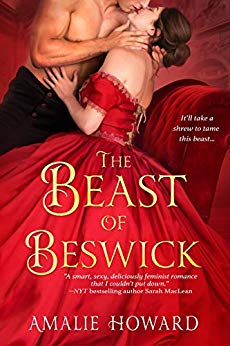
The Beast of Beswick
Amalie Howard’s The Beast of Beswick was a first for me. Never before have I reviewed a book in which the first fifty pages convinced me it was going to be getting at least a B+, and which then plummeted down, down, down, before leveling off in D territory, leaving seething due to its completely hypocritical double standard about sexual harassment that implies such harassment is okay, as long as the perpetrator is female.
Orphaned Astrid Everleigh, is, as she puts it, in need of “a different kind of beast.” Years earlier, Astrid refused to sleep with her then-betrothed, Edmund Cain, who, when Astrid broke their engagement, retaliated by circulating lies among the ton that she was no virgin. She’s been on the shelf since, but now Cain – now the Earl of Beaumont – is back, and he wants her sixteen-year-old sister as his bride. Astrid, lacking legal guardianship over her sister (that belongs to their uncle) resolves to get herself a husband who can take over guardianship and stop the marriage. She goes to Nathaniel – Thane – Harte, Duke of Beswick, and our beast du jour. He is a scarred war hero who submerges his troubles like a hippo in his custom-built Turkish bath. He turns down Astrid’s proposal, but when she returns with her sister in tow, on the run from her uncle and Cain, he takes her in and gives her a position which lacks a clear label – Archivist, maybe? – which involves taking inventory of all his deceased father’s china for auction.
I was sold for the first section of this book. When it comes to fairytales, I’m partial to Beauty and the Beast in any form. The book is well written; the descriptions and the dialogue are all natural, and if they made me pause, it was because I’d stopped to admire a turn of phrase I liked, such as how Thane is “a scarred, fractious, broken duke who had the emotional proficiency of a flea.” Ha! Unfortunately, after the first third, the story becomes impossibly heavy-handed and then unforgivably hypocritical.
At one point, Thane tells Astrid that she “decided to employ a woman-shaped hammer” to his life. From then on, I thought of Astrid as The Hammer Heroine. She is a relentless woman who represents a specific and modern interpretation of feminism. She has the vocabulary of someone you might find at any women’s march and is more than happy to discuss “the patriarchy”. She reads Shakespeare, Homer, and John Locke (no cheap romances for this intellectual!) and she’s so obsessed with ensuring her own equality that even with Thane literally about to penetrate her, she stops to have a conversation with him about the matter.
“Why do men have to hold all the power? Is it so hard to want equal footing? To be judged on the same merits and by the same standards?”
Even she recognizes that there’s something off about this.
Here she was, half naked in the arms of a very virile man. . . copulating in a deserted garden in the most magical setting possible, and all she could talk about was women’s rights.
Thane himself is an unoriginal beast. Ms. Howard clings to the stereotype like a life raft, and his motivations and thoughts are devoid of invention or originality. He is a beast therefore he believes himself an unlovable burden, therefore he must avoid love at all costs.
But all this alone wouldn’t have sent the story to the bottom of the grade barrel. Instead, that is the doing of Thane’s Aunt Mabel, Duchess of Verne. This woman, painted as a loving and supportive relative, portrayed in a manner that suggests she is a Delightfully Amusing Character (shock value is her forte), and described by Astrid as “truly a shining beacon of our underestimated sex”, is a bona fide sexual harasser. Throughout the story, much is made of her pursuit and conquest of footmen. Her last maid, she said “left because of the footmen.” She sleeps with the employees of her oldest friends. And no one, least of all Astrid, Queen of Rightness and Equality, is bothered. Now, if you heard of a man who pursued women (or men) 1) over whom he had substantial financial, social, and professional influence due to his much higher rank and highly-ranked associates in society and 2) who so horrified others in his employ that they left; willing to be unemployed and risk serious consequences to themselves rather than tolerate witnessing this behavior further, would you say that is anything other than sexual harassment? I think not. But Amalie Howard and The Beast of Beswick argue that sexual harassment is only sexual harassment if the perpetrator is a man. ‘Women will be women’, this story says.
There’s little else to say about this story, other than that I fervently wished Astrid had been an only child because her sister is awful too, as is her marital storyline. Bottom line: stay away from this book. It’s a wolf in sheep’s clothing.
Buy it at: Amazon/Apple Books/Barnes & Noble/Kobo
Visit our Amazon Storefront or shop at your local independent bookstore
Recent Comments

Bravo. Wonderful review. Was curious about this author and book, but the sexual harassment angle is an extreme example of a current trend in HR I find disturbing and loathsome.
Another nail in the HR coffin….
“the sexual harassment angle is an extreme example of a current trend in HR I find disturbing and loathsome.” Ick! I’m with you there. It’s almost as though HR writers have run out of classic toxic tropes to use, so they flip the narrative to somehow make it “okay.”
I don’t know if you read all those posts on the ASK about HR having a quality problem, but a lot of us commented that the niches and acceptable tropes are getting narrower and narrower. Marian Perera, one of the writers at AAR, has been trying to get her HR with an architect hero published, but she was turned down on the grounds that the man wasn’t titled or heir to a large fortune. And her story sounds awesome! You think publishing houses, which are being bled dry by self-publishers and small presses, would be willing to take more chances to appeal to a wider readership. But no. They instead seem determined to hasten their own demise.
Thanks, Nan!
I had to smile when reading this review, because the historical romance I’m currently querying is a Beauty and the Beast inspired story where the hero is disfigured… but this makes him all the more determined to go out in public, socialize with people, and enjoy life. He’s courteous and confident and never believes that his appearance means he’s doomed to be alone (and this acts like a self-fulfilling prophecy).
I enjoyed writing this, but whether publishers will want it… well, I’m going to find out.
You’re welcome! I like the sound of your newest story about a disfigured hero who isn’t trying to hide away from the world. It not only goes against the expectations of the trope, it makes for an intriguing storyline. Is this a Regency?
Writing is fun, isn’t it? I don’t know about you, but when I write, time ceases to exist. It’s a totally immersive and beautiful experience for me.
How many books have you written now, if you don’t mind my asking? You sound quite prolific.
Mainstream publishers… ugh. I get that they have their advantages, and I wish them well. But they seem to be doing everything in their power to ruin themselves rather than being open to taking chances that could save their tanking sales. Have you tried looking into small presses with open submission policies? I wish I had some resources to share on this front, but I don’t. It was a sad, sad day when Samhain went out of business…
“I like the sound of your newest story about a disfigured hero who isn’t trying to hide away from the world. It not only goes against the expectations of the trope, it makes for an intriguing storyline. Is this a Regency?”
Thanks, and yes, I wanted a disfigured hero who was outgoing and friendly because it goes against the usual trope. This is a historical taking place is 1890, because I needed the heroine to be a photographer. Guess who her subject is?
“How many books have you written now, if you don’t mind my asking?”
I published seven romances through Samhain and one through Loose Id. Unfortunately they both went out of business. I also have five unpublished manuscripts, but I’m reluctant to go with most romance-focused small presses because, well, Samhain and Loose Id went out of business. Ellora’s Cave and Dreamspinner stiffed authors. The only major small presses that still seem reputable are Carina and Entangled.
Thanks for your reply. A photographer heroine? I like it. And the late 1800s could use some more love in romances. There was so much on the technology horizon. Frankly, that story and time period would appeal to me a lot more than Regencies with titled heroes. (Regency is not a favorite era of mine, and I’m not a big fan of royalty/nobility. If I do read Regencies it is *despite* the setting rather than *because* of it. Sorry Regency fans!)
Ellora’s Cave stiffed authors? Wow, I hadn’t heard that. Never heard of Dreamspinner. Good thing you didn’t get tangled up with them.
As for your Samhain and Loose ID books, self-publishing through KDP might be a good option for you since those titles were already professionally edited. It’s the cover art that’s the real problem, although I’m told stock photos aren’t that expensive.
Wow! If my math is correct, 13 manuscripts is amazing. I assume these are all full-length 50,000+ word novels, so again, wow!
I really like a lot of Carina Press’s offerings, and they tend to be more open to unconventional storylines (by romance standards, I mean). So maybe they will be your lucky break. Although I remember you saying they tended to favor agented authors.
Good luck to you!
“A photographer heroine? I like it.”
Made for a steamy darkroom scene, I can tell you.
“Wow! If my math is correct, 13 manuscripts is amazing. I assume these are all full-length 50,000+ word novels, so again, wow!”
Haha, those are just the romance manuscripts.
I started out wanting to write epic fantasy, like Tolkien. I wrote seven epic fantasy manuscripts, all of them over 100,000 words, and realized that while I enjoyed worldbuilding like whoa, what really intrigued me were the relationships between characters. The eighth manuscript I wrote was a fantasy romance, and that was accepted by Samhain.
An article on the problems at Ellora’s Cave : https://dearauthor.com/ebooks/the-curious-case-of-elloras-cave/
Dreamspinner was another major name in LGBT romance, but I keep an eye on Absolute Write’s Bewares and Background Checks board, which is where I read complaints from Dreamspinner authors.
Thanks for your good wishes!
Those are just the romance manuscripts? Holy moly! I can tell you love the act of writing as much as I do- maybe more!
Thanks for the article about Ellora’s Cave. I forgot to mention that Carina Press has occasional First Page critiques, pitch contests, and work-in-progress submission periods if you ever want to test for interest. But it sounds like the manuscript about the photographer is complete, so you could just submit it to them on Submittable whenever, if you want.
Another addition to the demise of historical romance!
I no longer read many historical romances, but I love B&TB retellings, so had this one tentatively penciled in on my tbr, but will now probably remove it. The aunt reminds me of my least favorite stock character in romance: the “feisty grandma”—usually the heroine’s grandmother, this eighty-something woman ogles younger men unashamedly, urges the heroine to “get some,” and says all manner of inappropriate (for her age) sex stuff—because, ha-ha, isn’t it funny to hear old ladies discussing erections and orgasms? Ugh, ugh, ugh. Ruthie Knox, Melanie Harlow, and Kendall Ryan—all writers I have read and enjoyed—have used this appalling caricature in at least one of their books and the books in question were not improved by the addition of it. And I always ask myself, would a grandfather who behaved in the same way be allotted the affection everyone bestowed on the grandmother? I think we all know the answer to that one.
Yeah, this Aunt Mabel character sounds like Catherine the Great. I heard she had a thing for lower ranking men too.
“And I always ask myself, would a grandfather who behaved in the same way be allotted the affection everyone bestowed on the grandmother?” Believe it or not, I think it would depend on how he was presented. For example, I saw a fun BBC miniseries about Casanova where Peter O’Toole played the elderly Casanova looking back on his torrid, lusty life. And even though in this adaptation he was still an old horndog, there was enough subtlety and humor to make it work. Also, Benjamin Franklin in the musical “1776” is a delight as an old lecher, but only because Martha Jefferson plays on that and ends up making him and John Adams look somewhat foolish in the process. But yeah, when stock characters don’t go beyond their cookie-cutter parameters, it can be cringe worthy.