
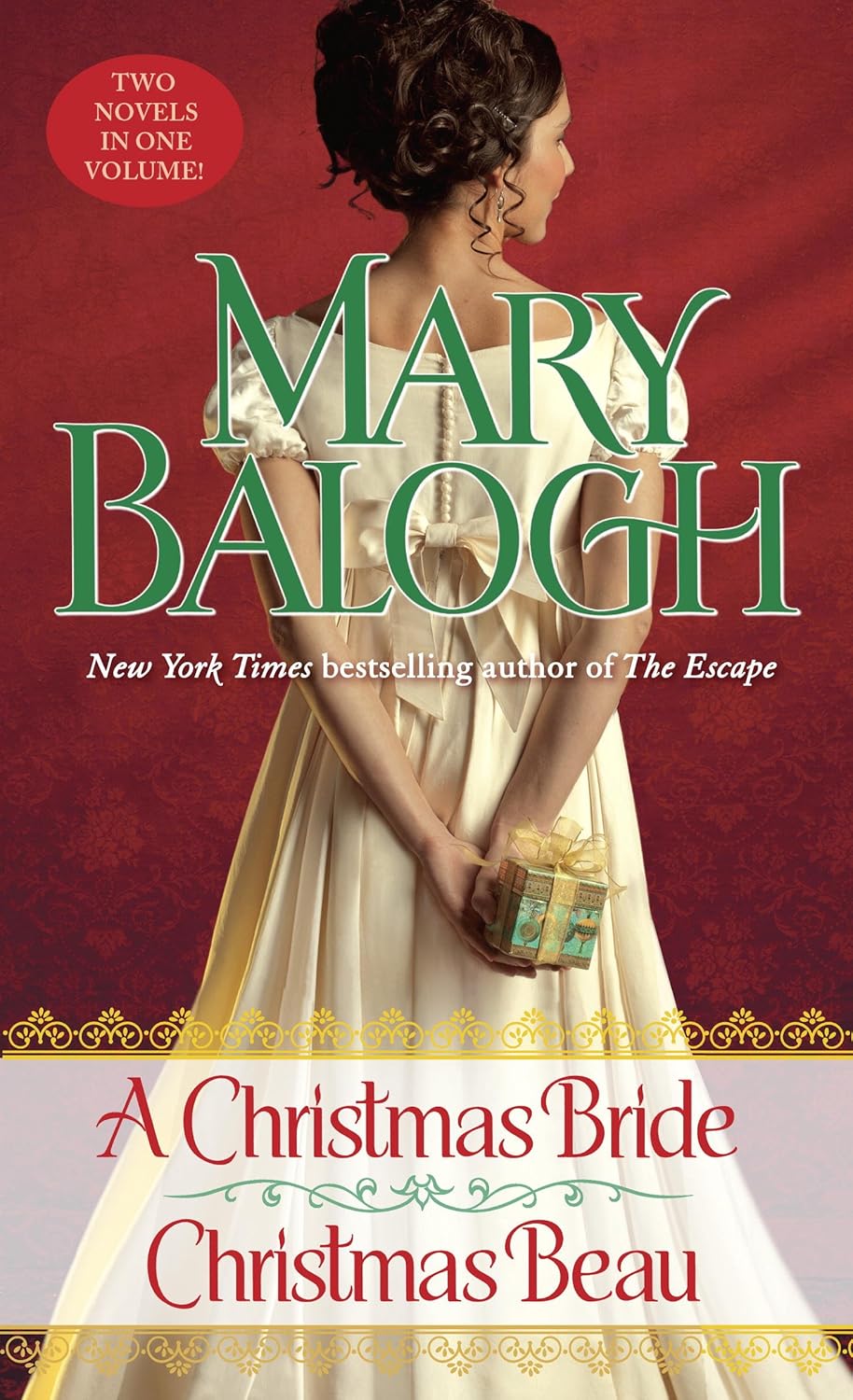
A Christmas Bride
It’s stories like this one, in which the author takes a big risk with one of her principal characters, which serves to remind me just why it is that Mary Balogh became such a renowned author of historical romances and has remained at the top of the tree for so many years.
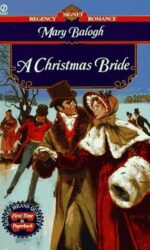 Because she’s been writing for so long, it’s sometimes easy to forget that her stories often feature characters and plotlines that were – and are still – unusual in the genre. A Christmas Bride, looks, from the old Signet cover, as though it will be a nice, comfortable story about, well, a Christmas Bride! – when in reality it’s anything but.
At the age of thirty-six, wealthy self-made man Mr Edgar Downes has decided that it’s probably about time he got married and so goes to London to see if he can find a suitable young woman to wed. Handsome, somewhat imposing of figure and definitely imposing of character, he finds most of the young ladies he meets with too insipid for his taste. But at the first ball he attends, he catches sight of a very striking, more mature woman in an eye-catching scarlet dress and finds himself very drawn to her.
The reverse is also true – and it’s not long before Edgar and the mysterious woman are hot-footing it away from the ball and into the lady’s bed for a passionate one-night-stand, with neither having any clue as to the identity of the other.
Being a gentleman – if not by birth, then most definitely by inclination – Edgar is rather ashamed of himself after the fact, and worries that he may have been too rough; the lady has no such concerns and doesn’t want to see him again. But Edgar is no green boy. He’s a determined and resourceful man in his prime who is used to getting his own way and making things happen, and when he discovers the identity of his mystery lady, he pays her a call, determined to apologise for his behaviour – only to find the lady completely unrepentant and undesirous of accepting any apology.
Helena, Lady Stapleton has been a widow for around fifteen years, having been married at the age of nineteen to a man in his fifties. She is fiercely independent to the point of rudeness and is absolutely adamant that she will never let a man control her life, so adamant in fact that it’s almost an obsession with her. The reader, like Edgar, begins to suspect that she must have suffered from some kind of abuse during her marriage, but in reality that is not the case.
As the story progresses, Helena becomes more and more determined to have nothing to do with Edgar, even though she is still very much attracted to him; and Edgar is more and more determined to find out what makes Helena tick, because he is coming to realise that perhaps she is just the woman for him. He needs someone who can hold their own with him – not a much younger woman who will be overawed by his physical size and personality and who will almost certainly become a doormat very quickly. One of the most engaging things about Edgar – who is a very attractive hero by any standards – is his self-awareness. He knows he’s a dominant personality who is apt to use whatever means necessary to achieve his ends, and he’s honest enough with himself to recognise that getting his own way all the time is not always in his own best interest.
Helena is not only older than the norm for heroines in historical romance (she’s the same age as Edgar) she’s also abrasive, obstinate, rude and often downright unpleasant. She doesn’t want anyone to get close to her, even as she is able to admit to herself that she’s lonely; but she continues to present herself to society as a “merry widow” who is happy in her solitary state. She is thought to have had numerous lovers, and does nothing to correct society’s belief on that point – but because nobody knows anything for certain, she maintains her social position.
In reality, Helena’s unpleasant manner is a way of keeping people at arms’ length, and her façade of mockery and superciliousness covers a well of intense self-loathing and the belief that she is liable to destroy the life of anyone to whom she gets close. So she allows no-one to get close to her and maintains the belief that something she did in her past was so unforgiveable that she does not deserve happiness or love.
I loved the way that Edgar so carefully and cleverly persevered with Helena. It would have been so easy for him to have given up on her or just accepted the little she was prepared to give him, but he doesn’t, instead offering her kindness, comfort and affection in exchange for her harsh words and dismissiveness. Even more impressive was the way in which he did all this without compromising his masculinity or becoming Helena’s whipping boy.
Because I haven’t yet read the previous book (A Precious Jewel), I don’t quite know the full extent of the horrible thing Helena did that has led her to believe she is worthless and undeserving. But I think the point is not whether what she did was really that terrible, but rather that she believes it was – and this is something which Edgar also understands intuitively when he decides that Helena has spent long enough in a hell of her own making, and takes steps towards setting things straight.
Alongside the tempestuous central relationship, there are a couple of sweet secondary romances, and we also become reacquainted with a number of characters from some of the other books in this series, most notably the Marquess and Marchioness of Carew from Lord Carew’s Bride. As with A Christmas Promise, Christmas works its own kind of magic in the story, and there are some wonderful familial relationships and friendships in the book, especially the one between Edgar and his father. It makes a nice change to read a father/son relationship where the two actually love and respect each other rather than being at each others’ throats!
I enjoyed A Christmas Bride very much, and was especially impressed with the way Ms Balogh redeemed her thoroughly unlikeable heroine throughout the course of the story. Edgar is a wonderful hero – formidable in many ways, he’s also intelligent and highly intuitive; he and Helena are certainly going to be leading each other a merry dance in the coming years, but they are, in the end, a very well-matched couple.
This title is available as a “two-in-one” with A Christmas Beau.
This review originally appeared in 2013
Recent Comments


A different opinion FWIW.
I have not read A Precious Jewel so perhaps that lack colors my reaction to this story but it was kind of meh for me. And I count myself a Balogh fan. I really liked Edgar (and his relationship with his father in particular). I was curious about Helena but didn’t like her much, especially in the end. Which is too bad because I liked pretty much everything else about the story. I get that it’s a “Christmas miracle” plot but not having an honest conversation before agreeing to marry – much less actually marrying Edgar – was a bridge too far for me, I think.
I love this book—one of my very favorite Balogh romances.
A Precious Jewel is one of my favorite stories by Mary Balogh and features one of her more unusual pairings. It does explain why Helena, in A Christmas Bride, feels the way she does and how what happened affected the Hero in A Precious Jewel. Mary Balogh has written many books over a long career, but her Signet Regencies hold a special place in my heart.
I think the reason I keep going back to reread Mary Balogh’s books is the complexity of her characters. She never writes the “arrogant duke” or the “spoiled beauty” or the “feisty debutant”. Her people are always more complicated than that.
I have the original edition of this one! It’s a good one.