
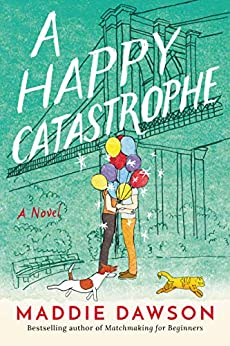
A Happy Catastrophe
This yikesworthy sequel to Matchmaking for Beginners finds Marnie MacGraw and Patrick Delaney coping with their growing relationship – and a sudden change that shifts their shared living situation forever. It also has the worst treatment of clinical depression with psychoaffective disorder in a work of fiction I’ve read in many a day.
Florist-slash-matchmaker Marnie and painter Patrick – the magic-producing optimist and the depressed realist – are blissfully happy together four years after they first got together in Matchmaking for Beginners (so the narrative keeps insisting, though they honestly don’t act like it). Marnie’s planning a future for the two of them (which mainly seems to involve pushing Patrick to do a gallery showing he’s not enthusiastic about, and asking him for a baby he’s reluctant to have), while Patrick is caught in a deep depression, still dealing with the fire that killed his previous girlfriend and physically scarred him.
Then Fritzie – the product of the two night affair Patrick had eight years earlier with Tessa Farrell – who gets a PoV chapter for reasons I fail to understand – pops into their lives. After Marnie invites Fritzie to come live with them for a year while her mother is elsewhere – without asking Patrick first – she thinks the girl’s presence will help convince Patrick that he’s meant to be a father. But Patrick is already spiraling over the stress of the prospective showing and the side-effects of dealing with his trauma, and the addition of Fritzie into his life does not improve his self-loathing. Will Patrick bond with his daughter? Or will her presence drive him over a dark edge from which not even Marnie can rescue him?
A Happy Catastrophe is a car crash between two different but viable ideas. Separately, the notion of exploring what life is like for someone dealing with heavy survivor’s guilt or the daily patterings of a baby-obsessed matchmaking white witch might make for an interesting read. Putting them into the same single story results in a tonal disaster that makes the reader hate the heroine and want to get the hero a good therapist.
Marnie seems to practice some form of magical thinking/white witchcraft that is poorly defined and New Agey in a woo-woo way. She puts everything down to The Universe. The Universe wants them to have a baby, because Marnie saw fifteen kids on the way to work, ergo she’s going to have a baby and she will mentally will the condom to break, no matter what Patrick needs or wants. She sees sparks in the air around two fated persons and this is how she matchmakes. She can communicate with Blix, her late mentor, by standing next to her toaster. This quirkiness was light and charming in Matchmaking for Beginners, but here – as Patrick grapples with a serious and continuing depression, PTSD and survivor’s guilt – it makes you want to punch her in the face with the heel of a size eight Doc Marten. She comes off as abominably, monomaniacally selfish here, the kind of woman who cries self-pityingly when she doesn’t get the ‘oops’ pregnancy she wanted, hours after her quasi-stepdaughter is revealed as a thief in her presence.
Patrick says that he’s happy with his life as is – in their non-married, non-kid-filled relationship – and he has every right to feel that way, but he is so painfully and understandably overwhelmed with self-loathing that reading his chapters is agony. Marnie mostly and literally makes him feel better because being around her flibbertygibbert freespirited self can mostly shut out Annelise’s (his previous girlfriend, who literally burned to death in front of him) screaming in his head. Operative word: MOSTLY. Sure, he’s internalizing most of this and refuses to tell Marnie about it, but she KNOWS he’s been through severe trauma. Why is Marnie trying to force this man to have another kid when he’s barely finished mourning Annelise? Why does she need a biological child at all? He’s been through some super heavy shit and Marnie doesn’t seem to recognize it. Annelise actually exists as a separate voice in his head commenting on the action. You cannot wish or magic such problems away. He needs therapy, and possibly psychoaffective medication.
And then there’s Fritzie, who’d be a believable child character had she not reacted to being abandoned by her bio-mom – who, undemonstrative as she is, is still the only parent she’s known – with almost unseemly cheer. She acts out once before Patrick and Marnie have their Big Third Act Separation, and that’s to steal money – which she promptly gives to a homeless classmate. Really?
And how does the author solve these many, serious problems? Well, she doesn’t. Not to spoil the book… oh heck, to spoil the book – Patrick recovers from his psychosis and emotional trauma by caring for Fritzie alone for a week, which makes him realize he needs Marnie in his life and put the voices in his head aside (which is Not How That Works, Author). Marnie gets everything she wants while paying very little in the consequences department, from a newborn via a pregnant neighboring teen, to Fritzie as her child, to a marriage with Patrick, to her parents fixing their romantic relationship (the book’s only decent subplot and the only thing saving it from a full-on F).
The biggest shame of all is that Dawson has actual technical talent. I would’ve loved Fritzie and Marnie in some other book, with some other plot.
Some subjects shouldn’t be the center focus of light fiction, and I’d say a man obsessively painting his dead ex girlfriend because he hasn’t fully recovered from failing to save her life doesn’t belong in a book featuring haunted toasters. If I wanted to read about Elle Woods falling in love with Eric Draven, I’d read something on Archive of Our Own, not A Happy Accident, which ought to be used as the outer wrapping for a very greasy basket of fish and chips.
Buy it at: Amazon, Audible, or your local independent bookstore
Visit our Amazon Storefront
Recent Comments



Where do I begin? Would it sound rather amateur if I were to say, “This book sounds like an absolute train wreck? I have no idea how you got through this one, Lisa.” Furthermore, this is the kind of book that gives me hope, as in, “At least I don’t write *that* badly.”
“He needs therapy, and possibly psychoaffective medication.” Has anybody ever seen a romance where the hero or heroine needs to go to therapy and/or take medicine for psychiatric issues? Maybe that’s a little too close to home for a lot of readers, but I think it would be better to go that route with a storyline than to choose the overly convenient “true love cures all” cliché. The former would be more accurate and respectful as well.
As for light/dark stories, I think they can work depending upon how they’re handled. Dark comedy/gallows humor can definitely be appropriate with certain characters and situations, but this book sounds like it has way too much of a contrast to the point where the heroine blissfully runs roughshod over the hero’s mental health issues for the sake of forced comedy.
Just as a random side note, does the cover of this book remind anybody else of the old Madeline series of kids books? Maybe it’s the color scheme and typeface…
@Nan: “He needs therapy, and possibly psychoaffective medication.” Has anybody ever seen a romance where the hero or heroine needs to go to therapy and/or take medicine for psychiatric issues? Yes—it does happen, although, especially where the hero is concerned, as I noted above, it’s rare unless the hero is a veteran suffering from PTSD. Melanie Harlow wrote a series called Happy Crazy Love (SOME SORT OF HAPPY, SOME SORT OF CRAZY, SOME SORT OF LOVE) where each story involves a character (who is part of a couple) facing mental health challenges and getting help through therapy & medication. Harlow has several other books (AFTER WE FALL being my favorite), with PTSD storylines. One of the things I like about Harlow is she shows that neither therapy nor medication will work without the patient’s commitment to attending regular sessions and taking their meds on schedule.
Wow! That’s good to know, thanks! Rare does not mean non-existent. :)
The hero in the latest Jenny Holiday gets therapy. I noticed it because it’s rare.
Thank you- curing depression with love did not work in my life, and I am glad of Recs for romance books that deal with this by taking medication & medical help seriously. Extremely rare!
I am not speaking of problems, life traumas, grief etc. – I can believe in new life options such as love opening us up to healing, but the happy heroine who (magically) heals the hero can be grating.
just like miracle cures for physical illness are often a disaster in a romance, IMO.
on this book:
babies & kids in general are the biggest psychological upset to a person and really overwhelm. It can be – often is- a happy upset. Babies are a real risk when you are mentally ill, or just shaky, and they can easily push you off the rails. Postpartum depression happens (briefly, but beautifully handled in Dani Collins’ latest, Beauty and her One Night Baby) and disturbed / confused / exhausted / … new fathers are the norm. This is why romances that treat babies as a cure really upset me, I do not read them.
Even worse, purposely forcing a man into fatherhood, when he does not want to, (and has problems,) is an utter no go for me. Nobody is allowed to make those life decisions for another, it is evil. If it happens, other story. If he is not clear, other story. But a clear “no” being disregarded by a woman, that is selfishness and evil, disrepsting father and child fundamentally. It seems from your review that this happens in the book – horrible to me.
(With exceptions, like DiscoDollyDeb, I have my special treats, like Harlequin Presents, or weird alien erotic books, or some such, where near anything goes ;-) Though forcing fatherhood… don’t remember such a book)
I so very much agree with your penultimate paragraph, Lieselotte. Perfectly expressed and well said. Any woman using a pregnancy to force a man into anything or to “cure” him is just completely unacceptable and contrary to any definition of love or, indeed, ethical behaviour.
Thanks, Elaine S!
It still seems to be such a”small sin” in Romancelandia, I miss an awareness of the despicability of it:
If a decent man then “settles into” the marriage / life she has forced him into, finding all her good qualities (since he needs to = she is the mother of his child), and forgives her, even denies how despicable it was, moves into loving her – this is so often described as a HEA – there is something wrong with that.
As long as she feels justified and has not somehow acknowledged and expiated that wrong, I think the poison of her action stays in those lives .
I have a close male friend whose then girlfriend, 25 years ago, said if he wouldn’t marry her and have children asap, she’d break up with him. He decided to take the chance even though he was ambivalent then about having kids. He’s now the dad of three and marvels that he ever thought it wouldn’t work for him.
I don’t mind the ultimatum–as long as both partners have a choice to say yay or nay.
Ultimatum is harsh, though it can be fine, coercion is wrong. I agree there is a fine line.
Babies are interesting. I suffered from a terrible postpartum depression with my first son and completely agree that babies are often hard. On the other hand, for many parents, there is no greater joy than their children. (I had three more despite my tough first go.) I wish more romances showed babies being raised by families, multigenerational. That’s how we are hard-wired to do it and modern society has made a hash of that IMO.
Sorry for your depression – glad you went on with more children as it brought you joy.
It was awful and I did not have any family nearby and my husband worked crazy hours. Also, back then (1991) they didn’t talk about postpartum depressions much so I didn’t really get any help. Fortunately, I didn’t have this problem when I had my other kids AND I knew I had to have more help at home.
In defense of Harlequin Presents—and with the full acknowledgement that unplanned pregnancies and/or secret babies are often pivotal plot elements in them—I’ve never read an HP where the heroine intentionally got pregnant or attempted to use said pregnancy/baby to coerce the hero into a marriage or fatherhood that he never wanted. In fact, the crux of many secret baby storylines is that the heroine kept her pregnancy and subsequent child a secret from the hero precisely because she didn’t want him to think she was trying to use the pregnancy/baby as leverage for marriage. I know it’s a fine line (and, of course, abortion—even a momentary consideration of it—is completely unknown in the HP universe), but I do want to stress that I have never encountered an HP with the “I’m making you a father because I know what you want/need better than you do” plot line. OTOH, I concede that, in the HP world, heroes are always ultimately happy about their secret children—once the secret is revealed.
True. I also do not remember this Plot in HP universe.
And yes, you describe the whole questionable setup of HP that I love anyway, the “I know what is best for you” is more a contemporary romance device, I find.
Oh definitely – control of tone is the issue here, and the book just flunks the curve.
Gee, even a magic toaster! Wow! I wonder what Marnie’s microwave oven is capable of!! Honestly, Lisa, your review was the best laugh I have had since Covid-19 struck. Thanks for a great read – not the book as I have absolutely NO intention of reading it – but your terrific review.
Glad you enjoyed!
Disappointing though the book was, I enjoyed the review, especially the last line. Thank you, Lisa!
Aww, thank you!
This is the same issue I have with Katherine Center’s What You Wish For. I can’t sign up for a feel good romance that has at its core a horror like school shooting.
That’s probably the reason why I’ve avoided the Roni Loren books about the survivors of a school shooting. I’ve read positive reviews of the series, but I can’t get my mind around making a school shooting the starting-off place for a romance series.
I loved that and the Roni Loren books, but that’s mostly because both authors have absolute control over their tones. It doesn’t try to shoehorn in whimsy and takes the character’s PTSD seriously, but allows them to move on and grow up with grace. It doesn’t mix haunted toasters with the smell of the hero’s dead girlfriend’s burning flesh.
* I said “grow up” because the heroes and heroines were all kids in the Loren books when they had to deal with that school shooting. Different situation in What You Wish For.
Yes, and the Roni Loren books make full mental health care a part of the character’s ability to move forward. In my review of The One You Can’t Forget I wrote: “I loved how this book embraces therapy. So many times, love is presented as a panacea for horrific trauma; in this book, it’s more like Wes’s love is Rebecca’s medical assistance device – not a cure, but a cane, perhaps, that supports her as she moves forward. Wes takes care of her after a panic attack and encourages – but doesn’t force – Rebecca to seek help. Wes hears her worst secret and forgives her – and then supports her going to therapy to work through it. The forgiveness itself isn’t a miracle cure. Hooray!”
Exactly! I liked those book because they establish the notion that people who’ve been through trauma are allowed to grow up and have full adult lives.
I get so upset by these light/dark book blends. I cannot laugh at a dead mentor’s toaster spirit and weep at a dead girlfriend’s screams in the same span of pages. Your commentary is spot on – trauma and mental health need professional support, not whimsy.
And that’s literally how it reads, too. The book’s one of those split-POV books, so you bounce back and forth between Marnie’s POV and Patrick’s chapter by chapter.
I once reviewed a cute paranormal historical filled with whimsy… Except for the part at the end where the hero’s friend tried to kill him because he was a delusional stalker who thought the heroine belonged to him. Whyyyy? It really didn’t need that subplot.
Yikes—what a mess! I don’t think this book was even on my radar before, but it definitely won’t be after reading your review. Coincidentally, I recently finished Zoe York’s LOVE ON THE OUTSKIRTS OF TOWN which features a hero who is suffering from depression and who masks it with various coping mechanisms, including constant exercise, especially running (“People can self-medicate with endorphins,” the hero’s boss tells him); and it occurred to me that we don’t often see romances with depressed heroes (unless it’s a military romance and the hero has a form of PTSD). One of the things I liked about LOVE ON THE OUTSKIRTS OF TOWN was the discussion of male depression and how men, much more than women, tend to use rage/anger, emotionally & physically abuse, and addictive behaviors (I should say here that the hero of OUTSKIRTS only uses the latter and mostly in regards to exercise) to cover it up. There was even a reference to an actual book, I DON’T WANT TO TALK ABOUT IT, which was one of the first books to address the different ways depression manifests in men than women. I thought York, within the framework of a traditional HEA romance, did a very good job of showing a hero with depression and the circumstances under which he decides to seek help.
I actually think there are a lot of depressed heroes, but that they’re not coded as such for exactly the reasons you state — that men use different coping mechanisms that cover it up — and also that the authors themselves probably don’t actually realize that that’s what they’ve written, and since they don’t realize what they’ve written, the way the plot ultimately handles it is so unrealistic that it clouds the issue further.
This book sounds exactly like why I don’t like grumpy/sunshine pairings. I know a lot of people really love them, but when I read one, I almost always find myself envisioning the couple five years later when the euphoria has worn off in more or less this exact situation, minus the haunted toasters.
Interesting topic worthy of its own thread. I know I’ve read some romances with depressed heroes, but it’s hard to recall them outside of the obvious PTSD (and usually for military heroes or cops).
Those sunshiney heroines that lift them up often turn out to be manic pixie dream girls, which has become a cliche.
Has anyone watched Afterlife with Ricky Gervais where the central character is dealing with depression and acting out after his wife dies of cancer? Edgey stuff, but good, I thought.
See, grumpy one/sunshine one pairings are usually my bag (that’s why I picked the book up for review) but lord did the author lose control of her tone.
Thank you for recommending some better books!
I think romantic humor and serious topics can blend and blend well,but not when the two opposing poles are stationed so incredibly far apart, as they are here.