
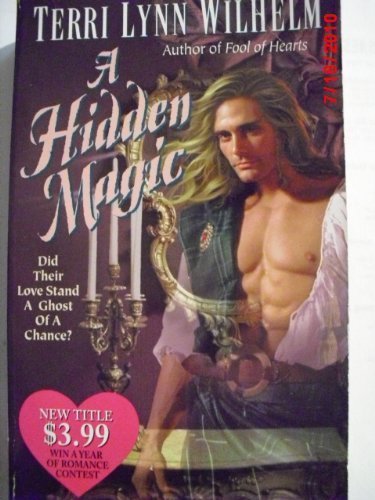
A Hidden Magic
A Hidden Magic could have been a very good book. But the author, guided one suspects by her editor and publisher, padded the book with a convoluted storyline when it wasn’t necessary, rendering this a very an average read. She also appears to have been swayed by the p.c. police in the manner in which the antagonist was eliminated. Call me blood-thirsty, but this villain should have met his end in a more satisfying manner – at the hand of the hero.
The book boasts a wonderful premise. A beautiful young widow mistreated by the men in her life, sells her estate to a captain in His Majesty’s army. There is a catch, however. He determines before she escapes to the continent that the house is haunted by a Scots, has in fact been haunted for 200 years. Threatening to turn her over to the magistrate, he convinces her to rid the house of the ghost before she goes along on her merry way.
Thus, in the mid-1700’s, in the English countryside, Lady Cicely Honeysett finds herself thrown over the shoulder of Captain Griffin Tyrrell like a sack of flour. She promises to do the deed, but the ghost has other plans. Because, you see, the ghost rather likes the Lady.
The Lady and the Captain dance around each other, slowly learning each others’ secrets. The Captain realizes she is not a swindler. The Lady realizes he is not as evil as her husband and father had been. While I appreciated their slow waltz toward realization, the author spent a little too much time convincing Lady Cicely about her own worth. Enough already!
The author does entice the reader with delightful scenes of intimacy. While the scenes themselves are rather more “Hot” than “Warm”, I settled on overall on “Warm” because there weren’t enough such scenes. Their dance together deserved a bit more time, a few more pages because the characters themselves are so enticing. Captain Tyrrell, although he appeared the traditionally arrogant, tall, dark and handsome hero at the start of the book, was actually quite loving and warm. That is, until the silly subplot turned him into the typical hero-who-must-push-away-his-heroine-to-save-her-from-danger.
This book is roughly 400 pages. The sub-plot easily could have been removed without damaging the intrinsic nature of the story, which was quite wonderful what with the ghost, Cicely’s maid, Griffin’s side-kick, and the townspeople adding texture to their romance. But Griffin’s ne’er-do-well “brother” shows up and the story flattens out. It begins to read like so many other romances and the reader loses interest.
That’s because there is less and less of the ghost, the maid, the side- kick, etc. But there is more and more of the dastardly scheme Griffin’s brother is plotting. Inevitably, the romance becomes of secondary importance while Griffin saves himself and the townspeople. I was willing to suffer through this because of how much I had grown to care about Griffin and Cicely. And because I knew the evil brother would “get his” in the end.
But the brother’s end was strangely unsatisfying, the result of an accident rather than mortal combat. I recently read an article by the author Jennifer Blake (The Literary Times, issue #19, 2/96), decrying the effect of political correctness in romance. She stated that, after reading an otherwise good romance, she was dissatisfied by the ending.
That book, in which the villain is similarly killed by accident, “felt like a cop-out, a contrived conclusion” to Jennifer Blake. She added that, “The reason for it, I suspect, was to allow the author to be rid of the villain without getting blood on her hands – or rather the hands of her heroine and hero. It just didn’t work for me. Where was the final, defiant confrontation to show the mettle of the protagonist and the love of the hero? What about comeuppance, justice even? What happened to the essential triumph of good over evil?”
While I am certain she is not criticizing A Hidden Magic, which wasn’t yet released when her article was written, she could have been, for I had the same reaction to the ending. That, and the sub-plot with Griffin’s brother took what could have been a wonderful book of 300 or so pages and turned it into a fair-to-middling book of 400 pages. I would much rather have read the shorter, more intriguing book than the one published.
Recent Comments

Oh, back when a paperback was $4¡