
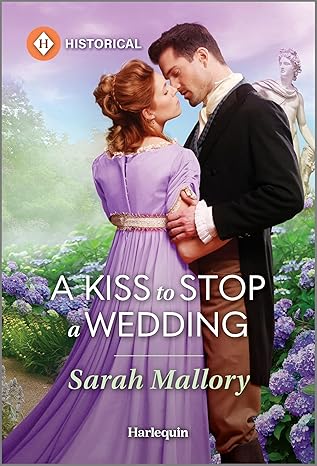
A Kiss to Stop a Wedding
Sarah Mallory’s A Kiss to Stop a Wedding is a charming, character-driven Regency romance featuring likeable, sensible leads in a slow-burn love story filled with longing and denial as they try to fight the impossible attraction growing between them. It’s well-written, engaging and very readable, with strongly characterised principals and secondary cast, and some lovely romantic tension between the leads.
Flora Warenne has lived quietly in the Warwickshire countryside with her Aunt and Uncle Farnleigh since the tragic death of her parents when she was ten-years old. Now twenty-six, she is engaged to Viscount Whilton, and although she doesn’t love him, she likes and respects him and is sure that love will grow with time. Lately, however, she has begun to get a bit frustrated with the mundanity of her life; she has been engaged to the Viscount for over two years and they haven’t yet set a date – and she has hardly seen him for the past year. She knows that peers of the realm have to be in town when Parliament is sitting and that he no doubt has other business interests to attend to, but she’s restless and needs something to do while she waits for the next phase of her life to begin.
She is walking the grounds at Whilton Hall when she comes across a stranger, a well-dressed man with dark, curling hair and laughing eyes who introduces himself as Matthew Talacre and says he has business with Lord Whilton. He explains that, having received no reply to the letters he has sent, he decided to come to see him in person, and is obviously somewhat put out to learn that the gentleman is from home. Intrigued, Flora allows Mr. Talacre to tell her the reason for his ‘trespass’ – that the statue of Mars that now stands in the formal gardens of the Hall actually belongs to him; it was stolen from the pleasure garden he owns in Gloucestershire by a disgruntled former employee and sold on – and he wants to arrange to purchase it back. Flora is surpised to hear this and naturally feels her loyalty belongs with her fiancé; she should say goodbye to Mr. Talacre and send him on his way. But she’s been feeling so confined and bored of late that she allows herself to walk a little way with him and to talk a little about her plans for the gardens at Whilton – which have been sorely neglected – and asks about Bellemonte, the pleasure garden just outside of Bristol Matt co-owns with his good friend, the Earl of Dallamire.
Matt enjoyed the time spent walking and talking with Flora – although after they part he realises he should have asked her more about the Viscount. He goes back to the inn where he’s taken a room and decides to wait around a little longer, hoping for Whilton’s return, and is pleased to join a fishing party organised by an old acquaintance at the end of the week. From these gentlemen he learns that the Viscount is not held in especially high regard, that he considers himself far superior to his neighbours and is looking to improve his lineage by marriage – and Flora can trace her ancestors back to the Conqueror. When Mr. Fairleigh extends an invitation to dinner, Matt gratefully accepts, even though he suspects Flora may not be all that pleased to see him.
She isn’t – but not for the reasons Matt might think. Flora has been unable to put him completely out of her thoughts, and the rush of pleasure at seeing him again and the way her heart beats faster is not something she’s experienced before, not even with her fiancé. She determines to be on her guard, but when Matt makes clear that he’s not going to say anything about their meeting earlier in the week, and that he has no ulterior motives for coming to dinner, Flora starts to relax a little.
At the end of the evening, Matt realises he might be just a bit smitten with the lovely and intelligent Flora – she’s easy to talk to and flirt with… and he likes her. He knows she’s not for him, and that he really should leave Whilton and conduct his business with the Viscount through his lawyers. But he isn’t ready to go quite yet and thinks that perhaps, if he stays a little longer, he can make a ally of Flora Warenne and perhaps enlist her help in the matter of the statue.
Well, that’s what he tells himself, anyway.
Matt and Flora are well-rounded and engaging and there’s plenty of romantic chemistry zinging between them. I liked Flora’s pragmatism, her desire to do the right thing and desire to be useful; she’s a woman of her time, constrained by convention and possessed of a strong sense of familial duty but she’s no doormat. She’s intelligent and spirited and keen to find a sense of purpose at her affianced husband’s side – dismayed to discover he has no intention of allowing her to do so. And while Matt seems like he’s going to be one of those stereotypical historical heroes who has vowed never to love because a woman done him wrong in the past, that’s said and then forgotten as he falls under Flora’s spell without putting up too much of a fight. He’s a decent, honourable and generous man who makes a point of employing wounded veterans who would otherwise be on the streets, knowing he could easily have been one of them if not for a fortunate association with the man who became a friend and is now his business partner.
The book blurb talks about Flora’s husband-to-be’s cruel streak” making him “anything but desirable” – and yes, I know the author probably didn’t write the blurb – and fortunately, I didn’t read that before reading the book, otherwise I’d have been questioning Flora’s intelligence. Why, if this person is so cruel, is she going to marry him? Thankfully Ms. Mallory’s approach is rather more subtle; she makes it clear that Whilton is not right for Flora and takes time to reveal his true character, initially presenting him as reserved, snobbish, and jealous, but as having a degree of charm and an appearance of concern for her that goes some way towards explaining why Flora accepted his offer of marriage. It’s only as Flora comes to know Matt and to realise – by contrast – how little Whilton actually cares for her, how little store he sets by her opinions and her wishes, that she begins to realise that her fiancé’s outward charm and polish are a veneer, and that underneath is an unpleasant, selfish and controlling man who has no compunction about stooping to underhand methods to get what he wants.
Ms. Mallory also does a good job of providing a very real obstacle to Matt and Flora’s romance. So often these romance road-blocks are so inconsequential and easily overcome as to not have been much of an issue in the first case, but the spanner-in-the-works in this story is something that has the potential to ruin not only Flora’s life, but that of her aunt and uncle, too, and which is going to need some clever manouevering to work out.
The introduction of a bit of melodrama in the last quarter of the story is somewhat over the top, the single sex scene (which barely justifies the ‘warm’ rating) feels shoe-horned in for the sake of it, and the confidences Matt and Flora exchange in their very first conversation – Matt talking about his doomed love affair, for example – feel like too much, too soon. But even with those criticisms, A Kiss to Stop a Wedding is definitely a good bet if you’re after an historical romance featuring a well-matched couple who interact and communicate in a mature way, and have to overcome realistic impediments on the road to their HEA.
Recent Comments




This sounds intriguing!
It’s a solidly good HR – well worth the read.
That blurb! I read that blurb in the bookstore yesterday. Then, I started reading your review and thinking, “What in the world?” Until I got to the part about the blurb. :)
Yeah, you have to wonder sometimes if whoever writes them has actually read the book and can tell what’s spoilery and what isn’t. Also, that doesn’t do justice to what the author does with the character. He’s a villain, yes, but she works up to it much more subtly than the blurb implies!