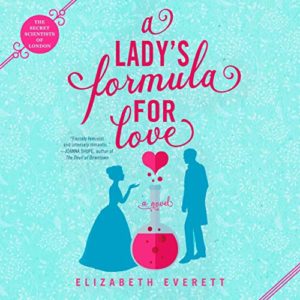
A Lady’s Formula for Love
Narrated by Elizabeth Jasicki
I’ve always loved historical romance, and although I’m finding it increasingly difficult to find historicals to enjoy (so much HR right now features twenty-first century people in costume) I still look out for new authors to try. Elizabeth Everett’s début romance, A Lady’s Formula for Love, was getting quite a bit of advance buzz, narrator Elizabeth Jasicki is experienced in the genre – although I don’t think I’ve listened to her before – so I decided to give this one a go, and… I really wish I could tell you it was great. But I can’t.
The widowed Violet Hughes, Lady Greycliff, is a brilliant chemist and the founder of Athena’s Retreat, ostensibly a social club for ladies, but really a place for them to indulge their passion for science and to undertake research, somewhere they can use their brains and display their intelligence freely without having their ideas belittled by men. But word has leaked out about the true purpose of the club, and Violet has received threats against her and the club that her stepson William, Viscount Greycliff (who is a government agent) suspects originate from a radical, anti-government group. Grey has to be away from London for a few weeks, so he engages Arthur Kneland, a former colleague and experienced protection officer, to act as bodyguard for Violet while he’s away.
At the beginning of the book, Violet has stepped outside the club to speak to a crowd of journalists (I had no idea why they were there) when Arthur – who is walking outside with Grey – somehow intuits that a bomb is about to explode (I had no idea how he did this – maybe he was a sniffer-dog in a past life?) and rushes to throw himself atop his new charge. This happens at the end of chapter one; by the beginning of chapter two, the insta-lust has started.
While preparing to put on the club’s first public event – An Evening of Edification and Entertainment – Violet is also working on a sooper-sekrit government project (given her by Grey) to create an antidote to a harmful chemical being employed by the aforementioned anarchists. Well, I say secret… it’s supposed to be a secret, but Violet had to ask some of the other ladies some obviously fake-science-y questions, so now they all know, too:
“…I had a question about sulfuric acid and potassium hydroxide, so I consulted Phoebe.”
“Then there was the particularly complex equation when I took into account Dalton’s law, and who better than Letty . . .”
(It would seem Violet’s “brilliance” extends no further than GCSE Chemistry. And in England, it’s “Sulphuric”.)
In A Lady’s Formula for Love, we have a romance between a couple who are a little older than the norm for the genre – he’s forty, she’s thirty – with some feminist themes nicely woven throughout. I appreciated that the message contained within – about the lack of options open to women, especially those of a certain status, their utter dependence on menfolk who could mistreat them without consequence, and the prevailing view that a woman’s opinions and thoughts were worthless – was conveyed subtly and in a way that was very much in keeping with the story and not at all heavy-handed. But I couldn’t get behind the romance; Violet and Arthur are lusting after each other from almost the first page and we get lots of sex scenes and internal monologue as substitutes for relationship and character development. The principals are fairly bland, and I really didn’t care for the way Violet was stereotyped as an absent-minded, mad-scientist type. We’re told she’s brilliant – several times – yet she forgets to eat and sleep… it’s so old hat. More interesting is the way she’s rebuilding her confidence and self-esteem after her late husband almost destroyed them through constant criticism, and how his insistence that a woman who enjoys sex is unattractive continue to plague her – although she seems to gets past that fairly quickly once she starts lusting after Arthur ;)
And speaking of Arthur. He’s stoic and a bit starchy and of course, haunted by a past failure. Twenty years earlier, on his first job, one of his protectees was shot. (Admittedly, the bullet when through Arthur, but still…) Of course he’s attracted to Violet, but as every good bodyguard should, he sets aside that attraction and keeps his hands (and other appendages) to himself so that he can focus on doing his job.
NOT.
Eh, of course he doesn’t. What he DOES do, is remind himself – often – that he can’t let his attraction to Violet distract him from his job – and then promptly does the opposite.
The pacing is uneven and the book suffers from the outset from there being just… too much, too soon of everything. Right from the start, we’re overloaded with secondary characters, stuff going on in the background that might or might not be relevant and insta-lust, and I was quite a few chapters in before I’d worked out what was actually going on. All this activity led to a diluting of the romance, and the lack of focus on the connection between Violet and Arthur led to a seriously underdeveloped relationship that went from a few conversations to … I was going to say the mattress mambo, but now I come to think of it, poor Violet is shagged on desks and tables the first few times and they don’t make it to an actual bed until much later! They were decent and likeable enough characters, but when it comes down to it, I couldn’t work out why they were interested in each other, or feel any real emotional connection between them.
Elizabeth Jasicki is a very experienced narrator, and some aspects of her performance are very good. She differentiates effectively between all the female characters (and there are quite a few), although I did have to rely on dialogue tags quite often to work out who was who. That said, I suspect that’s more to do with the fact that there are so many secondary characters who pop in and out, there just wasn’t the time to get used to them so I could identify them aurally the next time they appeared. The exceptions to that are, of course, Violet, and Lady Phoebe, to whom Ms. Jasicki assigns a distinctive, nasal drawl. (Oh, and the housekeeper Mrs. Sweet, who is from the West Indies – and the less said about her accent, the better.) Ms. Jasicki portrays the male characters without too much of a drop in pitch, but they’re okay – I liked her interpretation of Grey best of all. But, oh dear, her portrayal of Arthur was horrible and made an already underdeveloped romance into a complete non-starter. He’s a Scot and the accent Ms. Jasicki employs is … not good. It’s okay when he’s only got to say two or three words, but she had trouble sustaining it for longer than that and it would wander off somewhere, often as far south as Yorkshire, before she attempted to re-direct it back to more northern climes. I cringed every time he spoke, and in the love scenes… well, I fast-forwarded through some of them, because whenever he said something romantic or sexy, I just wanted to laugh. And then cringe some more.
A hero who sounds ridiculous is the death knell in a romance audiobook, but it isn’t the only reason I can’t recommend this one. The romance is underdeveloped, the plot is a mess and the big reveal is… I can’t say much without spoilers, but the ending is unsatisfying. The villain doesn’t get the comeuppance one might have expected or wanted, and although this person’s situation certainly evokes sympathy, it still doesn’t excuse their plan to maim and murder.
I could say more about my dissatisfaction with both story and narration in A Lady’s Formula for Love, but I think I’ve said enough to explain why I’m not recommending it. I spent ten hours, thirty-four minutes listening to it so you don’t have to.
Recent Comments