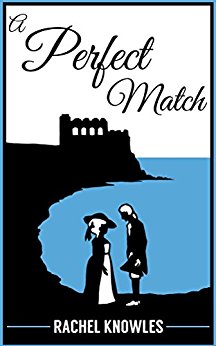
A Perfect Match
Rachel Knowles is a widely acknowledged authority on Georgian and Regency history, and her blogs are always an informational read. Her expertise is clearly evident in the tiniest of details in A Perfect Match, and I delighted in the authenticity of the story. This is a low-angst tale that proceeds at a measured pace in the proper style of traditional Regencies. Of note: The author has included a detailed glossary in the back of the book of Georgian and Regency terms – a perfect accompaniment for a reader new to early nineteenth century English historical romance.
After the death of her husband, Mrs. Westlake embarks on a trip to London – her first since her marriage – under the aegis of her cousin. Determined that her daughter, Alicia, make a brilliant match, she wants to shake off the stain of trade that clung to her wealthy husband, and regain some of the fame she enjoyed in her own first season. While her cousin is not haute ton, Mrs. Westlake is determined her plans for Alicia will meet with success and so makes up to Lady Melbourne and the infamous Whig hostess Duchess of Devonshire. She hedges her bets by currying favor with Tory hostesses to be sure that no one slights her daughter.
Like her father, Alicia is passionate about the antiquities of Rome and Egypt, and she is determined to visit her father’s intellectual friend, Mrs. Montagu, despite her mother’s disdain for bluestockings. At a party hosted by Mrs. Montagu, she meets Mr. Merry, second son of the Earl of Harting, and the two hit it off, bonding over their common interest in the ancient world. Like Mr. Merry, Alicia longs to study the manuscripts at the Reading Room of the British Museum, but instead, she’s required to endure her mother’s carping and harrying in order to become a model debutante.
During the course of the season, Alicia also draws the attentions of Mr. Hampton, who is the nephew and heir of the Duke of Wessex. Mr. Hampton and Mr. Merry are immediately antagonistic, and despise each other heartily while vying for Alicia’s attentions.
In the meantime, Lady Harting has been nursing a decades-long grudge against Mrs. Westlake, because she had been the Earl of Harting’s first choice of spouse. Lady Harting cannot bear the thought of her second-born wastrel of a son, Mr. Merry, showing any interest in Alicia Westlake.
In the best fashion of melodramatic heroines half her age, Mrs. Westlake manages to literally throw herself into the arms of the Duke of Wessex, and thus, ensnares the duke in her toils and is in alt to have one-upped her former rival, Lady Harting. In a remarkable volte-face, Lady Harting now determines that it is her first-born who should seek Alicia’s hand and ally himself with the House of Wessex.
And so it is that Alicia happens to be fielding the attentions of three gentlemen, two of whom she finds boring and barely tolerable, while the one upon whom she has fixed her interest, Mr. Merry, is inconstant. At one instance, he shows deep interest, at the other, he disappears for days on end, then reappears to beguile her. Meanwhile, the duke is pushing Mr. Hampton on her and the duchess Mr. Merry’s older brother. Will Alicia make a practical choice or will she hold out for the seemingly unattainable Mr. Merry?
This story unfolds over several months, and I enjoyed the slow process of discovery of the various characters. Knowles paints us a detailed portrait of Alicia: her role as a dutiful daughter, her ability to manage the unpleasant aspects of her life with outward grace despite inner turmoil, her passion for antiquities, her love of intellectual and witty conversation, and her expectation of love and like-mindedness from her future husband.
At AAR, we avoid spoilers where possible, but I would be remiss if I failed to bring up an issue that makes no appearance in the first three-quarters of the book, but becomes a pivotal point towards the end. All throughout the story, Mr. Merry makes no bones about his anti-religion stance but we’re not aware of Alicia’s views towards religion one way or the other. So the fact that it is vitally important to her crops up without warning and without seeding in the story prior to that, and thus, feels uncharacteristic and an artificial contrivance to prevent the hero and heroine from coming together naturally as is their inclination. This is what took my final grade down from a B+ to a B.
Overall, if you’re a fan of the Georgian period as I am, and enjoy quiet stories, you will enjoy this carefully crafted novel, and can rest assured there are no anachronistic details or out-of-turn thoughts. Even the language is just right.
Buy Now: A/BN/iB/K
Recent Comments