A Well Favored Gentleman
I read this book a few days ago, and have been struggling with how I felt about it ever since. Did I like it? Did I hate it? I wavered and wiggled and wrote a review that waffled as well. So here’s how I outsmarted my own subconscious. I asked myself, if you were my best friend and you asked me straight out, “Did you like this book?” I’d shuffle and I’d squirm, but in the end, I’d have to say, “No, I didn’t.” I wanted to – oh, how I wanted to, and maybe that’s where I ran into trouble. I came close to loving it two or three times – but that’s not good enough when I’m leveling with my best friend, is it?
Here’s what I liked –
I liked Ian Fairchild. The bastard progeny of the world’s biggest SOB, and a beautiful selkie maiden, Ian is tormented by self-doubt. He hates being a half-breed, for, along with the gifts his selkie heritage has blessed him with, comes the reverse – isolation and rejection when people discover his true parentage. All he wants out of life is a place to call his very own. When his dying father sends for him, Ian feels he will finally get his fondest wish – Fionnaway Manor. As heir, Fionnaway will come to him, and he joyfully sets to work to meet the people and repair the estate from the first minute he arrives.
I liked Wilda Fairchild. Ian’s cousin is nearing thirty, and is yet a stunning beauty with the IQ and temperament of a sleeping kitten. She is kind-hearted and lonely, and wants only to be a good person so someone will love and marry her. Some of the funniest dialogue in the story comes from Wilda’s efforts to follow the thread of a conversation.
I liked the emotions Christina Dodd made me feel through Ian’s heartache. This was the best part of the book. Ian is hurting and so rationalizes every action he takes, whether appropriate or not, in his bid to desperately grab hold of Fionnaway and hang on for dear life. It’s all he has. Ian is a forlorn and tormented man and his pain and suffering is very touching to witness.
Here’s what I didn’t like –
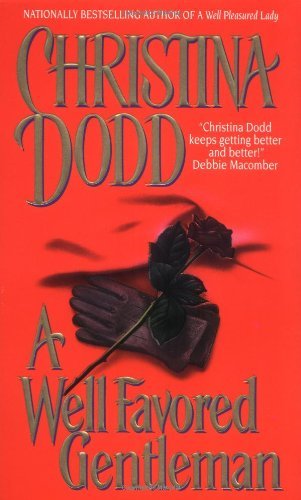
I hated the (step-back) beefcake cum Superman cover. It’s just not Ian, and the pose and facial expression are simply ludicrous. It’s a nit, I know, but there you have it.
I didn’t like the heroine, Alanna MacLeod. As rightful laird of Fionnaway, she was mostly whiny and self-centered, and I only began to warm to her near the very end.
I’m not a fan of the heroine-in-disguise device. Even Hollywood can rarely camouflage an actress to the point where she is completely unrecognizable without spending hours of time in the make-up chair. Yet, all Alanna needs to do to masquerade as the local witch, is douse herself with chimney ashes and put a rolled-up towel down the back of her bodice (to make a hump), and, poof, everybody’s fooled! Do you know how much chimney ash it would take to cover waist-length red hair? Plus, Alanna never appears to alter her voice or manner of speaking. And, Ian, who can see auras and wears a ring that allows him to detect when people are lying, is completely fooled by this cheesy disguise!
I have no problem with “forced seduction.” When written well, it can be very sexy. But, to steal a lady’s virginity when she’s sleeping is just not fair at all. Ian does this, and uses as his excuse he’ll do anything to guarantee his claim on Fionnaway, including making Alanna “his” whether she’s a volunteer or not. As if the first encounter wasn’t weird enough, in their second interlude, he holds her down until she submits. Alanna’s response to this is not outrage, no, she does a complete turn-around and suddenly decides she loves Ian to the very depth and breadth of her soul, and counter-seduces him. She never even mentions the fact he, for all intents and purposes, raped her when she was zoned out on pain medication (herbs, wine, and laudanum). Fairy-tale scenario or not, this did not work for me at all.
But, what I hated most was, there were parts of this book that were genuinely lovely. Ms. Dodd infuses wonderful humor in all her stories. The love scenes are very well done (even considering their context), and the story is a potentially compelling one. But the first half of the book is so confused with maybe-ghosts and might-be-witches and is-that-a-selkie-or-a-seal?, and contrived, unimaginative plot devices, I became exasperated. The second half of the book is stronger, but not enough to make up for what the story as a whole, lacks. I expected much, much better than I got.
Recent Comments