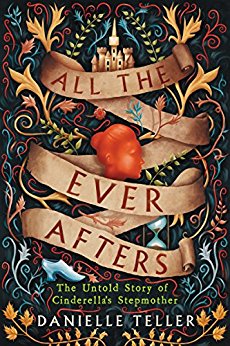
All the Ever Afters
Danielle Teller’s reimagining of Cinderella is an interesting story about how illusions can confound and contort, secrets lie fallow waiting to be discovered, and even the simplest of truths turns out to be much more complicated than it seemed. It’s also something of a depressing ride through the miseries that humanity can bestow upon a person, which can, when those miseries rarely abate, feel overwhelming for the reader.
Agnes – the woman who will become Cinderella’s stepmother – is put through the wringer, all but literally. The second daughter in a poor family, she’s sent to serve as a laundry girl at Aviceford Manor at a young age, where she becomes an object of abused derision by all except Emont, for whom she cared when he was ill. Agnes is given the opportunity to escape by becoming the lady’s maid for the aged mother of Abbess Elfilda – the woman who will become Ella’s godmother – in Ellis Abbey’s Rose House.
Pressed into service as a maid, then as a reader, for Lady Wenslock, Agnes finds life at the Abbey to be a huge improvement on life at the manor. But her ecclesiastical leanings are blunted – she cannot become a nun because she is a serf. The abbess’ cold reaction to her wish to join the order sends Agnes into the arms of Fernan, a messenger whom she first met during her journey to the convent. He rebukes her when she becomes pregnant, but the abbess is tired of his wenching and says he must legitimize this baby. Fernan and Agnes marry and have two children, but his life is the road and his immaturity results in Agnes taking up the trade of aleswoman. Fernan dies of the pox, forcing Agnes to start all over again.
Agnes leaves the children at the convent school run by the Abbess who so harshly rejected her, and Agnes is sent back to Aviceford Manor to become a wet nurse for Lady Elfilda – the abbess’ namesake and godchild, born of her diffident, maniacally moody sister and Emont. When Emont takes a new interest in the grown Agnes, it begins her rise in society – and plants the seeds for a legend that will paint her as a wicked stepmother for the ages.
Years later, Princess Elfilda, called Ella by Agnes, is renowned for her beauty, innocence and bashful modesty but is also a blank slate of mystery who is unknowable to the world outside the palace. Her beauty causes heads to turn and rumors to spin wherever she goes. But Agnes understands all too well her fragility, introversion and unworldliness; that her quiet and withdrawn nature is born of a deep childhood trauma, and a clinging, fashion-obsessed, selfish nature is hidden beneath the prettiness of her face. For all of the flaws in their relationship, Ella still guilelessly loves her stepmother. Living with her daughters Matilda and Charlotte in their royal rooms on the edge of the court’s social circle, Agnes must witness own daughters being shunned by society and not allowed to play with their nephew and niece because of their ‘contaminating’ physical flaws.
As Elfilda and Agnes’ stories begin to intertwine in legend and gossip – told in tandem throughout the novel – the reader is left to wonder how good – and how wicked – many of us truly are beneath our masks.
All The Ever Afters may well have been subtitled Pain: A Novel. For oh, is it stuffed from stem to stern by human miseries and oh, is it hard to get through sometimes. It is indeed a fairytale retelling, but it seems to believe that retelling Cinderella through the scope of historical fiction will provide entertainment.
We get everything from child abuse to the evils of the Catholic church dancing throughout this book like angels on the head of a pin. All The Ever Afters is short enough that there is almost literally no relief from the catalog of misfortunes heaped upon Agnes’ head until its third quarter. This might be an attempt at realistically painting life in the middle ages, but even in naturalistic fiction it can be a bit much to take all at once. While the sibling and stepmother-stepdaughter based arguments that take up the last third of the book feel extremely credible, they also feel too modern, which is an ironic contrast to the book’s intensely researched and extremely accurate and dark first third. A happy ending is rushed out in the last couple of chapters, as if mandated by the publisher.
That said, I liked the character work here with Agnes in particular, and Ella – flawed and scared and immature as she is – is rather winning in spite of her faults. The book makes an excellent point about how none of us are all good or all bad, though sometimes it’s a bit on the nose when it comes to telling us about it. The research and historical detail are well-done, and the prose very dramatic.
The degree to which you enjoy this book will probably depend on how much misery you like in your fairytales. I spent most of the book waiting for the author’s prose to turn a very sad pumpkin into a magnificent coach.
Buy it at: Amazon/Barnes & Noble/iBooks/Kobo
Recent Comments