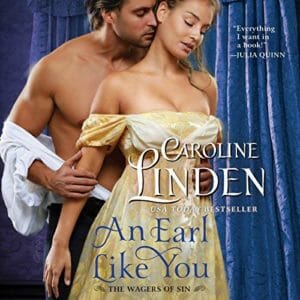
An Earl Like You
Narrated by Beverly A. Crick
Caroline Linden’s An Earl Like You was one of my favourite books of 2018, and was actually one of the very few historical romances that really hit the spot for me last year. If you’re a regular visitor to AudioGals and read my reviews (thank you for that!) you’ll probably know that historical romance has always been my favourite sub-genre – and you may have noticed I’ve been reviewing fewer and fewer of them over the past year or two. Why? Well, good historicals have been very thin on the ground lately, and not all of the good ones have made it into audio; and many of those that have made it have been assigned narrators I don’t care for (and/or who I knew wouldn’t do the book justice). That’s one of the reasons I delayed listening to An Earl Like You for so long (it came out in August 2018) – I loved the story and knew that Beverley A. Crick would do a good job with the narration, and I wanted to wait and savour it.
When Hugh Devereux became the Earl of
Hastings he hadn’t expected to inherit an enormous pile of debt along with the
title. The previous earl had been a
wonderful man – a loving husband and father, a good friend to many and
well-thought of by everyone who knew him – yet he’d died leaving his son in
total ignorance of the true state of the family finances and having spent both
Hugh’s sisters’ dowries AND the money that was supposed to have provided a
widow’s jointure for their mother.
Hugh learns all of this immediately after
his father’s death, but with his mother’s grief so raw, he can’t find it in him
to tell her that the man she’d adored to distraction has left her – all of them
– almost destitute. He intends to tell her, but as the days wear on and she
shows no sign of having the strength to deal with the news, Hugh just can’t
bring himself to shatter her illusions – so he needs to find a way of making
some money, and quickly. He’s not yet
prepared to sell himself to the highest bidder on the marriage mart – even
though he recognises that the only way he will be able to cover the entire debt
his father left is by marrying an heiress – and sets about keeping the family
afloat in another manner. Hugh’s always been a good gambler – he knows how to
win and when to cut his losses – so he moves the family to London and becomes a
regular at the Vega Club, where his careful play over the next couple of years
enables him to just about keep his head above water while also making enough
money to provide the elder of his two sisters with a suitable dowry.
Eliza Cross, daughter of an obscenely
wealthy cit, knows she will never be
accepted by the upper echelons of society because her father made his money in
trade, but she’s not particularly eager to become part of the ton anyway, or to make the aristocratic
marriage her father so clearly wants for her.
She rather thinks life as the wife of a country squire would suit her,
but is happy to fill her days running the household, working in her gardens and
playing with her dog – when one day, her father brings home a guest, the most
handsome man Eliza has ever seen – whom he introduces as the Earl of Hastings. Assuming the earl and her father must be
involved in some sort of business venture together, Eliza doesn’t think it odd
when the earl returns to the house several times over the next few weeks, and
nor does she question it when her father is often delayed and the earl opts to
spend time talking to her while he waits. Before long, Eliza has tumbled
headlong into love with Hastings – who aside from his good looks, is charming,
funny and kind – and is astonished when he asks her to marry him.
I’m a big fan of the
marriage-of-convenience trope, and this is a terrific example of how to use a
tried-and-tested formula while adding a bit of a twist and freshening it up a
bit. Hugh had always hoped to marry for
love – as his parents did – but his father’s irresponsibility has robbed him of
that chance, so when Edward Cross quietly suggests that Hugh considers marrying
his daughter in exchange for a large dowry and
the payment of all his debts, Hugh can’t completely dismiss the idea. But Cross isn’t a stupid man by any means,
and has also bought up all Hugh’s debts as further… inducement for him to
consider the scheme. Hugh realises he’s
caught between a rock and a hard place and has little choice but to agree to
Cross’s scheme, which is that he should court Eliza and make her fall in love
with him prior to marriage. If Eliza
refuses him, then Hugh will be free to continue as he has been, but Cross is
convinced that a man as handsome and charming as Hugh will have no trouble
getting Eliza to fall for him – and the deal is done.
Having a hero who deceives the heroine in
this way may be a bit of a sticking point for some, but Caroline Linden pulls
it off beautifully by making it clear that Hugh is actually attracted to Eliza,
and that while he’s courting her and doing his best to secure her affections,
he’s falling for her at the same time, even though he doesn’t realise it. He’s struck, at their first meeting, by the
warmth of her smile, the smoothness of her skin, and her innate grace and poise
– and while she may be no great beauty, she’s far from plain and becomes more
and more lovely in Hugh’s eyes as the story progresses. There’s no question that Hugh is a decent man
being pulled in many different directions; wanting to do the best for his family,
determined to be a good husband to Eliza, but eventually something is going to
give and Hugh is then faced with the prospect of convincing the woman he
married for all the wrong reasons to remain married to him for all the right
ones.
Beverley A. Crick’s excellent performance enhances the warmth of the connection the author develops so well between Eliza and Hugh, and she brings her customary emotional acuity to all aspects of the story. Her narration is as well-paced and accomplished as ever, and she differentiates skilfully and effectively between the various characters, assigning them all distinct voices that match their on-page personalities. She does a particularly good job when it comes to Hugh’s mother and sisters, who are all easily distinguishable from each other as well as from Eliza, and the same is true of Eliza’s friends, Sophie (heroine of book one, My Once and Future Duke) and Georgiana (whose book, When the Marquess Was Mine, is due out later this year). The differences in timbre and tone are subtle, but are effective in enabling the listener to tell each of the women apart. Hugh and Cross are the only major male characters in the story, and both those are nicely characterised; as I’ve said before, Ms. Crick doesn’t lower the pitch of her voice a great deal to depict her heroes, but she nonetheless manages to make them sound suitably and attractively masculine, and her portrayal of Hugh is no exception.
Combining a gorgeous love story with
excellent narration, An Earl Like You
is a must-listen for fans of beautifully written, character driven historical
romance. In light the dearth of good
historicals – and good historicals paired with good narrators – right now, this
is one to be savoured.
Recent Comments