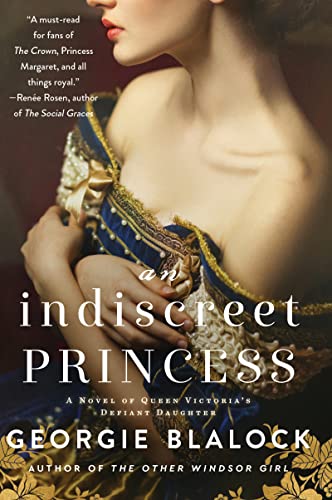
An Indiscreet Princess
Being a child of Queen Victoria was not easy, especially after the passing of her beloved Prince Albert, whose memory obsessed the monarch’s waking hours until her own death.
Nine of the queen’s ten children were unmarried at the time of Albert’s death, and Arthur, Leopold and Beatrice were all still underage. It’s Princess Louise, heading toward marriageability at the time of her father’s death but trapped in the never-ending web of mourning and tension woven by her mother who is the titular Indiscreet Princess. The central figure of Georgie Blalock’s charming if flawed novel defies royal tradition to build a life of her own outside of the palace’s strictures.
As in life, this Louise is a hot-tempered rebel seeking a way out of the royal household – and manages to find both in art, a years-long affair with her mentor in sculpting, and a Scottish duke-to-be.
Much of Louise’s story is one of rebellion. She didn’t want to live under her mother’s thumb nor her web of surveillance. Years after her father’s death, she’s expected to marry a man who will keep her near the Queen and at her beck and call. Louise wants a household of her own and the freedom to enjoy the art she loves; having endured her mother’s censure and spying as she becomes heavily involved in the art world, she refuses to spend the rest of her life suffering beneath the royal thumb.
Even though it is not a love match, marriage to Lorne, heir to the Duke of Argyll, is a perfect escape. Lorne is implied to be gay, and Louise is passionately in love with Joseph Edgar Boeh, the Queen’s favored sculptor and her (Louise’s) mentor, who is also married. The arrangement is perfect – until the Queen thinks Louise has fallen into Whistler’s bed instead, resulting in an exile for Louise and Lorne to Canada. Can Louise and Lorne curry enough favor with the Queen to get back to England.
A lot of what An Indiscreet Princess has to say about Victoria’s relationship with her kids is true, but the dialogue that delivers these truths is sometimes clunky. At one point, Louise and her siblings are arguing about her marrying Lorne, and Princess Alice rises to tell Vicky to concern herself about Prussia’s argument with a neighboring country. This feels less like something that might happen organically between siblings who also rule half of the world and more like the author trying to set some historical background into cement. Characters indulge in foreshadowing, and it rings hollow and flat. While the book is accurate about the intersibling conflict, Blalock doesn’t do a good job rounding out the people who oppose her lively, artistic Louise. Vicky, Victoria and Lorne in particular never rise above being more than cardboard obstacles for Louise to overcome, though she tries to add depth to Victoria that never quite makes her sympathetic enough.
The book has fun with some of the historical faces and figures of the time, including Napoleon III and James McNeil Whistler. There are some lovely passages about art and its importance in Louise’s life. But a certain lifelessness haunts the book, and does a disservice to Louise and her life. It’s a decent read that never rises to greatness.
Buy it at: Amazon, Audible or your local independent retailer
Visit our Amazon Storefront
Recent Comments