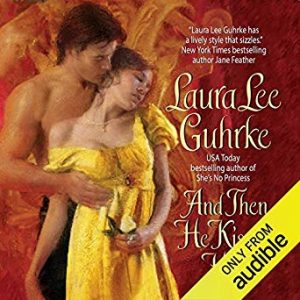
And Then He Kissed Her
Narrated by Zara Hampton-Brown
And Then He Kissed Her, book one in Laura Lee Guhrke’s Girl Bachelors series, is one of those books that’s often cited as a favourite by historical romance fans. Originally published in 2007, this is the first time it’s been available in audio, and it’s good to see some old favourites finally making it into the format.
Set in the late Victorian era, And Then he Kissed Her tells the story
of the romance between Harry, Viscount Marlowe – who, although an aristocrat,
works for a living and owns a successful publishing house – and Miss Emmaline
Dove (Emma), who has been his secretary for five years but is certainly not
desperately in love with him and, knowing him to be a rake of the first order,
is glad not to be so. When the book opens, Emma is being forced to listen to a
‘woe is me’ speech from Marlowe’s latest mistress – to whom he has just given
her congé – and has no patience with any of it, relieved (sort of) that she’s
not at all the sort of woman who would attract the attention of a such a man. Aged
thirty, Emma has kind of accepted she’s likely to remain a confirmed spinster,
and in any case, her ambitions lie in a different direction. She hopes one day
to become a published author, and has in fact written a number of books on
etiquette for young women; she has not so far been able to persuade Marlowe to
publish any of them, but continues to write, undaunted.
She is naturally disappointed when he turns
down her latest work… until something he says reveals that he hasn’t actually read any of the books she’s written. And
then she’s hopping mad. She resigns her post and takes one with Marlowe’s
closest competitor – but not as his secretary; no, she is given her own weekly
column on etiquette and other matters of concern to young women, from how to
find a respectable flat at a reasonable rent to the most appropriate way for a
young lady to refuse a marriage proposal from a widower to where to find the
best boots – a column that very quickly has the ladies of London – high and
low, young and old – talking about it and its author’s vast knowledge and easy,
readable manner of imparting it.
Marlowe – who clearly takes Emma and the
way she manages his office – and many aspects of his life (like organising
birthday presents for his sisters and selecting goodbye gifts for his
mistresses) – for granted, behaves like a total dickhead towards her to start
with. He’d rather have a tooth pulled than read an etiquette book, believing
them to be dull and pointless – and therefore not profitable. When she ups and
quits, he condescendingly reminds her that he gave her a job when most would not
employ a female secretary and then asks her – “What will happen to you? Without me,
your future is very uncertain, you know.” I may have cheered when she told
him to stick his job and that she’d got a better one.
Fortunately, he does redeem himself. Marlowe has been angling to buy
out his rival for some time, and when he does, Emma ends up working for him
again, but this time on a very different footing. As she clearly sets out the
terms she expects:
“We would have
to look at each other in a new way. Not as an employer and his secretary, not
as a lord and an army sergeant’s daughter, but instead as two people whose
opinions and ideas are equal in importance and value. We should have to regard
each other with mutual respect and consideration.”
– he finds himself impressed with – and more than a little intrigued by
– her poise and new-found confidence. As their new working relationship
progresses, both Emma and Marlowe start to see each other in a new light. He’s
man enough to admit he was wrong about Emma’s etiquette books – not just
because her advice columns are clearly popular and bringing in in money from
advertising, but also because he realises that she’s actually a very talented
writer. And Emma comes to realise that Harry’s unfortunate first marriage –
which ended in a lengthy, expensive and scandalous divorce – has damaged him in
ways she hadn’t seen before.
As I said at the beginning, there’s nothing new to be had in this
story, but it’s a well-done example of the trope. Emma and Harry (which is
short for Harrison – really? In Victorian England? Doubtful. And don’t get me
started on the sidewalks, candy, fawcets and all the other
annoying Americanisms!) are engaging characters and the chemistry between them
fizzes right from the start. Emma, who is perhaps a bit prim, but always kind,
is a terrific heroine, and I loved seeing her blossom as she gained the
confidence to strike out on her own and achieve her ambition of becoming a
writer and so much more. And while Harry is an idiot to start with, he is quick
to acknowledge that he was wrong and then, to help Emma to further her career
and offer help and support. I did feel that his character growth kind of
stopped once he and Emma were in a relationship though; we listen to her
overcoming her emotional barriers and breaking through the social conditioning
that bound most young women of the time and deciding she wants to have an
affair with Harry, but it’s clear that he doesn’t really appreciate quite what
a big step that is for her and that he’d be content with the status quo forever
without a qualm. I suppose that’s probably accurate for a man of the time – the
author points out several times throughout the novel that he has a far greater
degree of freedom than Emma in particular and women in general – and of course,
it’s down to Emma to take action to make him finally face up to the truth of
his feelings.
Zara Hampton-Brown is an accomplished narrator with a fair number of
historical romances to her credit, and she delivers an enjoyable performance in
this one. She has a pleasant, mezzo-range voice and is someone who acts as well
as reads, something I always appreciate. Her narration is well-paced and clearly
enunciated, and she’s able to convey a wide variety of emotion and
differentiate effectively between characters according to gender, age and
station. Her interpretation of Emma is excellent, capturing that little bit of
primness and the overall essence of her character really well, especially in
the moments of heightened emotion, whether she’s raging at Harry for being a
self-important git or quietly telling him about her childhood and difficult
relationship with her stentorian father. She lowers her pitch only a little to
portray Harry, but she nonetheless makes him sound attractively masculine and
just a little bit naughty when called for ;) (Chocolate, anyone?)
This one isn’t going to win any prizes for originality, but there’s
something to be said for familiar tropes when they’re well done, and that’s
definitely the case here. And Then He
Kissed Her is an enjoyable, well-narrated historical romance that is sure
to appeal to fans of the genre.
Recent Comments