
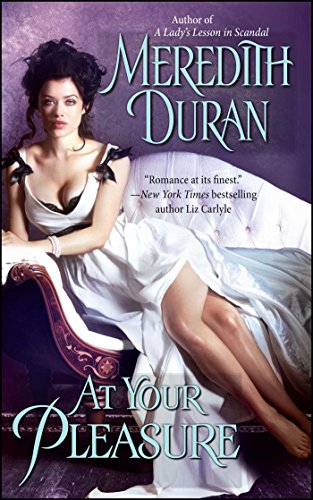
At Your Pleasure
I freely admit that the transition from Stuart to Hanoverian monarchy is a period of history I don’t know much about, for all that I regard myself as a bit of an amateur historian. But I didn’t need to keep one eye on Wikipedia as I was reading, because Ms Duran does a splendid job of explaining why the characters have adopted their particular loyalties, why the conflicts between them exist, and weaving all the necessary information about the complicated political situation into her story without making it seem like a history lesson.
But given At Your Pleasure is a book in which the main cause of the conflict between the two central characters is political and religious, I wanted a little more historical context and background. It’s absolutely NOT necessary in order to enjoy the book – it’s just me :)
Amidst all this political unrest and subversion, Ms Duran spins a terrific tale of love and betrayal, forgiveness and redemption. Leonora, the widowed Lady Towe, is the daughter of Lord Hoxton and sister of David Colville, both of whom have been stripped of their lands and titles because they have been plotting against the new king. The family is not Catholic, but rather, are political opponents of the Hanoverian monarchy, and father and son have fled to France where they continue to plot, basically abandoning Nora and leaving her alone to manage Hodderby, the home for which she has a deep and abiding love. Hoxton is settled at the Court of the Pretender in France, but Nora is in daily expectation of her brother’s return, even while knowing how dangerous it will be for him to set foot in England.
Adrian Ferrars, Earl of Rivenham has been sent to arrest Colville and bring him to London to face trial and, almost certainly, execution for treason. Nora is stunned at Adrian’s unexpected appearance, and not just because she knows the danger he represents to her brother. Their family estates border each other, so Adrian, David and Nora grew up together; and six years earlier, Adrian and Nora had fallen deeply in love and had a brief affair. When Nora’s father discovered their relationship, the pair were brutally separated, for Adrian was a Catholic, and thus not a suitable husband for the daughter of a high-ranking, Protestant family.
Their short-lived affair ended bitterly and violently, with Nora believing Adrian abandoned her to the fate forced upon her by her father (marriage to an older, abusive man) and Adrian believing she deserted him in order to do her father’s bidding and marry a rich man of his choice.
Adrian barely escaped David’s brutality with his life, and was then bundled off to France by his family for his own protection. Upon his return some years later, he renounced his faith and by virtue of his intelligence, charm and wits, rose quickly through the ranks of the court to become a trusted advisor to Queen Anne, and has retained his position under the new king.
The few times Adrian and Nora crossed each other’s paths at Court, he ignored her, causing her to believe he hated her; and the only way she can deal with that is to tell herself that she despises him. Their reunion is barbed and bitter, both of them haunted by memories of betrayal and heart-break and determined to convince the other of their utter indifference. Adrian is cold and cruel and Nora meets his harshness with sharp-tongued defiance, determined to protect her property and her brother, sometimes to the point of stupidity. What she doesn’t know is that Adrian is walking a political tightrope. He became a recusant in order to keep his own family safe from the sort of brutality inflicted upon him by the Colvilles – but he is still regarded with suspicion by many (especially those who are jealous of his position and influence) and has been given the job of bringing in David Colville as a way of proving his loyalty. If he succeeds, he will further cement his position of power at court – if he fails, his enemies will immediately accuse him of collaborating with Colville. And the Jacobite supporters want him out of the way so they can continue in their mission to restore a Stuart to the throne. With his political enemies prepared to join forces in order to bring Adrian down, he is prone to attack from all directions and decides there is only one way he can do what he must and keep Nora safe at the same time.
With the undercurrent of attraction that still swirls between them proving harder and harder to deny, the two begin an uneasy rapprochement. The devastating truth about what happened six years ago is revealed, and the barriers between them – barriers not of their own making – begin to break down. But even so, Adrian must ignore Nora’s wishes and act to protect her in a way which threatens to destroy their re-kindling relationship; to protect her from herself as much as from those outside forces which seek his destruction.
Ms Duran’s story is utterly compelling, as are her two central characters. Adrian is a wonderful hero, a man who can be ruthless and uncompromising when he has to be, but who also shows a remarkable capacity for tenderness and consideration. The depth of his love for Nora drives him to desperate measures, it’s true, but that love is never in question. Nora is a little more difficult to warm to, primarily because of the blind loyalty she shows toward David, who has put her in danger time and again. I found myself frequently wanting to scream at Nora to just cut the cord and leave him to fend for himself! Even though he is preparing to marry her off to another man to further his own ends, and after Adrian has revealed to her the extent of his duplicity six years before, she can’t bring herself to wash her hands of him. Loyalty is an admirable trait most of the time, but in this, Nora really is her own worst enemy.
Much mention is made of the helplessness of women in the society of the time; Nora, like most well-born young women, was regarded by her father as not much more than property, a useful pawn to be used in order to secure wealth, position and influence, and she is constantly frustrated by the way she is so often dismissed and treated as though she is not a person in her own right. Yet she is clever, stubborn, and courageous; her motives might not always be clear-sighted or in her best interests, but she possesses a great inner strength:
“He could not admire her destructive loyalty to her brother. But it was born of the steel at her core. As a girl, she had not disguised that steel, speaking boldly, daring the world to cross her. But now that she carried it concealed, it took on a new element of power, like the hidden stiletto that could save a man’s life when all else was stripped from him … men too often mistook bravado for courage. Her courage was not wasted on display.
But what a wealth of riches she offered to those who possessed her loyalties. She put her whole self into their defense and never accepted defeat. Even if her wits saw the weakness in a cause, she would sacrifice herself for the sake of honor.”
At Your Pleasure is a beautifully developed romance with real emotional depth set against a fascinating historical background. I found it to be an intense read with very little to lighten the tension and there are some scenes which make for downright uncomfortable reading – but I loved the intrigue and that feeling of walking the thin line along with the characters. The writing itself is gorgeous, and I applaud Ms Duran for the way she shows us the grey areas that are part of the lives of these characters and the tough decisions they have to make.
This review was originally published in 2014.
Recent Comments





At Your Pleasure, the two times I tried reading it, has been a DNF. It is not like I do not like historical novels set in real historical times. I really did not like Nora here. It was hard for me to see what Adrian found in her to love.
But AYP sent me down the rabbit hole of other Duran novels. The ones reviewed here got nothing less than a B+, deservedly so. The stories are compelling and writing beautiful. Having read/reread several of her books in the last few days, I find that her heroes are more likeable than her heroines.
Nora is so problematic for me. I do think she writes complex heroines but many of them like Mina, Emma, and Lydia are some of my favorite heroines!
I read it for the second (or third?) time a year ago and liked it even more as I understood the context better. Definitely an A for me.
Although I love the history part, this is definitely one of Ms Duran’s darker books. The cover, on the other hand, always makes me laugh. I know publishers don’t care about historical accuracy in cover art, but this looks like a still from the movie Gigi!
Yes, that is definitely NOT the kind of clothing a woman would have worn in 1715!
I read this the second time earlier this year. I admit I didn’t enjoy it as much the second time around thought it was a bit too dark and also a bit heavy on the politics. First time around I rated it a A- the second time C unfortunately. :-(
Now, I love all that stuff! Actual history is what’s missing from so many of today’s historical romances.
I just wasn’t in the mood for this type of story. And I’m a bit fed up of the nobility as well probably prefer to read an historical romance with working class charcters,wish more writers would write books based around ordinary people.
I’m trying to write a book like this, not sure if I will be able to do it I’m dyslexic. The book is based around working class charcters and is quite gritty so far.
You can do it!
Thanks!
I think I have a long way to go.
I think working class books are so wanted. You go!!!
You think readers will be interested in it?
Yes I do!!
I too found it less fabulous on the second read although for me it that meant it went from a DIK to a strong B. I struggled with how bloody minded Nora is about her brother.