
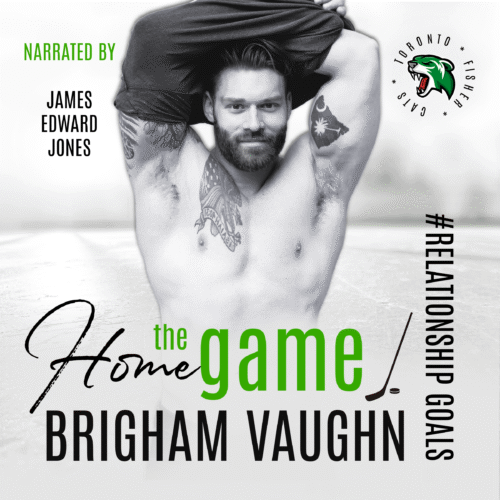
AUDIO: The Home Game
Narrated by James Edward Jones
The Home Game is book four in Brigham Vaughn’s Relationship Goals series, although it can be read or listened to as a standalone; there are recurring characters but each story is self-contained and the central couple in each one gets their HEA by the end. All the books in the series feature a fake-relationship, and while I admit that the reasons for the one in this book make more sense in than those in the previous one (The Waiting Game), I will also say that there’s a lot of credulity-stretching required to accept the overall premise here. I think the degree to which you enjoy this story will depend on how many improbable situations you’re prepared to turn a blind eye to.
School teacher Antoni Bianchi has recently assumed the guardianship of four children – ages six months to fourteen years – after his dearest friends were killed in a car accident. He’s determined to do the best he can for them, but it’s one hell of a lot of responsibility, and he’s struggling under the weight of it. As if things aren’t tough enough, what with juggling the demands of his job, looking after the kids, and worrying about the custody challenge being mounted by their grandparents, Antoni needs to find them somewhere else to live because the landlord of his current place is jacking up the rent – and it turns out that finding somewhere to house himself and four kids within his budget is pretty much impossible. When his aunt, a realtor, sends him to view a place he can’t possibly afford, it’s the last straw. Sitting alone in his dilapidated minivan on the driveway, Antoni finally allows himself to break down.
Matty Carlson, on-ice defenceman and enforcer, off-ice cinnamon roll and cuddle-bear, is selling the house he’d hoped would be a home for him and the large family he’s always longed for. Those dreams died with his divorce five years earlier and he doesn’t really know why it’s taken him so long to offload the huge house with its big, echoing rooms and reminders of failure. Still, he’s put the place on the market, and the realtor has arranged a viewing for her nephew, who is looking for somewhere large enough to accommodate him and his four children.
When Matty arrives home to see a rather beat-up minivan sitting on his driveway, his first thought is that maybe it’s the guy who’s supposed to be viewing the house this morning; his second is that the van is unlikely to belong to someone who can afford a multi-million dollar property. He walks toward the vehicle and peers in through the window, surprised to see a man sitting in the driver’s seat, his head in his hands, his shoulders shaking. Shit. Is he crying? Concerned, Matty knocks gently on the window and, when it lowers, introduces himself and asks the man if he’s okay; the guy is clearly upset and not thinking clearly, so Matty invites him in for a drink and something to eat while he collects himself.
As Matty prepares the food, Antoni opens up to him about his situation, telling him about the kids and how much he loves them, how overwhelming it all is, about the looming custody battle, and how desperately he needs to sort their housing situation. As he listens, Matty comes up with what he thinks is the perfect solution. He’ll take the house off the market and Antoni and the kids should move in with him.
Antoni is completely floored by this suggestion but of course, he says no, even though he can’t help feeling a little guilty at Matty’s crestfallen expression. Antoni leaves shortly afterwards with a bag full of food Matty insists he takes for the kids and Matty’s number in case of emergencies – not that Antoni intends to use it.
Well, of course, he does end up contacting Matty again, he and the kids do end up moving into Matty’s house, and it doesn’t take long for the two men to fall into a routine based around the kids and doing whatever is best for them. Matty is a natural with them – he’s a big man with a big heart, a lot of love to give, and an ingrained need to help people; he’s well aware of his own good-fortune and can remember back to a time when he, too, was just scraping by, and wants to pay it forward however he can. Unfortunately, his desire to do that has led to him being taken advantage of in the past and his friends are understandably worried that that’s what’s happening here – but Matty is absolutely set on doing whatever he can to help Antoni and the children.
The romance between the two men moves fairly quickly, especially given that Matty has only recently begun to question his sexuality and that he identifies as demisexual, but it works (for the most part) because of the way the two of them bond over the parenting responsibilities and how Matty so easily slots into their lives. It’s all a bit Hallmark to be honest, but Antoni and Matty are a good fit, and Matty is so kind, generous, and giving that it feels like he deserves to have all the good things he’s always longed for.
The thing is, that while the premise was promising, it didn’t take long for me to realise that there wasn’t actually a lot of story to tell, and that some scenes didn’t really contribute much or move the story forward. Don’t get me wrong – the writing is solid and I wasn’t bored, but the book could have been shortened by a third and the plot still would have worked. Also, it’s very focused on the daily routine of a large family with working parents, so if you aren’t interested in that kind of domestic/family-oriented storyline, this may not be the book for you. On the plus side, the kids aren’t merely plot-moppets and are written age-appropriately, and I did actually enjoy listening to Antoni and Matty working out how to be a family. But it feels as though the romance takes a back seat at times.
As to those credulity-stretches I mentioned at the beginning. The first is that a couple with four children would have no other option than to name their slightly younger, unmarried friend as guardian. I get why they didn’t want their parents to have guardianship (one of the kids is non-binary and the grandparents refuse to understand or allow them to be what they are), but surely mum and dad must have had other friends and other options? Giving the guardianship of four children to someone who doesn’t have the resources to look after them is not in the best interests of the kids OR the appointed guardian. Second – Antoni’s parents are well off (he says this himself) and are clearly prepared to help him out financially as well as with childcare, yet he acts as though he’s out of housing and financial options. And instead of using the life-insurance pay-outs to solve their immediate problems, Antoni decides to put the money aside for college – which makes no sense. I get wanting to plan for the future, but there would be no future without sorting out the housing and other financial issues. It’s too obvious a plot device; the author needs Antoni to have no other option than to take up Matty’s generous offer to get the story to work.
James Edward Jones returns to narrate this one and, as I said in my review of The Head Game, his pacing is a little on the slow side, and he’s a reader rather than a performer. He reads with expression and does attempt a degree of character differentiation, but in this book, it’s really hard to tell the difference between Antoni and Matty’s voices, so I had to rely on context and the dialogue tags most of the time, to work out who was speaking. Some of the characters are easier to identify aurally – August (The Head Game) is portrayed consistently, and the new coach, Gilly, is easy to pick out – but Alexis (the oldest of the kids, at fourteen) sounds like everyone else, and the handful of other female characters are similarly poorly served. This is my second time listening to Mr. Jones, and I think it will be my last; I wanted to give him another try after The Head Game, but his performance here has pretty much confirmed my thoughts about him as a narrator – which are that he doesn’t have a particularly wide range of character voices and that he doesn’t have the necessary ‘oomph!’ to really bring a narration to life.
Despite my criticisms, I enjoyed the story – even though it isn’t very realistic! It’s cute and heartfelt with plenty of warmth and tender moments, Matty is the biggest cinnamon roll and cuddliest cuddle bear ever, and I liked that the author is able to explore some heavy themes without dragging the story into permanent doom and gloom. I plan to finish out the series, and to pick up the next book in the author’s new, Sporting Chances series (Body Check, out at the end of May), but I’ll stick to reading Brigham Vaughn’s books with my eyes rather than my ears from now on.
Breakdown of Grade: Narration: C+; Story – B-
Running time: 13 hours, 29 minutes
Note: At time of writing, this audiobook is available exclusively from the author’s online store.
Recent Comments




Kindle Unlimited does reward longer books.
That’s a good point. Although I wouldn’t say this book is ‘deliberately stuffed’ – I just think the author let her enthusiasm for her story/characters run away with her and her editor didn’t rein it in.
But I’m sure that’s a factor in some cases
I’ve read two of this author’s books. I enjoyed The Head Game quite a bit, and thought The Husband Game was so-so. Both were too long for the story it was telling, but The Husband Game definitely could have been trimmed by a 100-200 pages (of it’s 575) without losing anything important. I like the way Brigham Vaughn writes overall, but they need an editor.
I agree about the length – I think I’ve said in all my reviews of BV’s books that they are on the long side, but I didn’t find that too much of a problem with The Head Game or Goaltender Interference, probably because I enjoyed the stories more.
Incidentally, I’ve noticed this tendency to length in several of the self-pubbed authors I read, (L.A. Witt has written some really long books recently!) Sometimes, if there’s a lot of character/relationship development going on, I don’t mind it. Others, it can be a real slog to get through.
The reason I stopped reading Brigham Vaughn’s books is that they are so long; despite generally having a good premise and smooth writing, they drag on so much that after a while I get impatient and wish they would just end. I feel like the romance often gets sidelined by a lot of external events and, like a lot of contemporary authors these days, Vaughn could do with a ruthless editor. Which is a shame because there’s a lot to like in her books.
Agreed. Like I said to Carrie, sometimes I don’t mind that so much in some cases, but it depends on the book. This one just didn’t have enough story to fill the page count.