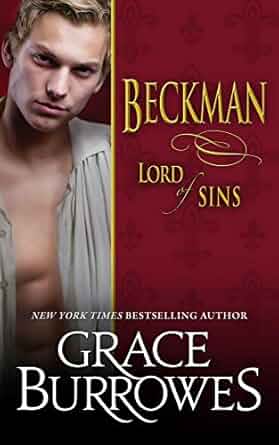
Beckman: Lord of Sins
This review originally appeared at Romantic Historical Reviews in 2013
The events in Beckman: Lord of Sins, book four in Grace Burrowes’ Lonely Lords series, run parallel to events that take place in book two, Nicholas: Lord of Secrets, and there are several references throughout as to what Nick is up to, rattling around in London, as well as to the cautious rapprochement that is taking place between Ethan (book three) and his half-brothers.
This book opens with the dying earl seeing Beckman off as the latter departs for Three Springs, one of the family properties which is in desperate need of attention. Lady Warne, Beckman’s grandmother, owns the place, although she does not live there, and she is not altogether happy with the responses she is receiving to her letters and enquiries.
We learn as the novel progresses, that Beckman is the “fixer” in the family, and that he has travelled extensively in this role, surveying the family’s holdings at home and abroad, and doing what needs to be done in order to maintain them and keep them profitable.
The thing that struck me immediately was the depth of feeling in the relationship between Beckman and his father – a thing rarely seen in historical romances. Normally, fathers and sons are at loggerheads or estranged, but here, Beckman is loath to leave; knowing his father is dying, he wants to stay, but also knows the earl is despatching him because he doesn’t want his family to see him in his decline. It’s also clear that Beck is something of a favourite –
Nicholas is a good time. You are a good man.
and that the earl is concerned about Nick’s suitability to inherit the earldom.
Arriving at Three Springs, Beckman makes the acquaintance of the women who run the house, the taciturn land steward and slovenly servants. The house and lands are in a bad way, but there is not enough money to do much other than to keep the house running in a very basic manner. The ladies – Sara Hunt, the housekeeper and her sister Polly, the cook – are helped by the mysterious Gabriel North, a man Beck immediately suspects is much more than a simple land steward, and hindered by a couple of lazy farmhands who Beck very quickly gets rid of.
Beckman: Lord of Sins is a very gently moving story about people finding their place and their purpose. Beckman has been a wanderer for years, a situation that came about when his father realised that Beck needed something to divert him from the course towards self-destruction on which he’d set himself after the death of his young wife and unborn child. But he’s become weary and a little bit resentful of being continually sent away for “his own good” and wants to put down some roots.
Sara is surprised to discover that this son of an earl isn’t above getting his hands dirty. He and Gabriel work all the hours God sends in order to set the estate to rights, something which takes its toll particularly on Gabriel because of a recent injury.
Like Beckman, Sara (whose full name is Sarabande) has her own secrets and inner demons. A hugely talented violinist, she married a man who subsequently exploited her and her talent, hawking her all over Europe, from concert halls to drawing rooms, and spending all the money she made on drink, gambling and other women. The Hunts were clearly a talented family as Polly (or Polonaise) is an incredible artist, a talent that appears to have been passed to Sara’s daughter Allie.
Although Sara’s cruel, wastrel husband is long dead, she and Polly live in fear of his relatives discovering Allie’s whereabouts and taking her away to exploit her talent as an artist. This means that they are reluctant to let the girl paint as they don’t want her to immerse herself completely in her gift to the extent that they had done in the past and in a way that left them open to the machinations of an unscrupulous man.
The thing that stopped me rating the book more highly, because the romance is by turns beautiful and scorching, was the fact that Sara’s secrets turned out to be so… well, insignificant. She has hidden herself away since returning to England because she is so ashamed of the fact that she gave “private performances” barefoot and wearing scanty costumes to rooms full of gawking men, feeling it makes her unfit to mix in society and causing her to worry in case one of those men should recognise her.
I admit I’d expected Sara’s deep secret to be something a little more scandalous, but in the grand scheme of things, that didn’t affect my enjoyment of the book. As I’ve said, the central romance is utterly beautiful, and Beckman is an absolute joy of a hero; kind, caring and insightful, and I never cease to be amazed by the amount of romantic and sexual tension that this author can bring to the merest touch of a hand or a kiss.
In Beckman, like the books that precede it, Ms Burrowes has also written a superb male friendship. I’m finding these to be among the highlights of the books in this series that I’ve read so far – in Nicholas and Ethan, the eponymous characters resurrect and repair a relationship destroyed years earlier and in this book, Beckman and Gabriel North strike up a friendship that I’m convinced will last for years. There were a couple of laugh-out-loud moments in their banter, there were times they may not have liked each other much, but it’s clear there was a lot of mutual respect and understanding between them; and in fact, their parting was almost as painful as the one that took place when Beck had to leave Three Springs after his father’s death.
I thoroughly enjoyed the book despite the misgivings I’ve mentioned about certain aspects of the plot. But Ms Burrowes is one of those writers whose characters are so compelling and whose handling of the emotional content of her stories keeps me coming back for more, despite some minor inconsistencies.
Recent Comments