
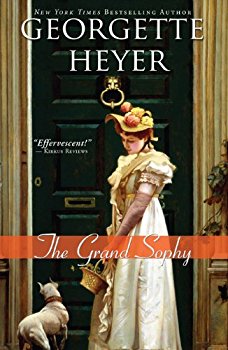
The Grand Sophy
The Grand Sophy, Georgette Heyer’s Regency Romance written in 1950, is a witty comedy of manners which will not fail to delight the sainted Georgette’s admirers and might well prove to be a keeper for others as well.
Lord Ombersley’s family is in a sad scrape. Due to his financial ineptitude they are forced to think more frugally than they want to. Lady Ombersley is basically nice but lacks a certain spirit and seems to be wanting in maternal instinct too. Of the younger generation, the student Hubert has landed in debt and the eldest daughter Cecilia has refused an eligible suitor because she fancies herself in love with a hopelessly unsuitable Byron-wannabe. In the absence of other volunteers, eldest son Charles Rivenhall has been obliged to take on the burden of all the responsibility in the family. He has also become engaged to Miss Wraxton, who embodies every obnoxious virtue his family lacks. Charles’s leadership comes perilously close to despotism. Other family members are a bit scared of him and even more wary of his fiancée, who will change their lives forever.
But the Rivenhalls are in luck, because Lady Ombersley’s niece Sophy arrives just in time. She’s a natural born diplomat who’s been traveling all around Europe with her father but seems to be friends with everybody in London. She is perceptive, quick-witted, and speedily figures out that family is in desperate need of her assistance.
Sophy is an outrageous free-spirit who subscribes to convention only when it suits her purposes. Her methods are unorthodox but effective. She uses reverse psychology and a pistol with equal competency, and is a dab hand at handling horses. She wouldn’t make a believable simpering miss if she tried, she’s got too much common sense (although sense does not seem to be exactly a common characteristic of people in this book). Although she proves to be an invaluable asset to the family in a time of crisis, she’s often at odds with Charles. Sophy’s joyful, confident demeanor endears the heroine to the reader. Such a Miss Fix-It could easily become irritating but Sophy doesn’t.
The subtle humor of the novel is based on intelligent character caricatures, the derivatives of which return to us again and again in later authors’ efforts. The social relationships are richly developed but understated; Heyer does more showing than telling, and consequently a lot is said in-between the lines. Even the romance proceeds stealthily and hintingly, as Sophy is not given to sighing, and the hero does not wear his heart on his sleeve either. Their feelings have to be inferred from their actions, not from internal monologues of love and despair. Love is hardly mentioned and usually discussed in a humorous vein.
Heyer pokes most fun of those who take themselves too seriously. Miss Wraxton, Charles’s fiancée, is an uptight moralist who makes an unpleasant habit of sharing tidbits of her virtuous wisdom with unwilling listeners. Her faintly veiled insults about Sophy and the way she pretends to speak no evil are reminiscent of Miss Bingley’s criticism of Elizabeth in Pride and Prejudice. Lord Bromford, who wants to court Sophy, is a twit, and Cecilia’s poet lives in a world of artistic reverie and conceit not accessible to us common mortals.
The more sympathetic characters are a delight as well. With all their faults, the Rivenhall family is a pleasant acquaintance, and Lord Charlbury delivers a hilarious health warning regarding mumps. Beware of children’s ailments, all ye lovers.
I can hardly do justice to The Grand Sophy with mere words, so I’ll just encourage you to locate her and find out for yourself. I defy anyone to read this and not smile. Even if you don’t belong to the Heyer fan club you should give The Grand Sophy a chance.
Recent Comments

“We don’t want to throw off a 25-year-old who’s just discovering Heyer,” said Todd Stocke, senior vice president and editorial director of Sourcebooks. This is an interesting point. Very current research, polling, etc. in the UK, and elsewhere in the western world, seems to indicate that anti-semitism, as demonstrated by pro-Palestinian and/or Hamas support and anti-Israeli feelings and protests is more prevalent amongst younger (18-34) than older people (50+). So what could that tell us about the reading preferences of younger demographic groups of readers? I offer no opinion, no judgement, no proof of any of this but it is, nonetheless, something to consider. As far as changing the output of authors to conform with “current” points of view, it’s akin to painting a BLM badge (or any badge representing a current opinion/organisation) on the Mona Lisa’s garment. I’d rather read things myself, in the knowledge that life is a dynamic and constantly changing, keep myself informed, form my own opinions and keep my mind open to other points of view, thank you.
I think the research is pretty clear that for a large swath of the world, “cancelling” art/history/literature makes people more hostile to the groups the cancelling would like to support.
And the rewrites come for Heyer. Sourcebooks is releasing updated versions of her books that tone down the anti-Semitism. People aren’t happy with their approach. In a long article in the NYT (sorry–it’s behind a paywall), the issue is discussed thusly: “Most troubling to readers is her 1950 Regency romance “The Grand Sophy.” In a pivotal scene, the novel’s heroine confronts a greedy, villainous moneylender named Goldhanger, who is described as a “swarthy individual, with long, greasy curls, a semitic nose, and an ingratiating leer.” “It’s not a stray comment, it’s a whole antisemitic scene,” said the romance novelist Cat Sebastian, who has read all of Heyer’s romances. “If I recommend her books, it’s with a lot of caveats.” When Heyer’s American publisher, Sourcebooks, decided to release new editions of her romances this year, they had to strike a precarious balance. Leaving the original scene could repel some readers. But changing it risked provoking a backlash from fans and scholars who see posthumous revisions as a form of literary reputation laundering, or censorship. After a lengthy back and forth with the Heyer estate, Sourcebooks made small but significant changes to “The Grand Sophy.” In the new version, the moneylender’s name has been changed to Grimpstone. References to his Jewish identity and appearance have been deleted, along with other negative generalizations about Jews. Acknowledgment of the changes appears on the copyright page, which says “this edition has been edited from the original with permission of the Georgette Heyer Estate.” The revisions could ensure that “The Grand Sophy” remains a romance staple for future generations. But they are also likely to stir up an ongoing debate about whether, and how, publishers and estates should handle insensitive language in older works. When it was revealed earlier this year that novels by Roald Dahl and Agatha Christie had been edited to remove offensive phrases, many were outraged by what they saw as an attempt to sanitize iconic literary works. The Heyer estate’s approach bothered Mary Bly, a romance novelist and literary scholar who in 2021 was brought on by Sourcebooks to write introductions for the new editions of the novels. To Bly, changing “The Grand Sophy” without acknowledging the flaws in the original felt like an attempt to obscure Heyer’s views. After the estate declined to include Bly’s explanation of the changes in an afterword, she quit the project. “They’re publishing a bowdlerized text, and I can’t have any part in that,” Bly said. “You can’t hide it.”…. They also worried some of Heyer’s language might put off new readers. Within her lighthearted romantic romps, Heyer occasionally trafficked in stereotypes that were common in her era, with negative portrayals of foreigners, working-class people and Jewish people. Sourcebooks suggested to the estate that they tweak potentially offensive or sensitive phrases, such as deleting a reference to the race of a young Black servant in “These Old Shades.” “We don’t want to throw off a 25-year-old who’s just discovering Heyer,” said Todd Stocke, senior vice president and editorial director of Sourcebooks. The publisher asked Bly to write introductions explaining Heyer’s historical and literary relevance. A Shakespeare scholar and chair of the English department at Fordham University, Bly publishes historical romances under the pen name Eloisa James, and is a die-hard Heyer fan. Bly suggested small tweaks to some of the texts, like removing the word “gypsy” from “Frederica.” But Bly felt “The Grand Sophy,” one of her favorite books growing up in Minnesota, would need more radical revisions….. The novel follows an irrepressible young woman named Sophy who visits her cousins in London and proceeds to wreak havoc on their lives — matchmaking, breaking up engagements, giving the children a pet monkey and taking their horses on a reckless joyride. The buoyant tone turns ominous when Sophy comes to the rescue of one of her cousins, a gambler who has fallen into debt. Setting out to confront Goldhanger, the moneylender, she finds him in a filthy hovel of an office. He is described as stooped, with hooded eyes, and driven by “the instinct of his race.” Elsewhere in the novel, he is referred to as a “devil” and a “bloodsucker.” To evaluate the text more thoroughly, Sourcebooks brought on Hilary Doda, an assistant professor at Dalhousie University, as a Jewish sensitivity reader. In her report, she noted that some of Heyer’s language echoed Nazi-era propaganda that had been exported abroad. Sourcebooks proposed changing the moneylender’s name to something less obviously Jewish and deleting or revising the… Read more »
I’m with Rose Lerner. Let people read the original and decide for themselves. I haven’t changed my opinon since my comment on this thread from 2017 – I’m seriously uncomfortable with retrospective censorship. Where will it end?
They’ve pulled the Eloisa James books from publication. How much did that cost? For what? To make people believe that Heyer was less bigoted than she–and most of her peers–was?
Obviously, they think it’s okay to censor her, too.
Whatever was pulled, Sourcebooks pulled it because Heyer’s estate required them to. Which is pretty sad because it sounds like Sourcebooks was making an attempt to straddle the fence: changing some of the language (which I believe is wrong) but at least letting readers know they’ve done so with Bly’s afterwards.
I don’t think anyone but an author should revise an author’s work – not even the author’s estate. Reprinting something old (keeping it intact) but including an afterword or forward that explains its historical/cultural context – both good and bad – absolutely works for me. If a work is so objectionable that even with annotations or contextual explanation it falls out of literary or consumer behavior, so be it.
How else do you teach/remind readers to wonder what they too might be consuming and glossing over, without ever considering whether it too may be problematic?
Yes, I think if someone who is not the author is going to make changes to a book, then there should be information somewhere about what has been changed and why. (You could even make an argument for authorial changes needing to be documented, especially in these days of automatic updates to Kindle books.) I’m assuming that Sourcebooks didn’t like the fact that Bly didn’t explain the changes in the way they wanted or write with sufficient (in their opinion) outrage.
Your last point is spot on.
I want to KNOW if a book has been altered. Period.
I’m of mixed feelings about this. I refuse to reread THE GRAND SOPHY precisely because of the antisemitic passages (plus my 21st C mind finds first cousin marriages off-putting), but that’s very different from not allowing others to read it. I think what bothers me most is when the book was written. If Heyer had written those descriptions in the 1930s it would be bad enough but I could probably ignore them and reread the book, but to write them in a novel published in 1950, after the organized state murder of Jews (and others) were known, strikes me as totally repugnant. I’m a bit confused by the statement about letting people decide for themselves. Does this mean decide for themselves whether to read it or decide for themselves whether the things Heyer says are accurate?
As for Agatha Christie, I recently reread THE HOLLOW. In some ways it’s one of my favorites because it gives the victim a personality and a voice. When Hercule Poirot comes across the murder scene, he feels that the dying man is, somehow, the most vital person there. There is a secondary character, however, a Jewish shopkeeper, whose nastiness is ascribed not to her personally but to her race. And, to top everything off, there is an offhand reference to a dessert made of chocolate and whipped cream, which is called [the n-word] in a cloud.
When I say let people make up their own minds, I mean as to whether they enjoy the story, not about whether Heyer’s views are problematic.
I’m all here for people saying, “I don’t want to read that.” I personally dislike age gap romances but I’m not asking that they be banned or altered to fit my perspective.
I struggle, however, with rewriting books to make them more palatable to today’s audiences.
My favorite Heyer is THE NONESUCH. I agree about the heat levels in her books, you are lucky to get one passage to swoon over, like, when Sir Waldo put Ancilla’s shawl on her shoulders at the ball !!… Fraught with genteel restrained passion, sigh. And imagine their waltzing, he is holding her to music, how romantic, but seen from third party characters’ viewpoints … And of course, the meeting of their refined minds, but then, the Big Misunderstanding, just to mention a few tropes. I envy first time readers.
I’m going to say something which is bound to be unpopular, but I can’t judge something that’s over seventy years old by modern standards . The book and the author are products of their time, and there is no doubt that the attitude GH expresses was prevalent at the time the book is set. That doesn’t make it right and I don’t condone it. But it doesn’t spoil the book for me.
My take is that we should all read what we like and never apologize for it..
I just read an interesting article about Marti Noxon who is adapting Gillian Flynn’s Sharp Objects into a series for HBO. That book is horrifying to me and, honestly, I wish I’d never read it. It’s so violent and dark. But if you like it, read on. If the mini-series floats your boat, watch on.
I’m in agreement with you here. There is so much shaming of readers going on these days on social media for liking what they like. This is not to say that you should not diversify your reading — I, for one, am hugely gratified that there is so much choice available in books these days — however, you shouldn’t have to apologize for what you read, just because it doesn’t match what is currently popular.
We should judge books by the historical moment in which they were written. However, when it comes to **favorite** romances, I have a hard time enjoying and taking pleasure in books that perpetuate hatred or demean people or groups of people. For me there is a clear distinction between respecting history and intellectually appreciating books from a historical perspective as opposed to promoting a book as pleasurable by today’s standards. The Top 100 list is not a literary book list of the best books but instead are a list of people’s favorites. I would have difficulty putting an anti-semetic book on a favorites list because as a reader I would always find the concept jarring.
Agree, Blackjack.
I’m not saying people have to cut problematic books off their favorites list–I’m sure there are problematic elements in some of my favorites, although I’ve had to stop rereading plenty of romances I used to love for various reasons. I don’t really miss them beyond a sort of nostalgia, I guess. There is plenty of great romance out there that doesn’t demean other people.
I loved The Grand Sophy when I first read it as a teenager, but when I reread it years later two things bothered me and so made it significantly less romantic: the fact that Charles and Sophy are first cousins (not necessarily unusual at the time but bothersome to me after I worked for two college professors on a genetics textbook) and the anti-Semitic portrait of the money lender. Both things pulled me out of the romance, as charming as the rest of the book might be. Obviously YMMV, and I certainly understand those for whom this book remains a favorite.
Susan, there is really great conversation about this very topic (the antisemitism) in a review on SBTB. (Sorry, not to plug another review site on here!) It’s also something that made me deeply uncomfortable after rereading this as an adult several years ago. This was one of the very first Heyer books I ever read as it was one of my grandmother’s particular favorites, but it’s just not a book I will recommend anymore or reread.
I agree with you. I have never liked this book exactly for the anti-Semitism. She may have been a product of her time, but that doesn’t mean, she wasn’t anti-Semitic. Just as I don’t give the 18th C. British nobility a pass for their involvement in the slave trade, I don’t give Heyer a pass for her anti-Semitism.
Having said that, I love Heyer’s other books and I love Georgian/Regency historicals. I just won’t read The Grand Sophy again or a book that extolls the virtues of white people keeping slaves.
I will still read plenty of Heyer’s books. Like you, I choose to keep this one off my list.
@oceanjasper : ” never read a Heyer romance until this year” !! I’m so happy you enjoyed it. I realise I read my first GH over 50 years ago and I still read, or listen to, my favourites. I agree with all the observations in your comments above. I think I enjoy them so much because they are fun, well written and full of humour. My only regret is that I would prefer a little less subtlety in the romance!
I have been thinking about the top 100 listings. For authors like a Georgette Heyer, Nora Roberts, etc who have a long list of eligible books is there a mechanism to first vote to identify which GH, for example, is considered her best so that we don’t dissipate her vote by all voting for different books?
As an aside I haven’t read one of GH’s mysteries for a long time so you have inspired me to try one again.
I had never read a Heyer romance until this year, although I liked her mysteries. I started with The Grand Sophy on audio. It was such fun, with delicious use of all the precision of the English language. However the romance is so subtle it makes Pride and Prejudice look racy in comparison.
This is often cited as many peoples’ favourite Heyer – it’ s not mine (that would be Venetia), but I can understand why it’s so popular. The audio narrated by Sarah Woodward is excellent – your introduction to Heyer on audio was a good one! Naxos’ recordings of Sylvester, The Black Moth, Venetia and The Corinthian are also highly recommened, and the older recording of The Unknown Ajax is great, too.
Venetia is my favorite by Heyer, too.
I think the comedy in her books translates well to audiobooks that have a great narrator. I’ve liked several of the audiobooks better than the actual books. Laura Paton’s reading of Faro’s Daughter is quite good, too.