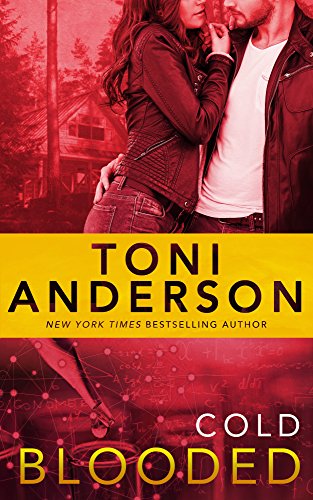
Cold Blooded
I’ve been reading more and more romantic suspense novels of late, and although Toni Anderson is an author who’s been on my radar for a while, for some reason, I’ve not yet got around to reading anything of hers. After reading her guest post here at AAR a few weeks ago, I decided to rectify that, and picked up the latest in her Cold Justice series – Cold Blooded – for review. It’s the ninth full-length novel in the series (which also includes a novella), but I had no problems whatsoever following the story, so I can say with confidence that it works perfectly well as a standalone. I enjoyed the book and would recommend it to fans of the genre; the plot is topical and well-executed, the characters are likeable and while the romantic angle is perhaps more low key than I normally like, it makes sense within the context of the story that this pair would take a bit of time to warm up to each other.
Pip West’s career as an investigative journalist might well be over following the recent publication of her story about police corruption that led to a dirty cop murdering his wife and kids before turning his gun on himself. Devastated and burdened with guilt, Pip has fled her home in Florida and driven to rural Georgia, intending to stay with her best friend, Cindy – a research scientist at nearby Blake University – while she gets herself together and works out what she wants to do with the rest of her life. Arriving at her friend’s remote cabin on Lake Allatoona, Pip is worried when she sees her Cindy’s car outside, but can find no trace of her. Upstairs on the balcony, she sees something floating in the lake and is horrified to realise it’s Cindy. Panicked and horrified, Pip manages to drag the body out of the water and to call 911 – but it’s too late.
Following the discovery of a terrorist cell in possession of weaponised anthrax, Special Agent Hunt Kincaid, WMD co-ordinator at the Atlanta field office of the FBI, has been tasked with reaching out to anyone in the area whose work involves the use of bacillus anthracis. Intelligence suggests that this new strain has come from a US source, so Hunt and his counterparts throughout the US are being alerted and given similar tasks, but given the number of government facilities, universities and biotech companies in the area – including the Centre for Disease Control – the Atlanta office is the first on the case.
Hunt’s first stop is Blake University, where he intends to speak to the staff and students who work with the anthrax virus there. His tour of the department is interrupted by news of the death of a PhD student who had been working on a new vaccine against the virus – and the timing is too much of a coincidence for him to ignore. He heads out to Lake Allatoona where the local police tell him they suspect the death of the young woman – Cindy Resnick – to be drug related. When her friend – the dark-haired young woman Hunt noticed immediately upon arriving at the scene – insists Cindy never took drugs, Hunt takes the assertion with a pinch of salt; after all, this woman found the body and because of that, is currently at the top of the list of potential suspects should this prove to be a homicide.
Pip knows the handsome FBI agent is suspicious of her, but she’s too mired in grief and anger to care. She knows Cindy wouldn’t – couldn’t – have committed suicide and she’s determined to find out the truth, but it won’t be easy. After her last investigation, she’s wary of law-enforcement – and once the local cops find out about her exposé of police corruption, they’re not exactly queuing up to help her either.
Pip and Hunt pursue their own lines of enquiry for the first part of the book, their paths crossing mostly accidentally, each suspicious of the other and very cautious about sharing what they find out. After a journalist stitched him up in a move that almost cost him his career, Hunt has no love for reporters, so he’s not well-disposed towards Pip – no matter that he can’t help the strong pull of attraction he feels towards her. But the more he sees of her, the more convinced he becomes that Pip had nothing to do with Cindy’s death – and Pip finds herself wanting to trust Hunt, even though she knows he subscribes to the police’s theory that Cindy’s death was, if not suicide, then helped along by her use of drugs. But a second death – another scientist and friend of Cindy’s – also thought to be drug related, brings Hunt to the realisation that Pip has probably been right all along and that there’s more to her friend’s death than getting high and taking an ill-advised swim.
The suspense storyline is tightly-plotted and well-researched, the tension building gradually through its various twists and turns until reaching the final chapters, which really amp things up and propel us towards an exciting, high-stakes finale. The romance is more of a slow burn, with Pip and Hunt gradually moving in ever decreasing circles around each other as they slowly learn to shed their suspicions and to work together, but this felt completely right given the circumstances and their past experiences. I appreciated the absence of the over-the-top mental lusting that is so often present in today’s romance novels; Hunt and Pip are attracted to and aware of each other, yes, but there’s never any sense that the plot is being suspended while they mentally drool over one another’s perfect bodies. I liked both characters, although I can’t deny that there’s something a bit stock-in-trade about both of them; Hunt is your classic ‘I don’t do relationships because I don’t like losing people’ type, and Pip is the ‘I had a shitty childhood and now I don’t trust easily’ one. That said though, they’re relatable and engaging, and I particularly liked the flirtatious, playful side Hunt allowed out occasionally. Pip’s grief is very well-handled, too – her sadness and feelings of guilt and uncertainty permeate the first part of the book in a subtle way, and I was pleased to see that she didn’t suddenly recover and start to act as though nothing had happened as the story progressed.
In the negative column though, there are places where the pacing flags and others that feel repetitive, particularly when we’re in Hunt’s PoV and he keeps reminding himself that Pip is a suspect, that he doesn’t trust reporters, and he shouldn’t get involved with her. I still wanted to know how things would turn out, but there were times I found myself skimming to get to the next bit of plot.
Overall, however, Cold Blooded is an enjoyable, suspenseful read, and I’ll definitely be seeking out more of Ms. Anderson’s work.
Buy it at: Amazon/Barnes & Noble/iBooks/Kobo
Recent Comments