Complete Abandon
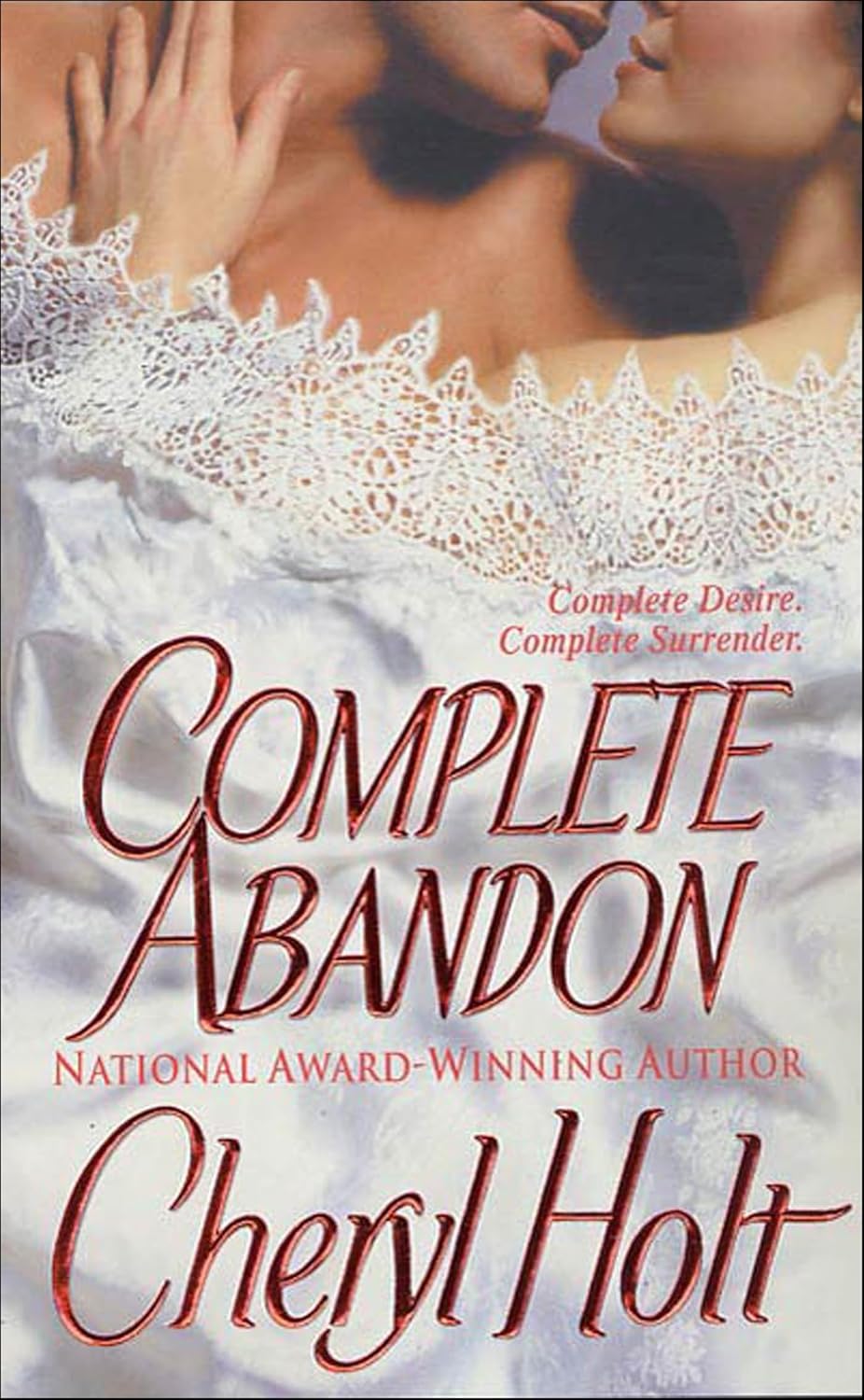
Complete Abandon is one of the most interesting books I’ve read this year. Not necessarily one of the best, but definitely one of the most thought-provoking. Categorizing it is a slippery proposition as it manages to be naughty, funny, over-sexed, and light on the history. At the same time, it features a thoughtful analysis of the problems inherent in a cross-class relationship, not to mention a hero and heroine who are mostly great together.
Emma Fitzgerald, a vicar’s daughter, is persuasive and well liked in her community. Although her father’s death has reduced her family to poverty, Emma is still a force to be reckoned with. The new Viscount Wakefield has come to his manor with an entourage of sleazy guests and a fistful of eviction notices for his tenants. Emma sets out for his home, determined to rid the neighborhood of his obnoxious guests and convince him to allow the impoverished tenants to stay. She marches up to his door, ignores the butler’s protestations that the viscount is not “at home,” and barges into the study, where Wakefield is conversing with his half brother Ian and his mistress.
What follows is a scene so hilarious that I laughed out loud reading it, even though I was in a mall food court. Essentially, Wakefield decides to get rid of the annoying Emma by shocking her. He tells her that the tenants can stay – as long as she performs one sexual act with him per tenant. He knows his insulting suggestion will cause the virtuous Emma to leave in a huff, never to darken his door again. Except she doesn’t. Emma calls Wakefield’s bluff and has him draw up a contract that she pockets. She leaves his house smirking over her boldness (and planning to talk her way out of any actual sexual payment), and Wakefield and Ian are left in the study with their jaws hanging open.
One might expect that Emma and Wakefield would spend time together, banter, fall in love, come up against troubling class differences, and eventually resolve their relationship. This is a romance, after all, and there are only so many courses a book can take. While this is more or less what happens, circumstances unfold in a way that is mostly unpredictable. The bond between Emma and Wakefield is emotional and sexual, and it surprises both of them. Emma is forced to reconsider her own resolve not to sleep with Wakefield and her reasons for associating with him. She is terrified to discover that she is just as vulnerable to love and lust as other women. Wakefield, for his part, also makes important lifestyle changes. He dispatches his tawdry hangers-on and his mistress. He gives up drinking. He counts the minutes until Emma comes through his door. She comes to mean more and more to him, but he can’t see any future for their relationship. He knows that a marriage between them would be completely unacceptable, and he also knows that she has too much pride and self-respect ever to become his mistress. It takes drastic consequences to convince both of them that their love is more important than society’s opinion.
Complete Abandon was a constant surprise. Whenever I’d get frustrated over a contrivance it would be countered by a scene bordering on brilliant. I am not a fan of cross-class romances as a general rule, usually because the hero (and it’s almost always the hero who is the richer, more aristocratic one) comes off like a selfish horse’s ass with no concern for the heroine’s pride or her morals. Wakefield has that aspect to him at first – he repeatedly begs Emma to stay with him, and has no clue that she is destitute and has needs of her own. Initially clueless regarding how those who aren’t rich and pampered live, Wakefield learns as he comes to know Emma and his other tenants. And just when I was at the peak of my annoyance with him, he and Emma share an exchange that provides one of the best analyses of class differences that I’ve ever seen in a romance. They discuss all their problems and agree on the lack of a solution.
Rakish heroes who change their ways are a staple in romance, but Wakefield goes beyond the clichés. His interactions with Emma make him think about every aspect of his life. He changes the less desirable aspects of his character, and he realizes how his behavior affects those around him. There is a very interesting subplot involving Wakefield’s relationship with his half-brother. Ian is illegitimate, and his relationship with Wakefield is characterized by equal parts jealousy and love. Just like the primary love relationship, the relationship between brothers evolves during the book. Emma is no slouch herself. She actually thinks through every aspect of her interaction with Wakefield. Though she succumbs to him, she doesn’t drop her drawers without giving serious thought to the consequences (as so many heroines are wont to do). She seems aware that she lives in the nineteenth century and that extramarital sexual relationships have inherent dangers.
With all this meaty content, why such a marginal recommendation? The happy ending comes after a separation, and the reason that the separation ends is a little unsatisfying. The author relies on a common crutch to reunite the couple, and one wonders if there could have been a happy ending at all without it. And then there’s the language and sex, which is so gratuitous that it eventually distracts. I like a good love scene as much as the next person, and enjoyed many of them here, even if they do border on purple at times. But after a while it all gets to be too much. The characters are so interesting when they are thinking about the problems that divide them and their feelings for each other, but when the bedroom door (or the library door, or at one point, the out-of-doors) opens, everything shifts gears into hyper-sex mode. Most of the words that you wouldn’t say in front of your mom make an appearance, and at first it’s titillating (no pun intended, although the word “tits” shows up too), but then it gets to be silly, and finally boring. Holt also provides a too-intimate peek into the mind of the villain. He’s a pedophile, and while I am fine with the existence of such vile scumbags in literature, I don’t want to be privy to their sick, prurient fantasies.
Still, this book has much going for it. If you can forgive some wallpaper history and get past (or enjoy!) the constant triple X sex, there are some interesting characters and thoughtful interactions that await your reading pleasure.
Recent Comments