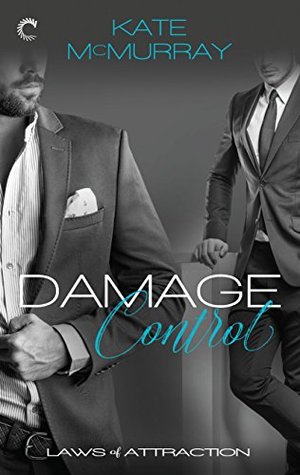
Damage Control
Damage Control is the first book in Kate McMurray’s Laws of Attraction series, and it opens when top defence attorney Jackson Kane is approached by senatorial candidate Parker Livingston to represent him when, as looks likely to happen, Livingston is arrested for the murder of a woman found dead in his apartment. The book is a reasonably well written and engaging tale, but there were a number of issues that kept pulling me out of the story, and there were times when the suspension of disbelief required was just too large for comfort.
Jackson and Parker – Park – have history. They met at college, aged nineteen, and were each other’s first everything; they stayed together for eight years until Park’s political ambitions (and daddy issues) forced them apart. Eight years later, Park is running for the senate… as a Republican. Okay – I’m British, so it’s entirely possible that some of the finer political points in the story passed me by, but basically, Park is a left-of-centre Republican who espouses many of the party’s conservative economic tenets while also believing it has gone off the rails and that change can only be effected from within. But the party and voters will never accept a gay republican, so he’s firmly closeted. Even though it’s a matter of record – and it comes up a few times – that Park and Jackson shared a couple of addresses over the years, we’re asked to believe that nobody, at any time during the vetting process put two and two together and made four? They were together as a couple for EIGHT YEARS. They didn’t ever have friends round for dinner? They never went out as a couple? Setting aside the fact I have a hard time believing that ANYONE would want to identify as a Republican these days, surely someone running for high political office would have been thoroughly investigated?
Anyway. It seems the murdered woman was a socialite whose father is a major donor to the party and Park’s campaign. Fortunately, however, Park has a watertight alibi for the time of the murder, and once that is established, the story turns its attention to trying to find out why the victim was at Park’s apartment in the first place? Did his political opponents lure her there with the intention of framing Park for murder?
Jackson takes the case – almost against his better judgment, which is the second big suspension of disbelief needed; he knows damn well that even though he and Park haven’t seen each other for five years, he’s treading on incredibly shaky ethical ground… but he does it anyway. And on top of that, in spite of his insistence that he and Park maintain entirely professional boundaries, they have sex. Which, obviously, can never happen again. Except when it does. And what makes it harder to accept is that Jackson does it knowing full well what the consequences will be if they’re caught.
“Jackson held up a finger. “We said there would be boundaries. This is a professional relationship. I can’t have a sexual relationship with a client. That’s right at the top of the list of ethical violations. It’s the kind of conflict of interest that could get me disbarred. We had whole classes about this kind of shit in law school.”
The gentleman doth protest too much, methinks.
I did like that Jackson was circumspect about getting back together with Park – and his concerns and hesitation feel natural – and I was pleased that Park at last got to understand just how much damage he’d done by breaking up with Jackson. Even so, the fact that he made such a big decision decision without even consulting the guy he was living with and had supposedly been in love with for eight years made him seem extremely immature and selfish – and speaking of immature, Jackson and Park are thirty-three years old, which seems rather young for where they are in their lives. Jackson was a defence attorney for a while, but moved into financial law and has built up a highly successful practice, in just ten years? And Park is running for the senate at that age?
The suspense plot is lukewarm at best, and the villain is a walking cliché who is identified because of the mistakes he makes rather than any super-duper sleuthing on the part of the police. The secondary characters of Park’s campaign manager, Martha, and Jackson’s most recent ex-, detective Gavin Shaw, are engaging, but not given enough to do, and the two principals are fairly bland, too. They talk in circles, rehashing the same things over and over, and although I quite liked Jackson, I never really warmed to Park. They don’t have much chemistry and I didn’t feel an emotional connection between them; and although they do get their HEA, their political views are so diametrically opposed that it’s hard to imagine them making a life together.
I may pick up the next book in the series, because I’m intrigued by the hints dropped that there’s something bubbling between Gavin Shaw and Jackson’s straight, married business partner, Reed, who may just not be quite as straight and married as we’re led to believe.
I really wanted to like Damage Control, but it’s not successful in terms of either the romance or the suspense plots, and I can’t, in all honesty, recommend it.
Buy it at: Amazon/Barnes & Noble/iBooks/Kobo
Recent Comments