
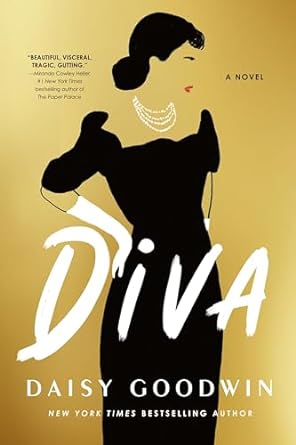
Diva
The real-life dramatics behind the life of opera legend Maria Callas are fictionalized in Diva, which follows the legend from her teenage to her final years. It’s a charming, dishy book that is wholehearted in its sincerity; a very moving look at Callas’ struggles. But it’s also a slice of historical fiction that’s rife with errors. It’s a fun book with a narrative that doesn’t move in a linear manner and definitely provides audiences with an entertaining portrait of the queen of the opera, but it manages to miss the factuality boat in several places.
Maria Callas grew up poor, struggling under the weight of her attention-hungry mother, Litzia, and her cheating father. Litzia favors Maria’s sister, and Maria yearns to please her. When she realizes little Maria has a powerful gift, an audition leads to acclaim, but her father objects to Litzia’s stage mothering. Litzia responds by taking both daughters to Greece.
Maria can never please her mother, but she finds admiration on the public stage. Her début leads to major roles, accolades, and famous friends, and she blooms from an ugly duckling to a svelte, glamorous fashion plate. Soon Maria draws the attention of two men: her unintelligent, socially awkward eventual husband, Giovanni Battista Meneghini, and Aristotle Onassis, a shipping magnate whose passionate affair with Maria threatens the bounds of his marriage, her career, and their mutual sense of sanity.
Diva has some problems with properly placing people and things in the correct timeline. To wit: Elsa Maxwell, infamous gossip columnist, is there to taunt Maria and capture her reaction to the news that Onassis is marrying Jacqueline Kennedy. This is an event Maxwell would not have known about, as she died a good three years before it happened. It’s worth noting that Grace Kelly – portrayed here as a groupie and a rival for Onassis – hated him and was a great friend of Maria’s. And yes, the novel makes grist once again of the rumor that Onassis and Maria had a stillborn baby.
But it’s fiction, and – aside from the bit about the baby, which has been denied by hundreds of Callas biographers before this, and the Grace kelly stuff – she’s really suffered enough – it doesn’t detract enough from the known record to puncture the reader’s enjoyment of the book. At its core, Diva does a fine job of giving one a glossy overview of Maria’s life while also telling us of the joys and horrors of standing in the spotlight.
Diva, like Maria herself, loves the opera and the art of music. But there’s a charm in its conversational nature. It allows the story to unspool slowly, bringing us back and forth in time, lacing in little pieces of facts as it goes along. Some readers might find this storytelling conceit dizzying, but in this case, it worked for me. The opera is worth attending, even if it’s a little cliché. Onassis and Callas’ romance, naturally, is filled with its usual sense of drama and pain, and also takes on a sense of submission and dominance.
The writing is sometimes good, sometimes flat; Goodwin sometimes stretches for effect and ends up delivering cliché. And yet the entire effect is a compelling one. Diva is an entertaining read, even when it goes off the rails.
Recent Comments



Great review! I doubt I’ll read it since I think the historical timeline gaffes would drive me crazy. Hopefully, another novelization will come along that is fabulous and accurate.
I’ve read a couple! Will come back with titles soon.
I read that Angeline Jolie has a movie coming out about Maria called La Divina. Diva sounds intriguing.
I had no idea about this, but now I’m looking forward to it!