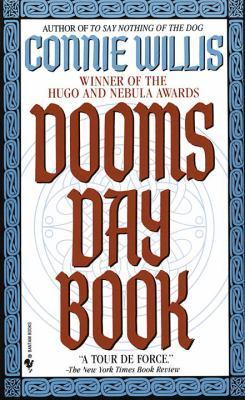
Doomsday Book
When I read Connie Willis’s To Say Nothing of the Dog two years ago, I knew I’d have to read all her other books as well. It’s taken some time, but I finally read the fascinating Doomsday Book, which is every bit as good as TSNOTD, although it is completely different in tone.
Doomsday Book was actually written six years before To Say Nothing of the Dog, and it features the same method of time travel. But While TSNOTD is a light-hearted send-up of the Victorian Era, Doomsday Book provides a somber look at the Medieval period – the fourteenth century, to be exact. The are two principal characters. The first, Dr. Dunworthy, is an Oxford professor, and most of his actions take place in the late 21st century. The other main character is his pupil Kivrin, who against his advice decides to travel back in time to the fourteenth century. Kivrin’s trip to the past is overseen by a professor from a different department who is not particularly knowledgeable about time travel technology, so Dr. Dunworthy is very worried about her.
Dunworthy’s worries are compounded when the time travel net technician, Badri, falls ill immediately after Kivrin is sent back through the time travel net. He tells Dunworthy that something is wrong with Kivrin’s time travel drop, and then collapses. Dunworthy becomes increasingly worried about Kivrin, but Badri’s illness turns out to be a new strain of influenza that causes a mini-epidemic and a quarantine of the Oxford area.
While Dunworthy is trying to discover what went wrong with Kivrin’s journey and deal with the millions of hassles that the quarantine has caused, Kivrin is ill herself, apparently with a form of the same virus that struck Badri. She is nursed by a medieval family and records her observations about them into a tiny recorder imbedded in her skin. Her experiences manage to eerily parallel what’s going on in the twenty-first century.
Doomsday Book contains many plot surprises, so I’m reluctant to reveal much more about it. Overall, it is a fascinating look into the Medieval Era, and it’s full of commentary on historians and their perceptions (right and wrong) about the past. Kivrin’s Medieval England bears little resemblance to the Medieval England of most romances, even though the family she stays with is a noble one. This is fourteenth century England with all of the grit and grime you would imagine – and then some. It’s so real you can almost feel the flea bites, but the family Kivrin stays with is like a modern one in the way they relate to each other. Kivrin makes several comments about the vastness and scariness of the woods that will enhance your appreciation for all the old fairy tales. This is my favorite observation of Kivrin’s, which comes near the middle of the book:
“I’ve been thinking about how you were right, Mr. Dunworthy. I wasn’t prepared at all, and everything’s completely different from the way I thought it would be. But you were wrong about it’s not being like a fairy tale.
“Everywhere I look I see things from fairy tales: Agnes’s red cape and hood, the rat’s cage, and bowls of porridge, and the village’s huts of straw and sticks that a wolf could blow down without half trying.
“The bell tower looks like the one Rapunzel was imprisoned in, and Rosamund, bending over her embroidery, with her dark hair and white cap and red cheeks, looks for all the world like Snow White.”
Since it has literary allusions galore, no one would mistake To Say Nothing of the Dog for a creampuff-light book, but it does have an up-beat tone and a frenetic pace. Doomsday Book is much more solemn, but it is just as engrossing. I had trouble putting it down, and one night I even lost sleep worrying about the characters; I had to keep reminding myself they were fictional! While the plot is certainly well-crafted, the characters are the backbone here. In Kivrin’s sphere there is a young girl named Agnes who will seem delightfully familiar to anyone who has spent a lot of time around children. In the twenty-first century, Dunworthy is frequently accompanied by Colin, the teenage grand-nephew of a colleague. Colin’s use of slang (he calls everything either “necrotic” or “apocalyptic”) and his view of the influenza epidemic as an exciting adventure are reminiscent of teenage boys everywhere.
And there’s so much more. It’s hard to believe that a book that deals with such somber subject matter could also be so funny, but at times it is quite amusing. I especially liked the vivid depiction of infighting and politics at the university. Like six year old children and teenage boys, some things undoubtedly change little over time.
Even if you usually like to stick to light and sunny books, I’d encourage you to give this one a try – particularly if you enjoyed To Say Nothing of the Dog. Doomsday Book is the next best thing to traveling back in time yourself, yet it also presents an interesting view of the future. With its riveting plot and vivid characterization, it is a book to savor.
Recent Comments