
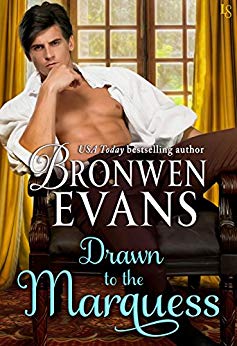
Drawn to the Marquess
Drawn to the Marquess is a unique book with a couple of old-fashioned problems that nonetheless provides proper spice and chemistry between our hero and heroine.
Stephen Hornsby, the Marquess of Clevedon, is nothing more than means to an end for Lady Penelope Fisherton. She is well aware of his rougish background and also that when he was younger he was a spy for the Crown during the anglo-Turkish wars. This is the skill she hopes to tap into, and by way of connecting to him she hopes to buy an expensive painting he seeks to gain at a Sotheby’s auction. Though that bargaining chip slips through her hands, she manages to beguile Stephen and enlist his help in proving her innocence in the matter of the death of her husband, the Earl of Rotham, with whom she had blackened her name by eloping eight years before at seventeen.
Rotham had seduced her in order to get his hands on her land and inheritance and proceeded to treat her poorly throughout their marriage, and has continued to make her life inconvenient by dying under suspicious circumstances. He has left her everything in his will, which buries her under a cloud of suspicion, especially in the eye of her late husband’s brother. The gossip about her has been vicious, and Penelope has avoided London for the last few years, but as soon as her name is cleared, she plans on living happily as an independent widow and never to seek out society again. She is also determined to never again to marry and allow a man to have power over her. So… why should Stephen make her feel differently?
Stephen fights so hard to obtain the painting because he a connoisseur of beauty, and as such, is immediately drawn to Penelope’s loveliness. He is going blind due to a hereditary condition, and is therefore determined to experience every joyful, beautiful sight he can before he loses his sight in middle age, as his father had done before him. Not wishing to pass the condition through his bloodline, he has decided to remain single and not to father any children.
Stephen asks but one thing of Penelope in return for his help in discovering the truth about Rotham’s death – that she allow him to try to seduce her. She agrees to this, but only if the seduction is on her terms. Stephen begins to delve into the mystery surrounding her husband’s death, all the while seducing her with the beauty of art and tempting words. But Penelope remains unbending. The two of them will need to surmount many obstacles, self-made and not, before reaching for their happy ending.
Stephen is amusingly arch and droll, and the author is quite serious about how his blindness has affected who he is. She has clearly done a lot of research into the degenerative condition (most likely macular degeneration) that will cause Stephen’s blindness and skillfully puts it into an historical context. The blind characters (and another main character, Jonathan, has a stutter that is treated with respect) come across like real people instead of moral lessons for the hero and heroine to follow.
Penelope’s bitterness, her suppressed eroticism, and her directness are all delights as well; she does not bend and she does not break, and that’s wonderful to see in a heroine. She has become a proud steward of her lands and has a life that is full.
Our hero and heroine have a steamy and intense romantic bond that is mature and gripping. Any romance that feels like a real, true, actual interaction that might happen between two people is a beautiful narrative victory. This book triumphs that way.
There is one fly in the ointment. Stephen’s insistence on seducing Penelope in trade for his help is a little bit slimy, no matter how the author tries to couch it as a battle of equals. As Penelope herself points out, this is no game, and her life is hanging in the balance; there is no room for sex games when you’re trying to avoid swinging from a noose. I know – it’s a romance novel, and we have to get the sex and romance into the tale somehow, yet it could have been handled more deftly, especially when he continues to focus on pleasure while more serious matters are afoot. And yes, Penelope is yet another Widow-Who’s-Never-Had-An-Orgasm, a cliché I continue to be tired of. These aren’t enormous flaws’; the quality of the romance ultimately subsumes them, and it’s nice to see a man who’s solely focused on the woman he’s attracted to pursuing her with fervor, but a slightly slower pacing in the build-up might have been prudent.
The writing is fun, the mystery is excellent and appropriately twisty (note: mention is made of childhood sexual assault, which may trouble some readers), and there are many endearing minor characters, but my favorites were definitely Dororthea, Stephen’s younger sister, and her loving husband. Evans has an excellent eye for the power and beauty of art, and that translates well to the text. There are some info-dumpy moments which could have been omitted, but which ultimately didn’t spoil my enjoyment of the read.
Overall, Drawn to the Marquess is a great romance with memorable characters. It’s a lovely midsummer read for a moonlit night.
Buy it at: Amazon/Barnes & Noble/iBooks/Kobo
Recent Comments


Yeah, I disliked this book too, though I did finish it. Too many improbabilities and confusing threads, such as the heroine hiring the hero to discover her secrets only to greatly fear his reaction when he discovers her secrets. Also, her secrets implicate rather than exonerate her. Insta-lust and rush to sex and commitment. The sex scenes bored me to tears, not to mention they were mostly in bad taste given the gravity of events happening around them. I did like the themes of blindness and coping with a disability, and that was the book’s saving grace for me.
You actually pointed out a flaw I forgot, how hot/cold the heroine’s attraction to the hero played out. I’m curious what you mean by them being in bad taste – because of the murder investigation situation? ‘Cause yep, that’s why I didn’t give it a full A.
No, actually I had some difficulty jumping from romance and seduction to scenes where the hero’s feelings about suicide and depression were the focus. Those scenes were compelling and intense and needed the rest of the story to match, I thought. It’s rare for a romance to have suicide so openly out there as a significant theme, but I did find the topic of coping with a life-changing disability the best part of the book.
Ahh! That part of it worked somewhat better for me and felt less abrupt.
I tried to start this for the second time yesterday evening. Unfortunately, from the opening scenes at Sotheby’s to the ludicrous conceit that unites the principal couple, nothing – the writing, the characters, the premise – works for me. This is a disappointing DNF.
Aww, I’m sorry it didn’t work for you – I admit I had to suspend reality about how the Sotheby’s auction played out and I found everything else rewarding.
Lisa we usually have very similar reactions to book. I may come back to this one!
Ooh, I hope it’s better for you on the next attempt!
Lovely review. I think I will try this one!
Hope you like it!
Oooh, this one sounds fun and intriguing. I have a long plane trip coming up. This might have to come with me.
I hope you enjoy it!!