
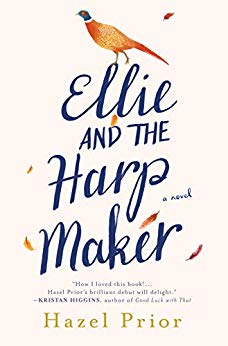
Ellie and the Harpmaker
Ellie and the Harpmaker is, tragically, one of those books that is bound to conjure comparisons with other, better works. While it’s fairly competent and it’s nice to see an autistic character get a beautiful love story, I could only think of more evenhanded, thoughtfully produced books I’d read elsewhere.
When Ellie Jacobs stumbles upon the barn of harpmaker Dan Hollis, she is stunned by the quality of his work. He’s been at the end of her Exmoor lane for ages, but they’ve never encountered one another until now. A convivial afternoon results in Dan giving Ellie one of his harps. It’s a gift her husband Clive doesn’t appreciate – after all, she’s no harpist – and he jealously demands she return it. She does, but Dan is disappointed that she wants to give it back – it’s not money he wants, after all. He insists that Ellie learn how to play the instrument instead.
Reluctantly, Ellie takes lessons from Dan’s girlfriend, Rhonda, whom he calls Roe Deer. While Elle’s not a natural like Rhonda, she does take to the instrument, and with each strum of the harp’s strings, her muted life begins to bloom into full color, washing away the loss of her father and grandmother, the pain of a personality muting marriage, and the fact that her emotionally abusive, cold mother is losing herself to Alzheimers. And it brings to life the possibility that she’s falling in love with Dan. Soon she’s lying to her husband about her lessons and the secret time away with Dan while trying to figure out if Roe Deer is hiding a major secret from Dan. But though the two soon yearn to be together, the increasingly unstable Clive stands in their way, threatening all they’ve built.
Ellie and the Harpmaker reminded me intensely of Colleen McCullough’s Tim. Though Tim and Dan differ in several ways, both novels feature autistic men paired with two older, neurotypical women who must burst through a taboo – a marriage, society’s nasty disapproval – to be with the men they love. I was so distracted by this parallel that it was hard for me to grasp this book, which seems made more to be a big screen weeper than anything else, with a ridiculous action climax that clashes with its simple, soapy melodrama.
Dan is the kind of naïf who’s too good for this world, and things like this often make him feel more like an artificial construct than a rounded human character. He’s the kind of guy who boils coffee just to smell it, then dumps it down the drain. His moderate autism seems to be portrayed accurately to a degree, though sometimes in stereotypical ways.
Ellie is a doormat, and it takes the entire novel for her to realize that maybe her life has been cut off and stubbed to a kind of living death because of her lousy mother and even worse husband. While the book tries to breathe life into her, she’s never particularly interesting. She’s as beige as the clothing she wears. Of course, she has an abusive mother on top of it all, whose wooden cruelty feels inhuman.
The romance is sweet unto sappy, with big, cheesy moments aplenty. The book can’t resist a single melodramatic trope, from Ellie being an amateur poet who writes florid poems about her emotions, to a precious child ultimately drawing the leads together with a cutesy drawing. If you’re in the mood for something ultra sweet you may like this more than I did; though I came prepared for cute I didn’t expect to be inundated with sugar!
The supporting characters are fairly weak. Clive is a super hollow, over-the-top villain and Rhonda has some interesting layers, but the book doesn’t prod at them enough.
The writing is fairly average. People speak in exclamation marks frequently, double-underlining the melodramatic nature of the storyline, and the dialogue tends to feel wooden. The big denouement to the tension between Clive, Ellie and Dan is cartoonish and over the top. Did we really such an overly dramatic element in a novel that’s mainly a tender love story between a married woman and a gentle harpist?
There are a few decent touches, though. I liked Dan’s sister, Jo and I liked Ellie’s friend, Kristen, who yearns to escape her village-bound life as well as the book’s general lean on the importance of instruments and music. But Ellie and the Harpmaker is a little too weak to work on its own as something worth reading.
Buy it at: Amazon/Apple Books/Barnes & Noble/Kobo
Visit our Amazon Storefront
Recent Comments

Maybe it makes more sense in context, but I find it really really implausible that a luthier of any kind would just give an instrument away. *shrug*
To have to buy it, you have to buy the “Dan is sweet and perfect and too good for this world and music just exists to make each other happy” part of the narrative.