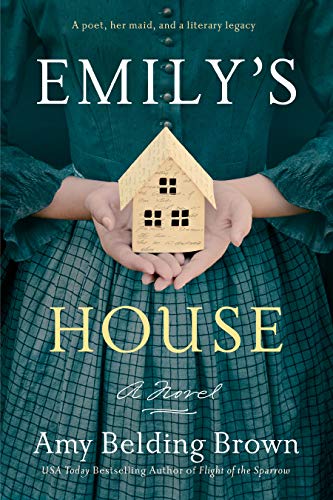
Emily’s House
Emily’s House is a well-observed slice of historical fiction that takes a working-class look into the life of Emily Dickinson and her maid, Margaret Maher…with one large fly buzzing in its otherwise soothing ointment.
Emily Dickinson’s relationship with Margaret Maher has been valorized for years by students of Dickinson’s poetry. A personal maid working in the Dickinson household, Maher became a confidant of Emily’s, and was instructed by her to burn her poems upon her death. Margaret not only refused to do so but actively encouraged Emily’s legacy, keeping the poems in her trunk and preserving them for eventual publication. Amy Belding Brown’s fictionalization of the subject is interesting in of itself; Dickinson and Maher were friends for seventeen years, until the poet’s death, and Maher ultimately never married, dying on her family’s nearby farm in Amherst, Massachusetts. What kept Maher single? Why did Emily trust Maher with her poetic legacy – which she wanted obliterated?
For a fictionalized Margaret in Emily’s House, her employment in the Dickinson house is a practical matter. With no husband on the horizon and her brothers planning on relocating to California and participating in the gold rush there, she plans on making enough money to join them on their journey west and then quit her job post haste. But Emily’s father – known as The Squire – threatens Margaret into staying. It’s not so bad a fate. Margaret comes to like working for the Dickinsons, especially wraithlike Emily, who keeps very much to herself and spends most of her time writing poetry.
Margaret is caught between a yearning for companionship and the surety that life as a housewife is crushing, unpaid labor with no thanks in return; in short, it’s no different from scrubbing Emily’s dresses and cooking her meals. Yet she takes a shine to the roguish Patrick Quinn, and soon finds herself being courted by him. Meanwhile, the all at once cheeky, delicate and mournful Emily begins to see the recently widowed Judge Otis Phillips Lord, and strikes up a romance with him. As history (and the book’s flash-forwards) inform us, both romances are doomed from the start. But what secrets and regrets does Margaret truly hold?
The best thing about Emily’s House is how well it works as a duel character study. Fiery Margaret springs to life under Belding Brown’s pen, filled with longing for her home country, her strong religious faith, and her very human failings and desire for love. Emily, too, is a complex creature – withdrawn, teasing, manipulative, artistic, self-mocking and loving. Their friendship is gentle but intense, and sometimes too close and smothering to be borne.
The narrative never once forgets that Margaret is Irish and thus experienced the hell of the potato famine years and, when she was a young woman, knew men who gave in to those first stirring cries demanding Irish independence (the Brooklyn Dynamite School and the Feanian uprising, two things I didn’t know much about, came up here and captivated me). Emily’s sister, Lavinia – called Vinnie here – is also wonderfully realistic and lovingly portrayed, and Patrick is beery, warm-hearted and charming.
Also charming is the way the author captures western Massachusetts, its landscapes and its social mores, all of which feel true to the time period.
But here’s the aforementioned fly in the ointment. The Emily in this story reads as mainly heterosexual, which flies in the face of the findings of most of Dickinson’s recent biographers. An author’s note from Belding Brown explains that she believes that biographers – both modern and old – have relied upon the papers of Mabel Loomis Todd too heavily. Mabel was the mistress of Emily’s older brother, Austin, and she later sued Sue Gilbert Dickinson for a slab of Dickinson land in the wake of Austin’s death, and between those two dates she translated Emily’s poems for publication. Belding Brown claims that Mabel, in the process of disparaging the hated Sue, inflated her own worth to Dickinson, leading to insinuations that Sue and Emily were lovers, and went about erasing Margaret’s worth out of a grudge due to legal matters. Yet the Sue in her story shows up frequently to sit in intimacy with Emily, and it’s hard to deny such intimate letters written between two women. It’s absolutely possible to contend with a bisexual Dickinson in fiction without making excuses for what you want to write. This reading ignores Sue and Emily’s passionate correspondence. Sue was the one who washed Emily’s body after her death, for heaven’s sake, not Margaret – who does the task in the book.
This complicates the fiction in an unnecessary way, perhaps making Margaret too much of an impassioned confidant to Dickinson. Which again, is fine in fiction, but one shouldn’t make excuses for one’s fiction if you want to push the envelope of reality. Mabel – unsurprisingly – turns up as an Irish-hating snob towards the end of the novel. While most biographers agree that Mabel didn’t like Sue and wasn’t the nicest person, in a novel she could be anything, so scapegoating her with so many bad turns feels a bit much. And who’s to say how close Emily and Margaret were in the end? Maybe Margaret held on to the poems out of her own loyalty to a love of poetry. Maybe she did so to spite Emily’s wish she be wholly forgotten.
Overall, Emily’s House is an engaging read that held my interest, and I’d recommend it for its good storytelling. But potential readers should bear in mind that some of the elements fictionalized by the author don’t quite mesh with some of the commonly accepted and known facts about Dickenson’s life in a way that perhaps goes just a little too far beyond dramatic license.
Buy it at: Amazon, Audible, or your local independent retailer
Visit our Amazon Storefront
Recent Comments