
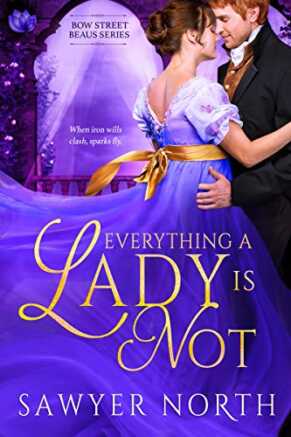
Everything a Lady is Not
The Prologue for Everything a Lady Is Not is, sadly, the highlight of the book. Everything that happens after that was so puzzling that I had a hard time getting lost in the story and enjoying the romance. The idea was appealing but the plot felt like a slice of swiss cheese – yummy in parts but too full of holes!
Eleven years earlier, Lucy (born Lady Margaret, the granddaughter of the Duke of Ramsbury) and her father were set upon by highwaymen. She was separated from her father and saved from drowning by one of said highwaymen – Sir Steadman, the Beau Monde Highwayman. Sir Steadman takes little Lucy back with him and raises her as his ward. But now, Lucy has inadvertently become involved in one of Steadman’s robberies and is being pursued by Henry Beaumont of the Bow Street Runners. She tells Henry her true identity and he agrees to take her to the Dowager Duchess of Ramsbury instead of arresting her.
Fortunately, the dowager is thrilled to be reunited with Lucy. She tells Lucy of a strange clause in her husband’s will:
Should she return and marry someone appropriate and approved by the age of one and twenty, the will settles on her a sum of one hundred thousand pounds. By appropriate and approved they mean born of a British family in good standing with the Crown and in possession of a royally bestowed title, or heir to one.
Lucy is three months shy of her twenty-first birthday. The dowager is determined to meet the deadline (and save the money from ending up in the pockets of the current, much despised duke). The problem is that Lucy has been raised by a highwayman and has little society polish. How will they get Lucy prepared and wed in three months?
And here’s the first swiss cheese hole – the dowager decides the ideal (and only) person to help Lucy make this transition is (drumroll please)… Henry the Bow Street Runner. I can think of dozens of reasons this makes no logical sense – he’s a man, he’s barely accepted in polite society, he can’t teach her the skills a polished lady needs (needlework, an instrument, household management…), he’s a man, he already has a job, he’s not her social equal, he’s not a governess, he’s a man!!! The book offers no explanation as to why this is a good idea. So, we go forward with Henry trying to teach a reluctant Lucy to be a lady worthy of her station and an ideal marriage candidate. But… isn’t she already? She’s granddaughter to a duchess and is about to receive one hundred thousand pounds? She’s hardly unmarriageable.
Poor Lucy struggles with table manners, small talk, dancing, and curtsying. And poor Henry has to teach her everything and keep her spirits buoyed. She also has to deal with visitors to the duchess’ residence who outwardly tease and taunt her (in front of the duchess). Here’s another hole – why would the duchess allow all these terrible people to belittle her granddaughter?
Finally when a handful of suitors arrives to meet Lucy (and for her to choose from) I could only scratch my head at the men chosen. They were all buffoons – one who would use her for political clout, one who would use her money to pay off gambling debts, one who is an unrepentant rake, one who humiliated her earlier in the story, and Henry’s evil brother! Is this really the best the duchess and Henry could offer Lucy?! It would have been much more interesting to see some actual competition for her hand.
The only thing that could have saved this was if the romance between Lucy and Henry had been strong but disappointingly it’s lukewarm. And Henry has this huge complex about being evil at heart when really he just needs to get a spine.
His selfish nature wished to confide his raging attraction for her, and to confess his betrayal. A stream of explanation formed in his mind and nearly crossed his lips.
Nearly.
However, his thoughts again retreated to what his brother would say of his attachment to a woman raised by a thief. Just as I predicted, he would say. From criminal seed grows a criminal tree. Every taunt, every insult, every degradation of childhood flooded his memory and rendered him woefully silent. She glared at him before tears descended her cheeks.
It’s really hard to fall for a hero who struggles with his own self-worth – even after he has proven his worthiness over and over. Frankly, my advice to Lucy would be – go back to Sir Steadman, you’re not getting the money because your would-be-husband is, and if society is anything like it’s shown to be in this book, you’d have a helluva lot more fun as a highwaywoman! Now that’s a book that I’d be more interested in.
Buy it at: Amazon
Visit our Amazon Storefront
Recent Comments

I would’ve whapped this one with a D; sounds extremely uneven TBH.
What a shambles; C- seems too generous. Mr North does not seem comfortable in his chosen genre.
I ended up at C- because, strangely, the writing was good. Usually when I’ve found the plot to be unbelievable, the writing is weak too. Here the writing was fine – it was just a loopy story. A strange combination!
“A strange combination.” Not necessarily. Just speaking for myself, long before I got into the erotica racket, I got a lot of positive short story rejections on the grounds of weak plot/nonexistent plot while simultaneously being praised for good style, pacing, characters, and dialogue. Based on your review, it sounds like Sawyer North might have the same problem.
Sadly, that’s true of about 95% of the newer crop of HR authors. (And some of the not so new ones.)