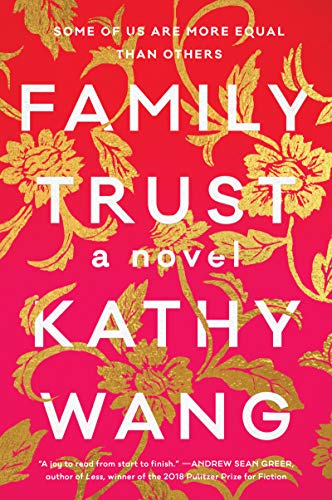
Family Trust
In Family Trust, Kathy Wang introduces readers to the Huangs, a Chinese family living in Silicon Valley and struggling to achieve the ever-elusive American dream. It’s a novel that deals with cultural identity as well as the complicated bonds between family members, and I’m very glad I read it.
For years, Stanley Huang has told the world about his vast fortune. No one has ever been able to pin him down about the exact amount he has amassed, but when he is diagnosed with pancreatic cancer, his family circles around him, determined to get a firm idea of what their inheritance will be.
Stanley’s son Fred is sure a financial windfall is just what he needs to finally make him feel complete. He’s a graduate of Harvard Business School, but his degree hasn’t brought him the kind of professional success he’s always dreamed of. He longs to be one of the leaders of a technology company, but so far, he’s only managed to secure a job as an investor for a low-level corporation. So much of his life, both personal as well as professional, makes him feel inadequate, so he’s pinned his hopes on inheriting a sizable chunk of change from his father.
Fred’s sister Kate hasn’t thought much about her father’s wealth or lack thereof. She’s a manager for one of Silicon Valley’s most prestigious tech companies, and though she once loved her job, it has lately started to feel stale and boring. She does her best to balance her hectic work life against the needs of her two young children and her husband, who is determined to start a company of his own as long as Kate will support him until he gets it off the ground. Most people would say Kate is leading a happy life, but she’s been too busy to give it much thought.
Mary Zhu is Stanley’s second wife, and is twenty-eight years his junior. In the ten years or so since their wedding, Mary has done her best to meet Stanley’s every need. She cooks his favorite meals, gives him foot massages every day, and is always ready to bolster his ego with the praise he so desperately needs. When she learns that Stanley is terminally ill, she can’t help but think all her hard work is finally about to pay off. It’s not that she doesn’t love Stanley, but life as his wife hasn’t been as easy as she expected it to be, and she’s ready to reap the rewards she’s certain she deserves.
Linda is Stanley’s ex-wife, and, to her way of thinking, is the person most responsible for whatever financial success he’s managed to achieve. After all, she was married to him for decades, and she worked tirelessly to ensure her family’s security. She and Stanley have been divorced for more than ten years, and she’s convinced she won’t be personally affected by his death, but she’s determined the bulk of Stanley’s money will go to Fred and Kate. She can’t stand the thought of Mary benefiting from the money that rightfully belongs to her children.
The story is told from multiple perspectives, thus allowing the reader to get to know each of the people closest to Stanley. These aren’t characters likely to evoke warm, fuzzy feelings from the reader, but I’m sure that was a conscious choice on the part of the author. Each one has his or her own very distinct personality, and Ms. Wang does a stellar job showcasing their strengths as well as their weaknesses. I would have liked to have seen a little more of their good qualities, and yet I understand why the author chose to focus so heavily on their flaws. I was able to relate to certain aspects of each character’s personality, even if I didn’t always like them.
I think it’s important for potential readers to know that the novel’s ending is pretty ambiguous. Certain plot points are fully resolved, but you’re likely to be left with a few questions after turning that final page. This might prove troublesome for some readers, especially if you’re a fan of concrete endings. For me, the conclusion rang true, even if it wasn’t necessarily the ending I was hoping for.
If you go into this book expecting a ton of drama and action, you’ll be quite disappointed. Family Trust is a quiet story, relying on the inner workings of its characters to drive the narrative forward. We spend a lot of time in the minds of the various players, something that won’t work for every reader. There were times I felt bogged down by the negativity expressed by certain people, but I came away from the novel with a deeper understanding of what it might be like to live in their skins.
Buy it at: Amazon/Apple Books/Barnes & Noble/Kobo
Visit our Amazon Storefront
Recent Comments