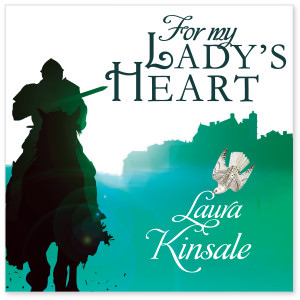
For My Lady’s Heart
Editor’s note: We have added sound samples below the review.
Narrated by Nicholas Boulton
Medieval romances aren’t a great favorite of mine. I will admit that I haven’t read a large number of them, but most of those I have read have been too anachronistic for my taste. Of course, there is going to be a degree of anachronism in any historical romance – after all, we usually read about the titled and the wealthy and not about the miserable poor eking out a harsh existence in the slums – but for me, medieval romances have to gloss over the more unpleasant aspects of their time to an even greater extent than those set in the nineteenth century. The other thing I’ve found frustrating is the language; in having characters who are supposed to live in the fifteenth century speaking as though they come from this one. It’s easier – I imagine – to ape the language used by Jane Austen as it is much closer to the English we use today, whereas a book written in language appropriate to the Middle Ages would probably not gain a huge audience.
But what Laura Kinsale does in For My Lady’s Heart is probably the closest thing I’ve ever come across to finding something that bridges the gap between my personal desire for at least some degree of authenticity in the language used in the story and the necessary compromise towards making it palatable for a contemporary audience.
I’ve read quite a few things about this book which led me to think that the language was difficult to understand – but that really isn’t the case at all, and if you’ve been put off by similar comments, then don’t be. I know the language isn’t authentic – if it was, I’d have been listening to seventeen hours of Chaucerian Middle English and having to rewind frequently to make sure I’d got the gist of what I’d just heard. But Ms. Kinsale has so cleverly interwoven the archaic forms and expressions used by her characters into the text, that they feel completely natural to the modern reader/listener as well as doing more than just paying lip-service to the fifteenth century setting of the novel.
On top of that, however, there’s no denying that her master-stroke lies (once again) in her choice of narrator for this audio. In the hands (or vocal cords!) of Nicholas Boulton, what might, in lesser ones, have come across as quaint “Ye Olde Worlde” expressions, instead sound completely naturalistic and authentic. Spoken passages which might look somewhat clumsy when written down flow beautifully and seamlessly – and I would strongly recommend anyone who found that the language on the page didn’t work for them to listen to the book instead. It’s a revelation and could completely change your view of it.
One device I particularly liked was the way the author differentiated between French (and Italian) and English. When the characters spoke French or Italian, they spoke in what one might term “normal” speech, whereas when they switched to English, the idiom took on its more old-fashioned form.
The story centers around the knight, Sir Ruadrik of Wolfscar and the haughty Princess Melanthe of Monteverde, whom he is escorting from France to her estates in the north of England.
Thirteen years previously, Melanthe had saved Ruck’s life on the day that he had lost his wife (who believed herself to be a religious visionary) and all his money and possessions to the church. As a result, he pledged himself to her and has spent the intervening years making a name for himself as a valiant knight and warrior, eventually reaching the notice of the Duke of Lancaster, one of the sons of King Edward III.
The story is filled with intrigue, greed and murderous conspiracies as the widowed Princess Melanthe walks a tightrope to freedom. She was married to an elderly Italian prince, and since his death, has been closely watched by rival families, the Nevona and the Riata, both of whom want the wealth of the Monteverde. Gian Nevona wants to marry her to acquire her possessions and the Riata want to prevent it. Gian is so obsessed with making her his that he has ensured Melanthe has never taken a lover since her husband died. Any man to whom she showed the slightest favor was instantly killed and he has destroyed everything she loved simply because she loved it. Melanthe is surrounded by spies and assassins, living every day knowing it could be her last, knowing that one false move on her part could lead to death and destruction.
I thought initially that in this haughty princess, Ms. Kinsale had created another heroine who is hard to like, and who, no matter how much I loved the book (and I did love it), I would never feel was completely deserving of the hero. But my opinion changed as the book progressed. On first acquaintance, Melanthe is arrogant and cold, and the tone of voice Mr. Boulton has chosen to use is correspondingly clipped. But it soon becomes apparent that she wears her coldness like a shield. To protect those she cares for, she hides her emotions beneath an icy exterior, not daring to show any preferences for fear of the consequences.
It’s not until she and Ruck are separated from the rest of their party that she finally allows her façade to crack and to notice that her fierce “Green Knight” is a very attractive man. While Ruck has adored her from afar in the courtly tradition, Melanthe finds herself unexpectedly in love and lust for the first time.
Feeling herself to be free at last from the weight of her past, Melanthe is disturbed by these new emotions, but nonetheless keen to act on them. I rather liked that it was she who had to make the first move in the relationship, but that rings true, as the code of Courtly Love put all the power into the hands of the woman.
Ruck is the epitome of the chivalric knight of old; honorable, brave and dedicated to his lady. His life has been arduous – he lost his family when he was very young and though he is of a noble house, the plague that wiped out his family and most of the local populous also destroyed the evidence of his heritage. He has vowed not to reveal his name and origins until he has proved himself worthy of his name. I thought the depth and resonance Mr. Boulton gave to his voice expertly conveyed Ruck’s imposing physicality, while his softer tones clearly showed the intense kindness and compassion that underlay his outwardly gruff manner.
He falls in love with Melanthe when he is seventeen and swears life-long allegiance to her. But he does not know the real woman; he has fallen for an ideal, and when he does finally come face to face with her, she does not know him and is rather carelessly cruel in her treatment of him. Yet she is still his lady – and he is still bound to serve her, even though he quickly realizes that his idol has feet of clay.
I really enjoyed the way their relationship progressed and seeing the gradual power-shift once Melanthe believes herself to be safe from pursuit. She becomes more flirtatious and openly amorous; and Ruck opens up and allows her to see the man beneath the armor, both of which put their relationship onto more of an even footing, even then they still have to navigate through degrees of uncertainty and awkwardness as they try to work out where they stand with each other.
“We wenden us the moment ye are ready, my lady,”
“Dost thou know why I love thee?” she asked.
“In faith, I cannought believe that you do, far the less why.”
She curled her forefinger in his hair and tugged. “By hap one day I shall tell thee.”
Once again, Nicholas Boulton delivers a stellar performance on all counts. His command of the language is obvious and he not only reads the quotes from Chaucer most convincingly, but the archaic English words and expressions roll off his tongue effortlessly, bringing the characters and story to life in a way which exceeded even my – admittedly high – expectations.
Incidentally, this is the first time in these books that he’s used a regional accent for a principal character, and here he convinces absolutely as “a rude and runisch northeron” (man of the north) with a voice that frequently put me in mind of Sean Bean and Richard Armitage rolled into one! Although I confess, I’m probably not going to be able to listen to either of those gentlemen now without thinking “oh – he sounds just like Nick Boulton!”
I fell in love with For My Lady’s Heart, a story of chivalry and romance, told in such beautiful prose that it often brought a lump to my throat.
“Then will we keepen watch and see. And if ye be someone new each morn, Melanthe – God knows thou art still my sovereign lady. Nought will I be at thy side in e’ery moment, but in spirit always, and return to thee with my whole heart, to see what bemazement thou wilt work upon me next.”
While I still think that Mr. Boulton’s performance of Flowers from the Storm is probably his best to date, his reading of For My Lady’s Heart runs it a very close second.
Caz
Recent Comments