Good Riddance
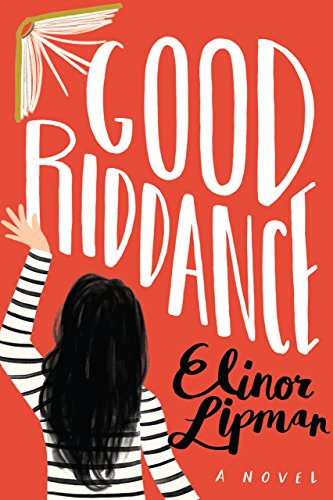
Elinor Lipman follows up Then She Found me with a funny new contemporary romance novel, Good Riddance.
Wannabe confectioner and ex-teacher Daphne Maritch’s late mom, high school teacher June Maritch, had a way with her sharp tongue. And her body wasn’t bad either. In fact the Pickering High class of 1968 – June’s first teaching class – so adored June that they dedicated their senior yearbook, The Monadnockian, to her and invited her to all of their subsequent reunions. That yearbook – filled with the signatures of the class and June’s snarky commentary on the changes and/or lack thereof of the student’s lives next to each picture – was a prized possession of hers, but Daphne absolutely doesn’t understand her mother’s attachment to it, nor does she understand some of the coded messages alongside some of the student’s pictures.
Of June’s two daughters, it’s Daphne who is bequeathed the yearbook via a handwritten note on the back of June’s will, and of the two of them it’s Daphne who has the least interest in it. Determined to declutter when she moves to New York and into a smaller apartment, Daphne dumps the yearbook in the recycling chute of her new building, thinking it reflects poorly on her mother’s character – only to have it scavenged by Geneva Wisenkorn, a wannabe documentarian, frantic chatterbox and notable busybody who calls Daphne after finding the yearbook in their recycling dumpster. She finds the book – especially June’s un-decodable messages – intriguing enough to mill a whole documentary from it. Daphne is aghast at the idea, but Geneva, whose last big triumph was about the last matzo factory in Brooklyn, won’t take no for an answer. She even manages to decode some of June’s abbreviations, which horrifies Daphne – as, naturally, the coded words don’t show June in a very good light.
Geneva insists on accompanying Daphne to the Pickering High Class of 1968’s fiftieth reunion and conducting interviews. Here, Daphne quickly learns that her mother was doing more than giving out As, that her parentage is officially in question, and that her likely biological father is Peter Armstrong, who had an affair with June a few years after graduation and was the man most likely to succeed from the class of ‘68. And Daphne finds herself roped into the life of her ex-husband, Holden, a sex addict who married her only so he could gain access to his trust fund. Her only refuge from the developing circus is her newfound relationship with her cute neighbor, Jeremy, an actor who’s trying to think of a way to break out of his CW mold. As Daphne finds herself dragged into Geneva’s narrative – and into the podcast that evolves from the documentary idea, which begins falsifying its evidence for more hits – more mysteries about June’s past surface, and Daphne must try to get the yearbook out of Geneva’s grip, then decide if she wants to protect her mother’s legacy, sell her story to a TV producer, or try to forge a life of her own.
Good Riddance is an interesting combination of comedy styles. Take the sharp barbs of the Marx Brothers, combine it with the most pathetically eager, fast-talking flim-flamming characters this side of Mel Brooks, throw in some trenchant Woody Allen-esque observations about life in modern New York City and a skosh of Norah Ephron’s heart and you have the book’s final formula. But the end result is pretty original and interesting – sometimes a black comedy that leans heavily on squirmy discomfort, sometimes a touching comedic pastiche, sometimes simply a story of a New York transplant learning how to live like an adult.
Daphne is the kind of person who takes an online course in chocolatiering and does acting classes in an obscure method to prime herself for the starring role in a one-woman play based on her life. You know someone like her; perhaps, in your twenties, you were her – though likely you didn’t have to deal with the upheaval she faces.
Most of the people in Daphne’s life, from Jeremy to her ex to Geneva, want something from her, and are looking to use the yearbook to launch themselves to a new level in their careers. This theme of having double agendas can be a little obvious – though no less amusing – after a while, but I really wanted Daphne to make a friend who didn’t care about nor was influenced by the yearbook. That’s why I enjoyed the presence of her father, the school’s ex-principal who was well aware of his wife’s cheating and is forging a new life with a new girlfriend (who ultimately turns to Daphne for sexual advice).
Ultimately, I ended up feeling like Daphne deserved better than Jeremy, but at least he was honest with her in ways others weren’t, so I was almost willing to give their relationship a pass in the context of the novel. This is a story about cannibalization of the past, and in that, he is the only one willing to be creative in the endeavor and involve her too.
The plot is twisty but the last fifty pages (mostly) peter out of plot with the major conflict resolved, leaving sub plots to be tied up with neat strokes and plot twists that don’t really fit with the resolution of the main plotline. This is a feature more than a flaw, but it’s noticeable and why I can’t give the book a higher rating.
Yet Daphne’s long journey back to her mother – and to forgiveness – is a delightful little trip that’s for the most part quite a funny ride. Sophisticated and bawdy, silly and touching, Good Riddance is an enjoyable read.
Buy it at: Amazon/Apple Books/Barnes & Noble/Kobo
Visit our Amazon Storefront
Recent Comments