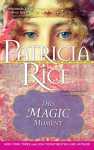
Grand Passion
When I picked up this book, I was familiar with the historical novels of Krentz’s pseudonym, Amanda Quick, and hoped I’d find the same magic within its covers. While on one hand, there is nothing wrong with this book – a fast-paced plot, likable enough characters and definite hero/heroine chemistry – it failed to grab me. There was a lack of depth and description that knocked it down from a B to a C.
A contemporary romance, Grand Passion features cold corporate raider Max Fortune (an auspicious moniker since his sole purpose in his lonely, love-deprived life is to surround himself with material wealth) and scatty inn-owner Cleopatra Robbins, who looks nothing like her namesake and is sick of jokes involving asps. Cleo resolves to inject warmth into Max’s life. From the start, the author sets the reader up to sympathize with Max, who had nightmares as an orphaned child and is scared of his emotions, never having had a close personal relationship in all his years bar with his mentor Jason Curzon, collector of fine art and CEO of Curzon hotels, a worldwide hotel chain.
After Curzon dies of old age, however, Max is on a mission to recover five valuable pieces of artwork that Curzon told him are located at the Robbin’s Nest Inn. It seems that Curzon had been living a double life, pretending to be a down-on-his-luck artist and living from time to time in the attic of the Robbin’s Nest, doing odd jobs for his bed, board and minimum wage. He was apparently drawn to the warm family atmosphere created by inn-owner Cleopatra and her collection of strays. In return for being an honorary member of Cleo’s extended family, he sorted out her leaky showerheads and unblocked the hotel’s myriad faulty toilets. When Max shows up, he believes Cleo is a gold-digging whore who seduced Curzon and stole his paintings. As for Cleo, she thinks that as a friend of Curzon’s, Max must be okay. In dire straits (a full hotel and another blocked toilet) she gives him Curzon’s old attic room and job. Somehow, Max gets sucked in.
Cleopatra and Max soon have what the French refer to as a coup-de-foudre, a moment of intense soul-gazing that signals the start of their intense attraction for one another. Cleo, though in her late twenties, has shied away from men since her parents were killed in what was supposedly a murder-suicide. The plot thickens when Cleo, who has a secret life as a writer of erotica and romantic suspense, finds she is being threatened by someone who is offended by her debut novel. This book is a steamy piece of fiction that contains Cleo’s most fevered imaginings and details her belief that her soul mate is a man in a mirror, who will come for her and she will know him when she sees him. She comes to believe this man is Max.
Cleo is a character whose compassion knows no bounds. She tolerates Max’s insecurity, she correctly interprets his little tantrums and doesn’t blow them into horrible Big Misunderstandings, and the whole “is-she-a-gold-digger?” theme is quickly resolved. Very quickly, Max goes from a lonely ruthless corporate raider to a vulnerable little boy who wears his scarred inner child on his sleeve. It is not long before Cleo has him fully on the road to spiritual recovery and he casts off his life of material wealth to bask in her nurturing glow.
It was hard to put a finger on the essence of what really bothered me about this book. As I say, there was nothing overtly wrong with it, yet it just didn’t resonate with me. One reason is that some of the characters, though bits of them tried to be original, like Cleo’s jazzy sneakers and the bizarre names of the members of the local women’s retreat, were entirely clichéd. We have thumb-sucking five-year old Sammy (one of Cleo’s stray’s offspring) who is always on hand with a cute phrase or two, and lots of cheesy scenes of Cleo’s extended family’s domestic bliss. If I had that many people interfering in my burgeoning love life (they know she’s had sex about two seconds after the deed is done), I’d run away.
I also found that the suspense plot was jaded and predictable, with Cleo’s problems conveniently structured with the purpose of bringing her closer to Max, who of course gets his chance to show us why heroes are, well, heroes. This part of the plot didn’t really stand out on its own, and when their private investigator was absorbed into their “family” and paired off with one of Cleo’s strays, I was nauseated rather than touched.
While I approve heartily of the love-cures-all-ills plot, and I am usually a big fan of novels that include scenes of family or domestic harmony, this book, with its cardboard hero and predictable plot lines, just didn’t have that wow factor for me. It wasn’t bad but it wasn’t great either.
Recent Comments