
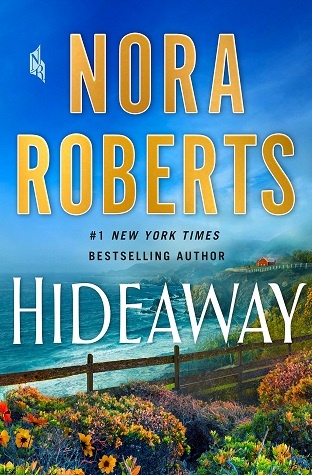
Hideaway
Hideaway is the latest standalone novel from powerhouse author Nora Roberts. It focuses on two families and how one violent act shapes their futures for years to come. While not as dark as some of Ms. Roberts’ previous books, I wouldn’t say this one is for the faint of heart, especially if child cruelty is something you find difficult to read.
Caitlyn Sullivan has grown up as a member of one of Hollywood’s most distinguished families, played her first movie role as an infant, and has never looked back. Her parents, grandparents, and even her great-grandparents are known world-wide, and Caitlyn just assumes her life will play out pretty much the same way.
Unfortunately, when Caitlyn is ten, she is abducted from her family’s ranch, and though she manages to escape before she’s badly hurt, the trauma of the experience will remain with her for a long time to come. The one bright spot in the situation turns out to be twelve-year-old Dillon Cooper who discovers the terrified Caitlyn not long after she escapes her captors. His mother and grandmother help reunite her with her father, and the two families are bound together in unimaginable ways.
As you might expect, the trauma doesn’t end there. Someone very close to Caitlyn turns out to be the mastermind behind her kidnapping, and all manner of chaos results from that discovery. Caitlyn and her father eventually move to Ireland where she can slowly begin to heal from all she’s been through. The road to emotional recovery is a long one, and the memory of Dillon’s gentle kindness is one of the things that helps Caitlyn get past everything she’s endured.
We then skip ahead a number of years. Caitlyn has returned to the ranch. In many ways, she’s managed to put the past behind her, acting in several successful films, making friends, and even dating a bit, but there are those who are unwilling to let her live in peace. Someone out there is determined to make her pay for messing up the long ago abduction, and it will take everything Caitlyn and her family possess to keep this person from succeeding.
One of this novel’s best features is the phenomenal relationship between Dillon and Caitlyn. They met only briefly as kids, but each had a profound effect on the other’s life. When they’re finally reunited as adults, their deep feelings are plain to see, even if neither is immediately sure whether acting on those feelings is a wise idea. They start out as friends, and it’s a true joy to watch that friendship turn to something more. They complement each other so well, and their chemistry is fantastic, even if they don’t act on it until the second half of the novel.
Nora Roberts excels at creating family bonds that feel completely authentic, and Caitlyn and Dillon have amazing families. There’s something so warm and comforting about the relationship dynamics that exist between the various characters. It’s not that people never disagree with one another; it’s more that even in the face of some serious arguments, the reader never doubts the love these people feel for each other.
The suspense is a big part of the plot, but it’s not quite as intense as in some of the author’s previous works. There’s a definite sense of danger that permeates most of the story, but there aren’t a ton of action scenes. The impending danger simmers in the background, and I found myself on the edge of my seat quite a few times as I waited to see exactly what was going to happen. Still, if you’re looking for something filled with a constant parade of danger-laden scenes, you’re won’t find that here.
The identity of the villains is not kept secret for very long. The characters learn who is responsible for Caitlyn’s abduction pretty early on and as a result, the reader is also clued in. In that, Hideaway is similar in style to 2018’s Shelter in Place, although not quite as intense. I don’t mind knowing who the villain is as long as the author can still keep me engaged, something Nora Roberts has always been able to do.
This isn’t one of Ms. Roberts’ most exciting stories, but it is a solidly enjoyable way to spend several hours. It’s full of everything I love about her writing; compelling characters, fabulous tension, and a couple of great bedroom scenes. It won’t make my list of favorite 2020 reads, but I’m still glad I picked it up, and I hope you’ll give it a try too.
Buy it at: Amazon, Audible or your local independent bookstore
Visit our Amazon Storefront
Recent Comments

Hideaway felt like two books in one, with a mismatch in pacing. The predominant story was, in the main, gently paced and family themed. I couldn’t enjoy this story because I was waiting for developments in the suspense plot advertised in the blurb. However, much of the action happened either “off-screen” or in the absence of the protagonist.
Despite that, reading Hideaway provided an enjoyable interlude. It’s one of the rare books I may enjoy more on re-reading, when I can appreciate Nora Roberts’ undeniably skilled writing without focusing on the plot.
I thought this was truly awful! Obviously La Nora knows nothing about what Big Sur is all about geographically and demographically. She turned it into Dallas-by-the-Sea with cattle ranches and movie stars. First off Big Sur is in Monterey county and has only about 1500 year round residents it’s unincorporated and has no urban area, just a collection of businesses some call Big Sur Village. In California there aren’t any “staties” only the California Highway Patrol which is pretty much the only “local” law enforcement for 71 miles from the Carmel Highlands to San Simeon in SLO county. In CA County Sheriffs are elected officials not small town cop surfer dudes and if there was a Sheriff’s office it would be a satellite station like L.A. County Sheriff has in Malibu. In fact if this had taken place in Malibu or Santa Barbara or more logically in Carmel Valley it would have been very believable as is it’s just impossible to digest. There are many many things I take issue with about the logistics in this messily constructed novel and last but not least, Charlotte.What a crock, La Nora obviously doesn’t understand Hollywood either.
It’s possible someone in Kansas who has only seen the iconic pictures of Big Sur wouldn’t notice, but an author should not depend on that and do their research.
I’m routinely bothered when authors get geography/local culture utterly wrong. I just had to stop reading a book by a Canadian author set in Manhattan that got both routinely wrong. It was so distracting–I just gave up.
Yep! A couple of years ago an author set her “canine” romantic farce in San Francisco which is an unusual and challenging city to live in and navigate and she made it seem like a suburban oasis with tons of free parking, it was ridiculous. BTW also a Canadian author.
My mother dragged us kids to Big Sur where we lived for two years in the eighties is reading this book and every few minutes I hear her grumbling “are you kidding me?” We are going to have so much fun “discussing” HIDEAWAY.
I love how authors like Julie James take a city like Chicago and turn it into a supporting character and make me want to experience it in person because she gets it right.
New York is a very specific place and it’s amazed me how big name authors get basic things about it wrong.
There’s something to be said for authors who create fictional cities for their characters to inhabit instead. Because really, if you’re just going to use a city for wallpaper, come up with your own.
Aside from people being able to find a parking place right in front of their destination, my favorite was an author who moved Madison Avenue to the other side of the park so her characters could meet on the corner of Madison and West 86th Street.
Not to be off topic, but does anyone know why Julie James hasn’t published in 2 years? Has she commented on it?
The most recent thing I know of is still this blog post, where she said that she’d been struggling both to balance work and motherhood and to write. At that point, she’d just started trying to write a new book (after previously scrapping two others) and was hopeful that this would be the one that would work out… but this was almost two years ago, and it looks like she’d stopped replying to comments by the end of 2018.
That’s interesting. As an Australian, I’ve enjoyed the sense of place in some of her previous books, although I couldn’t know whether it was accurate. In contrast, her depiction of Big Sur felt generic.
I don’t know “ranching” but I do know “farming” (the Australian equivalent) and her depiction of the Cooper ranch also felt unrealistic to me, with little mention of the ongoing worries and struggles of rural life.
Her books set in Pennsylvania and Maryland are my favourites. She paints a lovely picture of those regions. After reading the Chesapeake Bay Saga I had to go there, and we did for a month and it was as magical as beautiful as it sounded in the books.
The Cooper’s farm was not accurate at all, but placing it in Big Sur made it even more unrealistic.
There is absolutely nothing generic about Big Sur which is incredible, you feel like you’re standing on the edge of the world when looking out at the Pacific Ocean and there is magic there, yet most people just drive through and only stop for a moment, because there are no public toilets or town to stop and visit.
Big Sur sounds like my sort of place. One day, current events will be a memory and I’ll visit the US – and Big Sur.