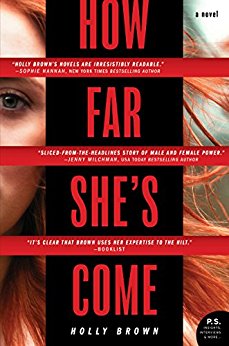
How Far She’s Come
Holly Brown’s How Far She’s Come tries to be a blistering take on sexism in the workplace and society at large, a treatise on intolerance of varied opinions in modern society, and a psychological thriller all in the same breath – but it’s so heavy-handed with the messages it delivers to its audience that it starts to become a little ludicrous.
The improbably named Cheyenne Florian is young, beautiful – and intensely paranoid about how she’s perceived by others. Ever since a series of vlogs she made critiquing the procedures of tribunals in college campus sexual assault cases resulted in a viral firestorm, she’s been trying to lie low. Her original opinion was middle-of-the-road but it was stated in a way that caused her to become a polarizing figure; divided between adulation for her pin-up girl looks and denouncers accusing her of stoking up false statistics about rape, her audience soon became impossible to please. The cyberstalking and harassment that followed drew the attention of a group of trolls (Cheyenne calls them ‘pro rape activists’). Nude pictures and a video were hacked from her phone and then leaked online by them.
All of this gained the traumatized Cheyenne enough interest that several news outlets vie for her services. She wins a slot as a correspondent with news channel INN, thanks to the impression she makes on a powerful, billionare producer.
That admiring producer, Edwin, is determined to make her a sensation on the network and hires her on the basis of her e-fame alone, even though she has no journalism qualifications; she will be molded afterwards, Trilby style, into a perfect co-anchor by him and Albie, his much more feminist co-producer. That requires Cheyenne to move to New York and leave her executive boyfriend Chase and her beloved, cancer-stricken father behind, and plunges her into a high pressure work environment that she tends to see as paranoia-ramping and suspicion-inducing. Soon she’s on one of the network’s most popular programs, with the press and her co-workers vying to take her down.
On her first day with the company, Cheyenne receives a manila envelope with a note and photocopied pages from the diary of a famous activist and former anchor. The note tells her that this is part of her education – and that she should avoid making the same mistakes as its writer.
Reluctantly, Cheyenne becomes involved in the story of the diarist, Elyse Rohrbach. Elyse was on Morning Sunrise, a national news program, and became the show’s final co-anchor thanks to the media frenzy stirred up by an infamous stalking trial. Dodging her resurgent stalker and misogynistic office politics, she begins a love affair with her bodyguard that might cost her everything. The deeper Cheyenne falls into the well of Elyse’s life, the more she learns, the more dangerous her own life becomes as her rise to the top repeats the pattern Elyse lived through.
As the media descends upon Cheyenne once again and the spotlight grows hotter, Cheyenne’s life and Elyse’s come dangerously close to colliding. Cheyenne must fight for authenticity and her true self while untangling the web of corporate intrigue that has ensnared her.
How Far She’s Come tries to amalgamate several different kinds of thriller elements into a casserole of goodness, but the result is rather weak tea. What Brown gets right comes out astoundingly well, from the way female sexuality is used to sell the news to the intense impossibility of pleasing a digital audience in this modern world. What she gets wrong ironically locks the book into a pattern of stock staleness and clichés that it never quite breaks free from, though the intense and pointed commentary will resonate well with readers.
There are many fallen newswomen who have been destroyed by the industry, emotionally, physically or both – from Christine Chubbuck to Jessica Savitch. Cheyenne rarely feels as lively or driven as either of those women – ambition is thrust upon her, then it becomes part of her, like a tick burrowing beneath the flesh of its host. Sometimes there’s a spark of original life to her, but she doesn’t breathe as a fully formed figure until the book passes the half-way point, and she continues to make unwise decisions even after she knows the score. While Brown does an excellent job of chronicling the queasy sense of paranoia one feels when one has been harassed and stalked, it’s both easy to sympathize with Cheyenne (as no one deserves to be harassed) and hard to root for her (her suspicion is so intense that it can be off-putting even if you sympathize with it). Her constant refrain (“how many of these people have seen me naked?”) is chilling in light of how many people in the world find themselves wondering the same thing.
Yet she remains disdainful of female friendship – until she comes to realize the book’s main message, that in twenty years, the world hasn’t come very far at all when it comes to feminism and women in the workplace. That message gets pounded into the reader’s head in poorly-conceived increments throughout the book, ending with a big, grandstanding speech from the heroine that just begs for orchestral backing. And yes, all of the people watching actually break into applause. It’s an example of the book’s tendency to lean on clichés instead of allowing original thought to shine through.
The most interesting supporting character is definitely Elyse, who thrives in her ugly environment, growing up a little more visibly than Cheyenne does. The rest of the characters are a bit cardboard, and the mystery itself is pretty easy to figure out, if you pay careful attention to the details.
The tone of the whole novel is sometimes too breathlessly Sally Reporter: Girl Writer (“…And there I was, swinging with the Elyse Rohrbach!”) to feel like a chilly thriller. Clichés tend to crop up (Memorable example: “I guess you can live small so no one can hurt you, or you can live big.”) and corporate executives use hashtag speech that’s just as cringeworthy as it was when the Simpsons coined the words ‘embiggen’ and ‘edgy-cute’.
How Far She’s Come does get terribly close to making a really provocative point about telling your truth, and it does keep the pages turning in a compulsively readable way. Unfortunately however, it’s ultimately undone by its own reliance on the familiar instead of the shocking.
Buy it at: Amazon/Barnes and Noble/iBooks/Kobo
Recent Comments