
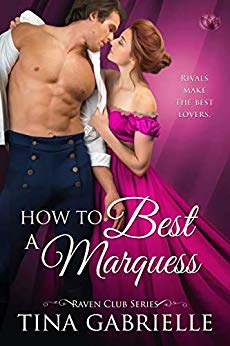
How to Best a Marquess
How to Best a Marquess possesses an interesting storyline and the writing is good, but sadly, the main characters never grabbed my interest and the central conflict could have been resolved with one good conversation. Instead of falling in love along with the hero and heroine, I fell in frustration.
Lady Ellie Swift desperately wants to take over the Raven Club (a gambling den) when her brother the Earl of Castleton retires as club owner. She already works there behind the scenes and, after an early romantic disaster, seeks only to be an independent woman. Hugh Vere, the Marquess of Deveril, wants the club as well. The Earl of Castleton suggests a contest – they should each put their ideas for the club into practice for one month and then see whose ideas are more profitable.
Unfortunately, Hugh is Ellie’s early romantic disaster. At eighteen, they were in love until one night Ellie saw Hugh kissing another woman. It’s been five long years since then and things have changed for Hugh – he unexpectedly inherited his title. When he last knew Ellie, Hugh was the penniless, untitled second son of a Marquess. (Except that no, younger sons of a Marquess have the courtesy title of Lord). Now, Ellie wants nothing to do with the new Hugh – her heart has barely mended and she has no interest in risking it again. She wants the independence the club would give her but she also wants to use the club to help battered wives leave London and start new lives elsewhere. She has already been doing this on the sly and plans to continue her efforts in a larger way once the club is hers. The contest begins and Ellie and Hugh spend the next few weeks in a game of cat and mouse – Hugh being the cat.
Many times while reading How to Best a Marquess, I wanted to lock Ellie and Hugh in a room because each of their interactions is packed with half-truths and misunderstandings. Hugh had his reasons for kissing the other woman (not good ones) but he hems and haws his way around the truth for way too long. And Ellie keeps pretending to herself and Hugh that she is not interested in a relationship with him for a frustratingly long time. I also wanted to just send Hugh packing because if he had loved Ellie since he was eighteen and was really just trying to protect her when he kissed the other woman, then where has he been since he gained his title and why are we told that he’s been with “widows, actresses, and dancers” and “last mistresses”? If we are to believe that he loved Ellie, how are we to reconcile the fact that he did not come to her right away after inheriting his marquisate? We are never told why it took Hugh so long to seek out Ellie.
I wanted to like this book more; the writing is good, the premise could work, Ellie is trying to do something honorable. But in the end I was just frustrated by the main characters, all the unanswered questions, and a story that just didn’t bring anything new to the table. How to Best a Marquess is the second book in the Raven Club series but reads fine as a stand-alone. I don’t think I’ll follow the series as this one just fell flat for me.
Buy it at: Amazon/Apple Books/Barnes & Noble/Kobo
Visit our Amazon Storefront
Recent Comments

This could have been interesting, and there’s nothing worse than an interesting book that gets killed by bland execution.
Also, how often is a title passed on “unexpectedly” to someone? Wouldn’t that require quite a number of people to die before the unsuspecting hero inherits it? During the Napoleonic wars, wasn’t there a custom for oldest sons to stay home to keep that from happening? I keep reading – and reading about – men who out of the blue, due to a lack of male heirs or a whole series of unpredictable deaths become a duke, earl, whatever.
Oh, the “My father and two older brothers all died unexpectedly in the same accident, therefore I am now the Duke” setup. And yet there’s rarely if ever any exploration of the emotional effects of losing so many family members at once.
Yes, exactly. But then they’re usually – and conveniently – very distant relatives that the hero didn’t know he even had!
But of the times when it isn’t, Loretta Chase’s The Last Hellion addresses the emotional fallout brilliantly. I cried buckets just at the prologue!
Thanks for the rec! I’ll check that out.
Exactly – it’s incredibly common in HR. Okay, so I think we all know that there are only so many plotlines out there, so there’s bound to be a degree of repetition if you read a lot of books in one particular genre. I understand that, and accept it – it’s unavoidable. But the best authors find ways to make those similarities and tropes work differently, or they “divert attention” from them by creating memorable characters and situations, and making those characters work within the constraints of the genre (especially in HR because of the restrictions placed on women during the 18th/19th centuries when most HR is set). The point you make about all the unexpected inheritances is yet another in favour of dropping this ridiculous notion that the (mostly American) publishers have that historical heroes have to be dukes or earls or the books won’t sell. Writing about just plain Misters or landed gentry would do away with the need to kill off so many family members!
Here’s to Carla Kelly and her non-aristocratic beta heroes and very different “tropes”!! Indeed, they don’t all have to be dukes or earls, etc. Especially when an author just buggers it up completely and gets the whole thing wrong. A respite from all of the unrealistically huge, overgrown aristocracy would be wonderful.
Oh, do you have any Carla Kelly recs?
Many of her books feature non-aristocratic characters. Marrying the Royal Marine is one of my favourites – it’s part of a series, but works as a standalone. The Ladyship’s Companion, The Wedding Journey, The Admiral’s Penniless Bride, Mrs Drew Plays her Hand are the books of hers I’ve read most recently – and of course the classic Reforming Lord Ragsdale, although that features a Lord (obviously!) Another author I like who writes a lot of non-aristos is Marguerite Kaye.
Thank you!
Lisa – Any of her historical romances, whether trad regencies, those with a Napoleonic War naval connection or her wonderful books set in old New Mexico (The Spanish Brand series) are well worth a read and most live on my keeper shelf.
Thank you Elaine!
*sigh* Another run of the mill historical by an author who can’t be bothered to do any research (esp. about titles).
And – ENOUGH WITH THE GAMBLING CLUBS ALREADY! As if it’s not bad enough that HR London is packed with more dukes than one could feasibly shake several sticks at, pretty much every other building in St. James’ is a gambling club. Please can we move on to something else now?
Here, here Caz!! I concur 110% with the gambling clubs – see below a little blurb about Crockford’s. Generally the clubs were owned and run by people not of the aristocracy. And, ugh, look at the silly, repulsive (virtually generic) cover with the wrong shirt for the era – they did not button up the front but were put on over the head. It wasn’t until the 1870s that a button from neck to waist shirt was patented. Costume research isn’t rocket science! And, besides, it’s fun! Loads of costume museums to enjoy.
Re Crockfords: “The dissolute Regency Period saw the craze of heavy gambling reach fever pitch. William Crockford was one of the most prominent figures of this age, whose incredible rags to riches tale was fuelled entirely by his aptitude for gambling. Beginning his career as a fishmonger, half a century later he had founded the ‘Crockford’s’ gambling club and become one of the wealthiest men in England (worth the equivalent of £95 million today). (from: “London Historians’ Blog – Random musings about London’s history”) Hardly a duke, was he!!!
Please don’t blame the author for the cover. They don’t usually get a say.
Not to mention the trope where the hero and heroine are separated, so she stays chaste while he bangs a bunch of nameless, faceless women to show how sexually potent yet emotionally bereft he is. I’m really tired of this one.
Ugh I hate that trope. “I totally thought of you while I came in this other woman, baby!”