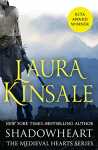
In the Shadow of the Green Line
You know how everybody’s always complaining about the sameness of settings in the books we read? The main reason I decided to read In the Shadow of the Green Line was because it takes place on the Mediterranean island of Cyprus (with nary a Greek tycoon in sight, forsooth). Unfortunately, the book turned out to be nothing more than a travelogue, occasionally interrupted by a suspense story plagued with flat characters and bad writing.
Out-of-work research scientist Alexa Karras is on a trip to Cyprus, her parents’ homeland, to sell off a piece of property for her mother; the family needs the money to pay for her father’s cancer treatment. She’s staying with her cousin Nick and his family, but there’s tension in the air. Nick tried to persuade Alexa not to come in the first place, and now he won’t do anything to help her sell the land. When Alexa meets an old lady from the village, and then a creepy guy named Costas, she gets the definite impression that something fishy is going on in the village, and her cousin may be involved.
Nick’s wife Eve shows Alexa a valuable-looking artifact her daughter found on the beach, and Alexa agrees to take it into the city to get it appraised. Instead, she’s detained and spends a night in jail, under suspicion of trying to steal an antiquity. Once she’s released, she meets an attractive American, Peter, who convinces her to join him as he travels around Cyprus. Somebody tries to run them down, somebody tries to drown Alexa, and somebody tampers with Peter’s car. It becomes clear to Alexa that somebody wants her dead – but who? And why? And who exactly is Peter, and what’s his real interest in her?
It’s painfully evident that this is a first book; as a matter of fact, parts of it read like the first draft of a first book. The pacing is erratic, the writing often clumsy, and the characterization flat. Neither Alexa nor Peter ever really came alive for me, partly because of the insertion of a number of extraneous points of view (Evil Psychotic Villain, EPV’s henchman, police inspector, etc.); the main impression I got of Alexa was particularly unsympathetic. She blames the loss of her job on her supervisor, she doesn’t get along with her mother, she wants to wait until after her father’s death to return home because she doesn’t want to be there when he dies. And she does an incredibly stupid thing: even after she’s convinced someone is following her, she goes out in the middle of the night for a swim and – surprise! – is attacked in the water.
While it’s true that the setting is probably not familiar to most readers, that’s no excuse for stopping the action dead to insert travel-guide passages like the following:
“That afternoon, they visited The House of Dionysius, The House of Theseus, and The House of Aion, discovered by a farmer as he was plowing his fields. The mosaic floors had impressed both Peter and Alexa. Mythological as well as daily life was depicted with the use of the stones’ natural hues. An inscription read: In Vino Veritas. They saw the network of pipes that had been used to carry water to the magnificent bath complex…The village of Omodos was on the outskirts of Platres. It was known for its lace and wines.”
Very interesting, I’m sure, but what does any of this have to do with the story? The reader is also subjected to a mini-treatise on the history and politics of Cyprus, which does play a part in the action (the title refers to the dividing line between the Greek and Turkish territories on the island), but it’s not integrated into dialogue or even an internal monologue. Plunking a civics lesson down in the middle of the story was distracting at best and annoying at worst.
To say that the romantic element is weak and seems tacked on is an understatement. Much of the dialogue is clunky and artificial-sounding. Extremely minor characters are described in unnecessary detail. A lot of important information is conveyed in flashback, so that it loses its impact. And all of this is a real shame, since there’s actually a fairly good story lurking back there somewhere. I want to be very clear about this: it was not the unusual setting that frustrated and turned me off in this book. It was poor execution of the writer’s craft. I wish I could give a better recommendation, in order to encourage other writers to take a chance on out-of-the-ordinary settings, but I just can’t. Not this time.
Recent Comments