
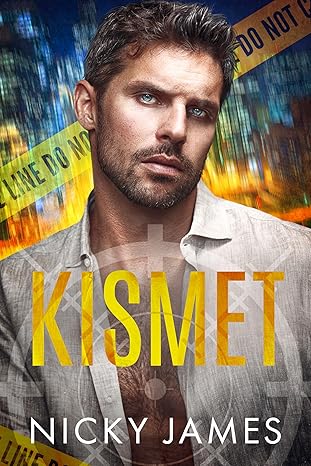
Kismet
While it’s set around the Christmas period, Nicky James’ latest standalone romantic suspense novel is most certainly not a fluffy-bunny holiday story. And then some. Kismet is a superbly plotted emotional rollercoaster of a read that goes to some dark places – please read the author’s warnings on her website – because the mystery is centred around sexual assault (none of it takes place on the page though) and there is a lot of discussion around the subject and some opinions expressed that I’m going to call ‘morally grey’.
It’s actually a difficult book to review, because saying too much about Kismet’s structure and narrative devices would give away big spoilers; I’ll talk a bit about the basic premise and characters, but this is a story you need to experience without knowing too much about it beforehand.
Detective Kobe Haven of the Ottawa PD knows he’s not particularly well thought-of by his superior officers and was only promoted from patrol because of a dearth of other candidates. He’s good at his job – he’s intelligent, observant and perceptive – but he can be impulsive and isn’t always good at toe-ing the official line, so is almost always looking over his shoulder waiting for the reprimand that will get him sent back into uniform. He’s got a rather ill-concealed crush on the city’s new chief pathologist, Dominque Chevalier; their interactions have been minimal but Kobe is well and truly smitten, drawn to the other man’s good looks and aura of quiet introspection.
When Kobe and his partner, Rue, pick up a new murder investigation a few weeks before Christmas, he can’t help the little jolt of anticipation that runs through him when he learns that Dr. Chevalier is the on-duty pathologist and is already assessing the scene. The victim is a man in his fifties whose body appears to have been posed on a wooden bench along a riverside trail; the bruising around the neck indicates strangulaion, but the most striking thing is the plastic spike protruding from his chest, which Kobe guesses has impaled the heart. Attached to the spike is a single white rose, and dangling from the stem is a piece of card with something written on it in black ink. “A heartless bastard.”
Kobe is almost sure the pathologist’s eyes linger on him for a second when he registers his presence, pleased when the other man remembers his name as they greet each other. But a murder scene is no place to try to get flirtatious or personal, so Kobe tamps down his attraction to focus on the task in hand. Dominique is not very forthcoming, insisting that he can’t give any detailed information until he’s performed the autopsy – a standard response, but a frustrating one nonetheless. Also frustrating is that Kobe can’t quite work out if the flashes of admiration he thinks he’s seen in the handsome doctor’s eyes mean that his interest might be reciprocated. He’s never been good at picking up on those types of signals, but he decides to take a risk the next day, and asks Dominique out for a drink – but is no less confused (and maybe a teeny bit disappointed) when the other man suggests they can talk about his findings in more pleasant surroundings than his lab. But it’s not an outright rejection, which is something.
For his part, Dominique is not at all sure he should be getting involved with anyone (let alone someone he works with), but something about Kobe Haven calls to him. Dominque is caring for two-and-a-half-year-old Cosette and is still clearly grieving her mother, and while he adores the little girl, it’s been so long since he’s felt anything deep inside other than exhaustion, emptiness and loneliness that he can’t being intrigued by Kobe, who is such an endearing mix of shyness and sharp intelligence that he finds himself, for the first time in years, wanting to let someone in.
Their romance moves fairly slowly, which makes perfect sense for who these two men are – Dominique, still grieving and needing to focus on Cosette; Kobe, a bit clueless about relationships although aware that his need for security can cause him to push for too much too soon because it’s scared guys off in the past. His uncertainty in his personal interactions is a good contrast with the way he acts in his professional life; although he has insecurities there as well, he’s more confident and authoritative when it comes to his job, good at spotting connections and progressing theories in an intelligent and logical way. Dominique is more enigmatic – the story is told from dual perspectives, but even when we’re in his PoV, there’s an underlying cautiousness that characterises his part of the narrative. Yet somehow, they just fit – two damaged souls looking for connection and understanding, and yearning for the kind of normalcy in their lives that neither has has experienced for a very long time.
The mystery plot is propelled forward when another murder victim is found – this time a young man in his twenties – with a flower spike driven through his penis with a note attached that says “A self-righteous prick”. Kobe suspects that sexual assault is somehow involved, a suspicion confirmed when two more young male victims are found with exactly the same injuries, and he theorises that whoever is responsible for the murders is out for revenge for an assault or assaults that were never investigated or prosecuted. As someone who was a victim of abuse himself (not sexual), he can understand what might be driving the perpetrator to such extremes – not being seen, not being taken seriously, not being listened to when begging for help – so he’s not at all surprised at the idea of a victim fighting back. And if that’s the case, Kobe isn’t at all sure he wants to find the killer.
There’s an undeniable message here about the way victims are still routinely dismissed when reporting sexual assaults and which shows perfectly why so many of them never come forward. It’s an uncomfortable subject and is hard to read about, especially in a world where misogyny is rife and getting worse – but it’s not something that should ever be brushed under the carpet and I’m pleased the author doesn’t do that.
Nicky James has a real gift for coming up with clever, twisty-turny plots, but the final big twist in Kismet is totally devastating in a way I don’t think she’s done before. I admit that I had an inkling of where things might be heading, but I wasn’t completely sure until the reveal – and having suspicions in advance made what happens no less of an emotional gut-punch to read.
She’s also amazingly good at crafting complex, but flawed characters. Sometimes they’re characters you don’t warm to straight away – like Dominique, who is very reserved – and who grow on you slowly; sometimes they’re like Kobe, who is immediately adorable in his awkwardness, with a heart-breaking backstory that makes what he’s been able to achieve all the more impressive in a way that he doesn’t see for himself.
Kismet is a gripping read and one I found hard to put down. It’s a multi-faceted story featuring superbly written characters and a tightly-plotted mystery, and I suspect that when the audiobook comes out and I go back to the story, I will notice things about it that will make me go ‘oh, of course – now I see how/why X’. I couldn’t stop thinking about it for days after I finished it; it’s refreshing to read something that isn’t simple or simplistic that acknowledges that life is rarely black-and-white, and I enjoyed it a great deal.
Recent Comments



I just finished the book and OH YIKES! I did not see the big twist coming. I struggled throughout the book with Kobe’s conflict about whether he wished to actually capture the murderer since the victims were obviously bad people. Comparisons to Nicky James’ Valor & Doyle series are inevitable here and those 2 detectives always stood for justice, even if the victims were villains. This is similar to other detective series I have read, such as J.D. Robb’s In Death series. I’m just used to detectives feeling that their job is to get the murderer and determinations of justice should be left to the court system. In no way could I have predicted how it would all go down in this book. Wow, I think this book will stay with me for a while so kudos to Nicky James and I agree with the grade Caz gave!
Not sure what to think about this. I might need to read a spoiler before I can read the book itself. Is there an HEA, or HFN?
There is definitely an HEA, but as I was writing the review I was thinking of you and that it might be a bit tough going considering the subject matter.
Email me if you want spoilers!
Just finished the book—and phew! that twist…absolutely devastating and it came out of left field for me; but then, looking back, I see that James did give very subtle clues. An excellent book with a bleak, but important, outlook. In a rather oblique way, KISMET reminded me of Taylor Fitzpatrick’s THROWN OFF THE ICE in that both books are rather unorthodox takes on traditional romances.
Yes, exactly! NJ says in her note that you can go back and read it again and realise what she’s going to do – it’s incredibly clever. I loved that it was so thoughtful and painfully honest; stories and characters with this level of complexity are rare in the genre IMO.
I’m just catching up and reading this review and your reference to Thrown Off The Ice DDD pretty much clinches it for me. I’ll be back when I’ve read the book.
Finished it yesterday and I have no idea what to say or how to react. It’s going to have to sit for a bit.
Just started this. SO excited because I just finished Paternal Instincts, which reminded me why and how much I love Nicky. Then, sentence 2: “corpse” of trees. Literal record scratch. I have to put it aside to forget I saw that hahah.
10% in and Nicky’s ability to create a completely different vibe for each of her series is just spectacular.
Yes absolutely – and it’s not something e very author can do.
If the trees are bare-branched (ie skeletal) and creepy then maybe “corpse” is actually the right word, ha ha!
Ha! Love it!
I might have emailed her about that typo actually – but it was pretty close to the pub. date. Hopefully she’ll correct it!