
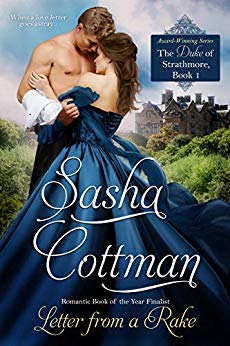
Letter from a Rake
In Sasha Cottman’s Letter from a Rake, Millicent Ashton and her family have recently arrived in London. Her brother is the heir to a viscount and it’s time for twenty-year-old Millie to take her place in Society. However, Millie grew up in India, and as a result, London is foreign to her. Worse, she’s plump, and the story starts with her in a ballroom overhearing a remark about the elephant her family brought back from India.
Determined not to allow people to make her feel miserable, Millie befriends another girl called Lucy Radley. So far so good. Then Lucy introduces Millie to her brother, Alex Radley, the heir to the Duke of Strathmore.
Alex is the handsomest man Millie has ever seen, and even better, he asks her to dance. To her dismay, though, he grabs her hand and drags her on to the floor. Once there, he stands motionless. Realizing what a spectacle this is, Millie tries to talk to him, with no effect. Finally she gathers the tatters of her dignity and leaves, while other couples tactfully dance around the silent statue that is Alex.
If you’re wondering what’s going on, when Alex saw Millie, he was filled with lust. And when he tried to dance with her, his penis “threatened to punch a hole in his trousers”. The next morning, he lies in bed, imagines sucking Millie’s nipples, and gets the biggest erection ever erected in the history of erections. That settles it; he has to find a way to apologize to her. So he sends her flowers without signing his name to the cards, gets her brother to arrange a meeting in the park, accidentally-on-purpose turns up at the museum she visits, and so on.
Around a third of the way through the story, this lukewarm courtship has decided matters for Alex. He is in love with Millie, and she is going to marry him. But Alex is illiterate and ashamed of it, which is how the Big Misunderstanding comes about. He confesses his love to Millie, and despite being just as desperately in love with him, she refuses to take him seriously. Undeterred, Alex starts planning their wedding. Problem is, his family then makes their annual trip to Scotland, so he needs to send Millie a letter, and he asks his brother to write it. Said brother gets drunk and writes a letter to his sweetheart instead, but Alex signs and posts that, so Millie assumes Alex is courting the other girl, and shenanigans worthy of high school ensue.
So much for the plot. As for the characters, Alex personifies the idle rich, but he never comes off as exciting enough to be an actual rake, maybe because he’s only twenty-three and often seems younger. The author keeps telling us that he’s suave and debonair, only to show him as impulsive, gauche and unable to deal with the messes he causes. The one time he defies his father, the Duke compliments him on finally showing some backbone.
Nothing about Millie’s personality stands out except that she also seems too young for romance. At one point, she bursts into tears, so her father comforts her.
James reached out and lifted his daughter on to his lap on the couch. She flung her arms around her father’s waist.
Maybe it’s just me, but I can’t imagine a twenty-year-old woman sitting on her father’s lap. Millie also has the usual ‘not like other girls’ schtick.
There were times she despaired of the females her own age. All they could think of day and night was how they were going to sink their claws into some unfortunate bachelor and his bank account.
India is a distant, exotic locale; it provides a nose ring and the occasional nostalgic moment for its spices and warm weather, but it never influences Millie’s identity, religious views, politics, etc. Oh, and the Kama Sutra is equated with sex.
I downloaded this book because it was free, so at least I didn’t lose any money. Ultimately, Letter from a Rake doesn’t live up to its intriguing title, and when I read “rake”, I expected someone experienced, seductive and a little dangerous, like Rhett Butler. Not a besotted twenty-three-year-old who stands silently while people waltz around him, unable to move because of the Tower of London in his trousers.
Buy it at: Amazon/Apple Books/Barnes & Noble/Kobo
Visit our Amazon Storefront
Recent Comments

God, the hero sounds awful. If he were shy I would give his behavior a pass but “I’m gonna stand here with a boner and humiliate the already socially fragile heroine” is…yikes already. Add in the railroadish courtship and you end up with a resistable package. Just…talk to her maybe? Suave heroes do not do that nonesense with the letter or stand around with their Eiffel Tower Of Arousal in their proverbial palm.
This could’ve been such a nice us-against-society romance! Just eesh. There are so many better ways to show attraction between partners.
And enough with the exotification of Britain’s colonial period, authors!
The hilarious part is that the hero’s father demands an explanation for the dance-floor behavior, so the hero has to confess what happened. I’m sorry, but you cannot be a rake if you’re shamefacedly admitting to your daddy that Moby Dick just surfaced!
Well, maybe he could! He could sit on daddy’s lap and, with his hands around daddy’s waist …………………………… I can’t believe I even thought of that!!! ;-}
Errrr, must be the heatwave we are having. Can’t think of anything else!!!
He tells.
His father.
Oh sweet fancy Moses.
This is downright laughable. I have lost respect for this hero.
“Punch a hole in his trousers”???? Is that supposed to be sexy? :-p
“James reached out and lifted his daughter on to his lap on the couch. She flung her arms around her father’s waist.” That would have the Thought Police and Social Services round in the blink of an eye!. I think you were too generous, Marian. Maybe an F would have been better! Regarding the idea that Millie was not influenced by living in India, it’s probably fair to say that British girls taken out there during the Raj lived pretty sequestered lives, never had to lift much of a finger to do anything for themselves (servants) and tried very hard to import all things, all ideas British and youngsters were generally sent home for their education. From what I have read about the Raj, it was a rare western woman who adapted, adopted or even enjoyed living in the midst of such an amazingly beautiful place and culture. (See White Mughals by William Dalrymple for a wonderful read about it all.) Great review of what looks like a plate of something pretty nasty.
I have been meaning to read the Dalrymple for the longest time. This might be just the impetus to do so.
I read WHITE MUGHALS while doing research for my last book & I thought it was pretty questionable. The author clearly did his research and his data seemed both solid and comprehensive–but he was also writing from the perspective of a British man trying to better understand his Indian great-grandmother (?? I think? I don’t recall the actual family relation). The whole time I was reading I had a feeling that he was wearing several layers of rose colored glasses.
I was glad I read it, I wouldn’t exactly warn anyone AWAY from it, but add a pinch of salt maybe?
AH!! Thank you for this. I am glad Dalrymple isn’t racist like Kipling, but perhaps, yes, I can see his “lens” being unsympathetic or overly rosy by turns. I’ll keep this in mind.
It’s difficult to tell whether the heroine of this book led a sequestered life in India, because she enjoys chai tea and mehndi, reads the Kama Sutra and wears a nose ring. So I didn’t think her parents insisted on only British customs being followed. But this also gives me the impression that the author cherry-picked some pretty aspects of Indian culture, and ignored everything else.
It looks like there’s a veneer of exoticness associated with the heroine’s exposure to India that she promptly forgets when she returns to England.
You do manage to pick ’em! The Tower of London comment was so choice, I had to use it in today’s tweet for the review! :P
“…unable to move because of the Tower of London in his trousers.”
I laughed out loud when I read that. Marian, that is the epitome of fake-rake-hood in current HRs.
WHY do authors include India in their books set during the British Raj and then have them be cluelessly racist? How can one grow up in India and not be influenced at all?
And, oh, of course! Those natives always threw the Kama Sutra and exotic sex moves at every white Britisher. I think you should do a blog article on AAR about what the Kama Sutra really is.
“How can one grow up in India and not be influenced at all?”
Perhaps authors who write like this have lived in the same country all their lives, and as a result can’t put themselves into the mindset of someone who grew up in a very different place? I left the Middle East when I was eighteen, and now I live in Canada. Even after I got Canadian citizenship, though, it took me years to get used to voting, because that just didn’t exist where I grew up.
Glad you like the review!