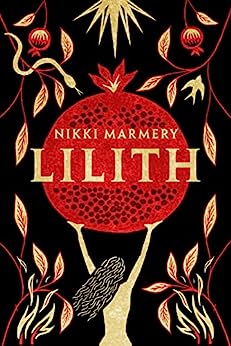
Lilith
Lilith is many things in a single overstuffed package. It’s an overly-modernized take on the tale of the Bible’s first rebellious wife; it’s a cry for goddess worship that works and ought to be heard. As a Catholic schoolgirl who grew up on Tori Amos’ Mary Magdalene worship and ‘we both know it was a girl back in Bethlehem’, I found this appealing. Nikki Marmery does take our fallen heroine past Eden, helping her find true love and giving her many immortal years through which to live as she tries to restore the feminine half of the universe, but the book’s wildly uneven tone and sometimes antiquated ideas made for slow reading. This is a novel in which Lilith both sadly laments her son’s imprisonment in hell – and makes snarky remarks about the size of Adam’s package.
You know the story of Lilith, but perhaps not this story of Lilith. She is created to be Adam’s wife, things are equal in the garden, all is well until he wants to subjugate her. He rejects her, and she leaves Eden to wander alone. Or so you would think. Instead, she discovers her own power thanks to an encounter with the Tree of Knowledge, and thanks to its intelligence, she imbibes the existence of Asherah, God’s feminine half, also exiled from the heavens. Lilith thinks she has the perfect solution to her problem – she’ll liberate Eve by tempting her into eating from the Tree of Knowledge, restore Asherah to power, and finally ascend to paradise. But life’s much more complicated than that.
Lilith is kind of like a feminist take on Orlando or Forrest Gump. Yes, really. Due to the character’s immortality, Lilith gets to travel through history trying to spread the word of Asherah through the ages, only to be constantly stymied by the sexism she encounters. But why in the universe is she a bystander to so much of her own narrative? Worse, the tone of the book swings wildly between light-hearted farce and serious, emotional scenes. Lilith’s anger is justified in many ways, but all of the male characters are cardboard, sexist, bad guys, with the exception of the big JC, for the most part, and the one Lilith comes to love, whose name I will withhold as it’s a spoiler.
This is also a very Christian telling of the Lilith story; God is an omniscient, loud voice, etc. I would be remiss in avoiding mentioning Lilith’s frequent equation of menstruation with womanhood and childbirth as the ultimate power of women, which will not sit well with a number of readers and felt discomforting to me, in particular. The whole thorny ‘to create life is to be superior’ notion is floated here. If that’s not your bag, avoid this book.
In the end, it’s the sloppy tone that keeps this take on Lilith from singing, or living up to its full potential.
Recent Comments