
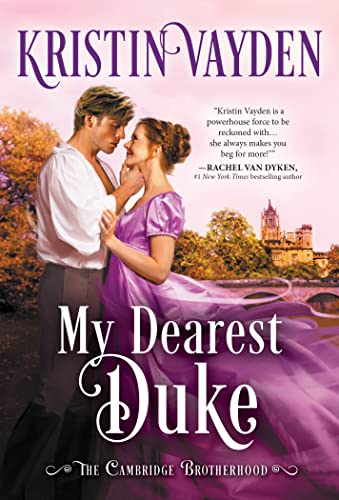
My Dearest Duke
My Dearest Duke feels like an old skool romance without the old skool sex. Its gothic-but-realistic for the era treatment of mental illness, and its dramatic spy-related plot would feel right at home in Ye Olden Days. That is not an insult to the book’s quality. But the end result is just all right – competently told but not stunning.
Lady Joan Morgan bears a secret – she is working as a handwriting analyist for the Home Office. Codenamed ‘The Saint’, Joan is an orphan who resides with her only living brother, Morgan. At the age of nineteen, she re-enters the marriage mart in order to better provide a cover for her work, but quickly finds herself becoming more and more deeply entrenched in her brother’s.
Divinity scholar Lord Rowles Haywind struggles with the rumors that circulate about his mother’s persistently poor mental health. Those rumors have dogged him into the marriage mart, where he is a less-than-stellar prospect. He’s also worried he’ll inherit his mother’s affliction and that any child he has will also be subject to it. But the decision is taken out of his hands by the death of his brother, which means Rowles inherits the family dukedom.
Joan and Rowles knew each other when they were younger (Rowles and Morgan are close friends), and Joan begins to develop feelings for Rowles as he makes social calls upon Morgan. When Joan’s connection to several bluestocking groups hit the scandal sheets, Rowles shows her great – if awkward – sympathy, and when Joan becomes emotionally involved in a case at a local foundling home, involving a child bearing the surname Agneau, he offers his support. Slowly but surely, they proceed toward matrimony. But Joan withholds information about her spy missions from Rowles, and Rowles deals with his mother’s condition alone. Eventually, their secrets emerge into the light.
The Achilles heel of My Dearest Duke is its meandering nature, which is punctuated by dramatic moments of violence or derring do. Some readers will enjoy several long interludes where Joan learns all about what happens at a local foundling hospital and her passionate belief in doing more Good Works, but for many historical romance fans it will feel like a rehashed plot they’ve seen may times before; generally, it feels like the reader is being subjected to an educational film strip instead of a romance novel. It exists in the book to show that Joan is a Good Woman and to connect her to the foundling whose last name so disturbs Morgan. To be frank, we already know that about her because she’s putting her neck on the line for England and the Agneau plotline could’ve been accomplished with less padding. This leads to a genuinely surprising revelation about Joan which is revealed late in the story.
The most interesting part of the book revolves around Joan’s spying. The tandem she makes with Morgan proves to be quite formidable, and though it’s clichéd to watch her pose as a groomsman to get intel, she nonetheless is very competent and fun to watch in the field. When Rowles finally gets involved in her mission, things really begin to roll. Both Rowles and Morgan completely respect Joan for her skills and mind, which is a refreshing delight to read about.
Rowles is the most woebegone creature I’ve read in many a romance novel, absorbing his mother’s rants and abuse in good patience while fearing that some day he will become bedbound and grief-bound as she is. Everything about the plot related to his mother is melodramatic, from her violent bombast to her off-page suicide, which is slow and eventually successful. Rowles understandably gets his strength from studying scripture, and he is a kind, reasonable, and patient man; he sometimes comes to life in the presence of Morgan and Joan, which is nice.
The romance between them is initially a very polite, restrained one, made of passionate waltzes and gentle courtship. But genuine steam develops between the couple over time; these are the most heated kissing scenes I’ve read in a ‘closed door’ romance in many a moon, and to keep things G-rated, I’ll simply say that the kissing is surprisingly, well, French for a book that goes into great detail about Regency-era funeral liturgy, and there’s a fairly spicy-for-a-no-on-page-sex-romance epilogue that strongly hints at how passionate the marriage is (somehow, implied carriage sex turns up even in wholesome, FTB romances, to my amusement). I especially appreciated the trust that Rowles has in Joan.
I truly liked Morgan and I sense that his might be the next book in the series. Maybe that will provide a better all-round read than My Dearest Duke.
Buy it at: Amazon, Audible or your local independent retailer
Visit our Amazon Storefront
Recent Comments



Her last name is Morgan, and her brother’s first name is Morgan too?
Also, she’s a nineteen-year-old handwriting analyst? I wonder when she first began training in this field.
The handwriting analysist part actually makes sense: