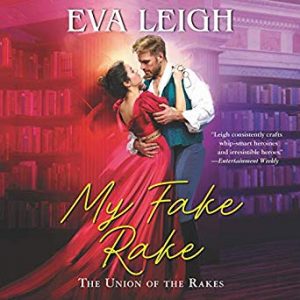
My Fake Rake
Narrated by Zara Hampton-Brown
Lady Grace Wyatt, the daughter of the Earl of Pembroke is a 26-year-old herpetologist (one who studies reptiles and amphibians). She’s regarded by society as weird and, somewhat surprisingly, considering her parentage, not seen as desirable wife material. She has largely withdrawn from socialising with the ton and spends most of her time at a specialised private library. She does have a crush on Mason, a naturalist and the son of a viscount but he doesn’t see her as anything other than a colleague. In a plan to get Mason to notice her, she enlists her friend, anthropologist Sebastian Holloway to be, as the title says, My Fake Rake – on the basis that if she’s attracting attention from a rake, then Mason is sure to notice her as a woman at last.
The irony is that Sebastian has a crush on
Grace and she hasn’t noticed him as a man before.
The book is misnamed however. Sebastian,
crippled with social anxiety, does not ever become a rake, fake or otherwise.
He does become a man about town who impresses the ton greatly but he’s not at
all rakish. He doesn’t drink or gamble to excess and he is not a womaniser. I
kept tripping over the description, used all throughout the book, of him
learning to be or actually being a rake. He just wasn’t.
However, as Sebastian begins his “rake
training” he and Grace spend a lot of extra time together and she begins to see
him as a man and a desirable one at that. It’s true that most all of what I
know about the Regency is from romance novels or the BBC’s Pride and
Prejudice (and various other Jane Austen adaptations) but it was a little
unbelievable that Grace was so unaware of the behaviours society required of a
ton gentleman.
Big Misunderstandings are my least
favourite trope. I much prefer when main characters communicate openly with
each other. The entire conflict in My Fake Rake is built on neither
Sebastian nor Grace telling the other how they really felt and constantly
misconstruing each other’s words and actions. For me it quickly became tedious
but I know there are listeners who think of a Big Mis as catnip so I’m
obviously (as it turned out) not the target audience.
I did like that the Regency England of this
book was far from all white and homogenous. The book was a great example of how
easily diversity could be included in a story. I did think both Sebastian and
Grace were a little anachronistically woke but I’m not going to complain too
much about it; their sensibilities closely match my own, after all.
For some reason I expected My Fake Rake
to be sexier than it was. There were only two sex scenes – both frank and
earthy but it was by no means an erotic romance. That’s not a complaint – the
sex fit the story – I just needed to recalibrate a little.
The narration by Zara Hampton-Brown felt a
little slow. Perhaps that is me being unduly influenced by the text – I found
the story slow as well a lot of the time; more of me being impatient with the
frequent misunderstandings – but I also felt that Ms. Hampton-Brown’s pacing
was a little too measured, increasing my feeling that the book ambled to its
conclusion.
The character voices in the performance
were good; perhaps the male cast could have sounded a little deeper, but they
were well-differentiated enough that I didn’t struggle to identify them and I
thought the emotional tone of the story was apt.
There were also some curious vocal/editing
errors – at one stage there was reference to a “dee-butt” (instead of the
correct pronunciation of “debut”).
I expected a conflict to arise with
Sebastian’s status as the son of a wealthy industrialist. His father had
severely limited Sebastian’s allowance in pique at his son not entering into
the family business. So, even though his family is rich, Sebastian is very much
not. And Grace is the daughter of an earl. But it wasn’t an issue and that
puzzled me. I wanted there to be at least a conversation about it. After all,
one of the reasons Sebastian didn’t press his suit from the beginning was that
he thought she was far above his touch.
I enjoyed the somewhat unusual careers of
the protagonists and I liked Grace and Sebastian as characters, but I would
have liked more energy in the book – both from the narrator and the text itself
– and less misunderstanding.
Recent Comments