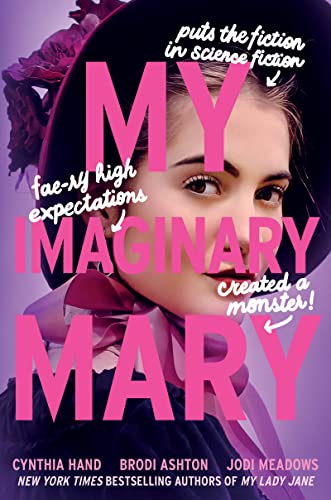
My Imaginary Mary
My Imaginary Mary is fun, fizzy and completely off the wall. With it, Cynthia Hand, Brodi Ashton and Jodi Meadows add another volume to their Lady Janies series – and nope, it’s not about Marie Curie as they’d previously said it would be, it’s about Mary Shelley and mathematician Ada Lovelace, who shares the narrative with Mary. As wth their previous efforts – which have included fantastical retellings of the worlds of subjects as disparate as Calamity Jane and Lady Jane Grey – this series takes these real-life women to new locations and into different, often supernaturally-influenced situations. In this case the authors play with time. Those looking for a realistic depiction of Mary Shelley’s life will not be satisfied, but goth-leaning teenagers looking for a lighthearted summer read will be delighted.
In the novel, Mary Godwin, her father, her forward stepsister Jane Godwin – who plans to enter the world of acting and change her name to Claire Clairmount – and stepmother attend a house party at Mr. Babbage’s, planning to be enlightened by a night of mental stimulation. Over the course of the stormy evening, Mary meets the henpecked daughter of the infamous Byron and protégé to Babbage, Ada Byron, as well as Percy Shelley, a tempting poet-to-be whose status as a rich heir keeps him out of Mary’s reach. The group watches magician Giovanni Aldini perform a parlor trick using electricity, causing a dead frog to bounce back to life – for real, and much to his astonishment. This inspires the first creative impulse in Mary, who seems to be called to writing.
Mary and Ada’s friendship, developed that night, only grows stronger when there’s a sudden knock at the back of Mary’s wardrobe as she writes. She learns that the wardrobe has a concealed door within it. At the other end of the knock is Ada’s former governess, Miss Stamp – who is Mary’s fae godmother. (In this world, the fae are ordinary people who are gifted with extraordinary magic). The two girls learn that they have fae gifts – and will be tutored together in secret in the art of magic in the Byrons’ attic. Mary then figures out that the frog coming to life was a side effect of her fae magic. Meanwhile, she and Shelley agree to write together.
Ada worries about her future as a possibly unmarriageable heir of Byron and that she can never live up to his legacy as the most enchanting fae of all. Ada turns her attention to creating a simple automaton that will change the whole world. PAN – Practical Automaton Number One – is the result of Ada’s careful calculations, and while it can do any task she has programmed it to do, it doesn’t live and breathe. At least until Mary applies fae magic to the creature. Suddenly he is a technological marvel, completely autonomous in emotion, reasoning and behavior. But Aldini wants the girls’ magic all for his own, and soon Pan and Ada are on the run – and only Mary and Claire can help them. Will Mary be able to save Pan and Ada, will Ada be reunited with her father, and will Mary and Shelley’s partnership go awry?
You may know some of these answers thanks to your knowledge of literary history, but I assure you, you’ll have no idea about the world waiting for Ada and Mary. My Imaginary Mary employs modern language, fantasy and a magical road trip to create a brew that’s fast, funny, unruly and enjoyable. Sometimes it gets a little too chirpy and self-knowing, but mostly it’s a fun and quickly-paced ride.
The two girls are delightful. While Mary yearns for adventure and romance beyond her grey little home and meager life, Ada just wants to be good enough to live up to the Byron name and get away from her smothering mom. The fae magic they possess often seems like a bane instead of a boon; people desperately want to use them for their magic and will do anything to get to it, making their lives treacherous.
There are some unexpected romantic twists and turns here, and the book centers itself around the way the two women develop their skills as an author and scientist.
And yet there is one simple problem with My Imaginary Mary, which is its sometimes overly-meta commentary and asides. There are some egregiously twee moments (like Mary saying “oops, I did it again” after bringing Pan to life for the first time) that definitely grated. But perhaps teenagers will find these tiny asides less annoying. In any event, the book lands a recommendation for its worldbuilding, wonderful characters and sense of creativity.
Buy it at: Amazon, Audible or your local independent retailer
Visit our Amazon Storefront
Recent Comments