My Lady’s Temptation
Sir Josce FitzBaldwin, illegitimate son of Lord Haydon, has vowed to avenge the murder of his father and sisters. He blames Reiner du Hommet, the incompetent sheriff of the shire where Lord Haydon was fatally attacked. Josce tells Reiner that if the bandits aren’t caught in a fortnight, he (Josce) will avenge himself by killing Reiner.
Josce doesn’t realize at first that Reiner isn’t actually incompetent. Along with his bastard son Adelm, Reiner is the leader of the band of outlaws who murdered Lord Haydon and his two young daughters. In his villany, Reiner offers Josce hospitality at his house, hoping that Josce will seduce or rape his daughter, Elianne. This part of Reiner’s plan didn’t make a whole lot of sense to me, but it did serve to throw Elianne and Josce together.
Josce distrusts Elianne, who may be the spy for her wicked father. Elianne is terrified of Josce. In this atmosphere of fear and hatred, Elianne surrenders her long-guarded virginity to Josce. They’ve known each other for – maybe – two hours.
The plot about Reiner and Adelm’s villainy is complex – so much so that I cannot begin to summarize it. The characters of Josce and Adelm stand as mirror images: both bastards, both have been forced to make their way by strengh, skill, and cunning through a society that is prejudiced against them. Hampton has obviously done her research as well: this novel is filled with interesting insights into medieval culture, especially the financial necessities that underlay life in manor and priory.
However, the pacing of the entire book is awkward. The first hundred pages of the book are slow. Those hundred pages cover the approximately two hours before Josce and Elianne have sex. During that period, people can’t have a conversation without being interrupted by paragraphs and paragraphs of thoughts, reactions, and internal musings, not to mention loads of information about the economic reasons for the location of the flour mill, for instance, and how letters of credit might be used in place of currency. Also, during that hundred pages, we are told, in exhaustive detail, what Reiner and Adelm are up to and that Adelm plans to betray Reiner. I thought it would have greatly increased the tension and interest of the book if these details had been given out slowly, as Josce and Elianne figure them out. Instead, we watch them puzzling over things that we already know.
Josce and Elianne’s first tryst seemed incredibly abrupt and unlikely to me, and the subsequent growth of love and trust between them was rapid beyond belief. Neither character ever came to life at all, and I felt distant from them and unengaged by their emotions. Compare this to another medieval I read recently: The Marriage Bed by Claudia Dain. For all I know, that book could be completely historically inaccurate. But because the characters in it are so vital and real, the entire book comes alive. In My Lady’s Temptation, the only character who has that vital spark is the curiously sympathetic villain, Adelm.
I wouldn’t say that Hampton’s prose is purple in the best PPP Contest style, but it is flowery and sometimes it brought me up short. For example, at least six times in this book Josce’s lips “slashed” across Elianne’s. To me, “slash” is a word that completely fails to describe what lips do. Numerous times threats and curses are “spewed.” The word “ache” is used to describe three separate sensations on one page (grief, the need for vengeance, and the feeling of having ridden a horse for too long).
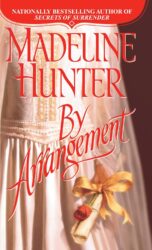
It’s quite possible to write a medieval romance that has a well-thought-out plot and is also historically detailed; anyone who’s read Madeline Hunter can attest to that. While My Lady’s Temptation is certainly rich in historical complexity, I found the experience of reading it to be unemotional and dull.
Recent Comments