
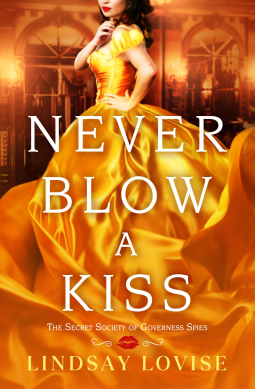
Never Blow a Kiss
Never Blow a Kiss is a contemporary romance in historical clothing. If you hate this kind of thing, that’s enough to warn you off of the book before parting its covers. But underneath those covers is a pretty amusing story. It’s just not a very historical historical romance.
Emily Leverton was not meant to be a governess, but to keep her mission intact, she’s willing to pose as one. Emily is not graceful, ladylike or gently-born. Her name isn’t even Emily Leverton – it’s Esther Lewis, and Esther’s past is something she’d like to keep buried. What she is good at is teaching spycraft, which is why she’s been recruited by a network of governesses who secretly spy on the ton for for the mysterious Dove. But Emily (I’m calling her that as that’s the name the author uses) won’t be able to do that for very long, since someone’s threatening her over her long-buried past.
Enter Zacharia – Zach – Denholm, a butcher’s son and former soldier who now works for the recently formed Metropolitan Police while dealing with the ton at night as a newly-wealthy railroad magnate. Emily, heaven help him, has intruded upon his latest murder case, but he also wants her for his own. Her sauciness immediately intrigues him.
Emily and Zach are forced to team up to suss out the threat coming for Emily’s neck. Now if they could only keep their hands off of one another…
This is Lindsay Lovise’s first novel, and every first novel has its own humps to overcome – chiefly that this is one heck of a wallpapery historical, complete with Emily asking Zach if hair is his “fetish” during their love scene. Never Blow a Kiss feels a little like a modern romantic suspense story with a couple of petticoats and coaches here and there. Also would someone in 1838 England know what a noodle is? Because Noodles is Zach’s nickname for Emily, and well…
The book does have some virtues, however, which are Lovise’s snappy writing and her enjoyable characters. There’s also some fun suspense to be had with the central mystery, and some decent supporting characters. The mystery percolates along with a decent amount of steam and a sense of humor. It’s a moderately gripping, ahistorical tale with a tough woman and a supportive, dazzled, equally tough man at its center.
Your enjoyment of the book will depend upon your tolerance level for wallpaper historicals. If you can get past the historical mistakes, Never Blow a Kiss is fun and fast-paced but wildly imperfect.
Recent Comments


Because I love to geek out on these things, OED lists this usage of noodles from 1779:
“A string- or ribbonlike piece of pasta or similar flour paste (sometimes containing egg) typically cooked in liquid and served either in a soup or as an accompaniment to another dish; (more generally in North American usage) any style of pasta. Formerly also: a dumpling cooked and served in a similar manner.”
The usage of fetish described here, however, is from 1893.
Ooh, thank you for this!
Fetish? I don’t know what that means in this context–what am I missing?
(In this case, they are talking about noodles–the dish–and that generates a nickname.)
OH! Got it. I was confusing it with Noodles! Thanks!
I just realized I might have misread your question (see my comment below). From the OED:
4.a.
1893–
Originally Psychology. An unusual or unconventional object or activity to which a person’s sexual desire or gratification is strongly linked; the object of a sexual fetish (sense 4b).
(For reference, 4b is “A form of sexual behaviour or desire which is stimulated or gratified by a particular inanimate object (such as shoes, rubber, etc.), or by a part of the body (such as feet, hair, etc.) or an activity not ordinarily regarded as sexual. Cf. kink n.2 2c.” That one is from 1955.)
Thanks for the warning!
Heh, less a warning than a “be cautious if the history side of hr intrigues you.”
I am reading this now and am really enjoying it. The wallpaper-y part of it isn’t bothersome to me and I love Emily and Zach. The mystery part is done well–I just watched Ripper Street and it has all those late Victorian vibes. It’s sexy and funny.
It’s a happy B for me, thus far!
Also, the noodles thing is valid. Noodles were known to Britain from the middle ages. They were very in vogue!
I was inspired to look up the etymology (it’s such a fun word somehow), and it looks like it was first attested in 1779! A little word gift from German. Does anyone know what word was used before?
from Bon Appétit:
In modern English, we use ‘noodle’ to mean ‘head’ or ‘brain. In food, we never call pasta ‘noodles’ – the long stuff is always ‘spaghetti’; noodles are what you get in Chinese food. The word noodle in a non-food context was (and still can be) generally a mild insult – ‘you silly noodle!’ – which apparently predates the food useage (noodle=noddle=back of the head since the 1400s, apparently) although I don’t know if it would have been a common expression in the 1830s.
‘
In the US we don’t generally use the term “noodle” alone for pasta, but it’s not uncommon to use it in conjuction with the pasta name…which is pretty redundant really: “spaghetti noodles” or “macaroni noodles.”
But macaroni isn’t noodles! We just use the name – rigatoni, farfalle etc. Although most ppl will call them pasta shells or bows or whatever. Noodles only refers to Chinese/Japanese/Asian food here. If you asked for noodles in an Italian restaurant here you’d probably get a funny look!
Sure.
They make the point in the book, it’s not common!
Different strokes for different folks! I think I might like her next novel.