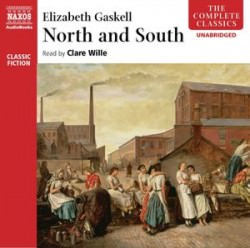
North and South
Narrated by Clare Wille
Unabridged version ISBN: 978-9626341858
When North and South is mentioned these days, it is most likely in reference to the BBC miniseries based on the book, rather than the book itself. That’s not a bad thing, because the miniseries is superbly done. It takes a complicated story of love and life in industrial England in the mid-19th century, and makes it accessible to the modern viewer. But no matter how well done the TV adaptation is, the book is a gem worth pursuing for a patient reader, or better yet, a patient listener.
Elizabeth Gaskell’s writing can be described as somewhat melodramatic, sentimental, and at times wordy, as was common for early Victorian writers. But the dated mode of writing doesn’t have to detract from the beauty of the writing or the enjoyment of the book. In fact, the style helps to immerse the reader in the time and place. North and South was, after all, written as a contemporary novel, and so shows authentic details, such as the language, dialects, and descriptions of daily life. The audiobook is read by Clare Wille, whose ability to manage not only the language of Gaskell, but also the many characters and dialects, is nothing short of amazing. Wille not only has to distinguish the male and female voice of the many characters, but she must voice the different manners of speaking between the social classes in the northern industrial town, as well as the differences in dialect between the characters from the south of England and those of the north. She does all this with skill and realism.
The story is both simple and complicated. When Margaret Hale’s father, a vicar in the Church of England, decides he can no longer serve the church due to differences of faith, he moves his wife and daughter, Margaret, from the slow moving life of rural southern England to the industrial north, there to hopefully find employment as a tutor. Margaret, being raised on edge of gentility, finds the close association with manufacturers and “shop keepers” to be repugnant. She also finds the town of Milton to be dirty, noisy, and rough. There she meets both the successful manufacturers, such as Mr. Thornton who comes to be tutored by Mr. Hale, and the millworkers, such as Higgins and his two daughters, Bessie and Mary.
Gaskell was heavily influenced by Austen’s Pride and Prejudice when writing the romance within North and South. The story of Margaret Hale and John Thornton parallels that of Elizabeth and Darcy on many levels. There is arrogance, ignorance, misunderstanding, and finally respect and understanding. Like Austen’s book, North and South shows the complicated lattice of social interactions and how class restrictions influence relationships and limit choices. Unlike Austen, however, Gaskell’s tale takes on the social problems of the day. The industrialization of England is elevating the middle class and straining the class structure of English society. Along with the changing social structure, Gaskell also explores the plight of the millworkers and struggles of the mill owners to stay competitive in a volatile market.
Gaskell’s romantic notions go farther than getting the main couple together in the end. She also sets about getting another “couple” together– the mill owner, Thornton and the union supporter, Higgins. As complicated as the misunderstandings are between Margaret and Thornton, they are nothing compared to the wall of prejudice and mistrust between the mill owners and their workers. Gaskell ideal was to see the two sides finally acknowledge their interdependence and work together to better the lives of the workers and the profits of the owners.
It should be noted that religious faith plays a large part in the book. Several characters struggle with faith and belief is openly discussed in several conversations. Even so, this is in no way an “inspirational romance.” Gaskell instead explores the different approaches to faith at that time, using the experiences of each character’s life to illuminate their struggles. The part religion plays in the book is very much in keeping with its importance in the culture of the time, and is there for debate rather than for proselytizing.
Clare Wille’s narration of Gaskell’s enduring story of love and struggles in industrial England is a rare treat. If you’ve enjoyed Pride and Prejudice and have a little patience with a writing style that is out of fashion, you will be rewarded with an awe-inspiring listening experience. Gaskell’s beautiful language and emotional story-telling coupled with Wille’s perfect narration is truly not to be missed.
Carrie
Recent Comments