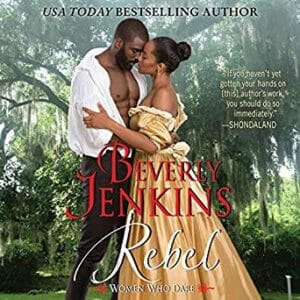
Rebel
Narrated by Kim Staunton
For some reason I had never read or listened to a Beverly Jenkins book before. I’m ashamed! Rebel is my first but it definitely won’t be my last.
Set in New Orleans in 1869 after the
emancipation, Rebel is the story of
Valinda Lacey, a Black woman from New York and Drake LeVeq, a former Union
soldier. Neither Valinda nor Drake had been enslaved but both feel passionately
about the fate of the freed men and women who were learning to navigate life
after slavery. I had so little knowledge about this period of Black American
history (not a surprise really given I’m a white Australian woman) but it was
fascinating (and enraging and many other things, particularly viewed from the
lens of current times where so many things seem the same). I have no doubt that
Ms. Jenkins’ history was authentic.
Valinda came from New York, against her
father’s wishes, to teach freed men and women to read. So many formerly enslaved
people could not read or write and this lack of education severely hampered
their ability to thrive. An education had, for the most part, been something
only for white people but now, it was possible.
Valinda is engaged to her best friend Cole.
Cole and his business partner, Lenny, are on a European trip to arrange
financing for a newspaper they want to start. While she’s waiting for Cole, she
will teach in New Orleans and Cole will pick her up on his way home to New
York. Or at least, that’s the plan.
As much as Cole and Valinda are good
friends, it is not a love match. Rather, Valinda had watched her older sister
be married off to a much older man at the behest of her tyrant father. Val
didn’t want that for herself; she saw how unhappy her sister was. To sidestep
her father’s plan, she and Cole became engaged. Because Cole is the son of
Valinda’s father’s employer, there wasn’t much he could object to.
Valinda is an independent woman. Her father
referred to her as a “hellion”. Her parent’s marriage is not at all happy and
neither is her sister’s. She doesn’t have high regard for the institution of
marriage at all actually, never having seen anyone happy with it before. She
and Cole have an agreement about how their marriage will be and because of their
strong friendship and other reasons I won’t go into here because spoilers, she
knows she will be safe and content, even if there will be no passion.
After Valinda is attacked by a group of
violent men, Drake LeVeq and his sister-in-law, Sable, come to Valinda’s
rescue. As it happens, within hours, Valinda is kicked out of her lodgings and
is left with nowhere else to turn but to the LeVeq family.
The LeVeq matriarch, Julianna, takes
Valinda under her wing and offers her a place to stay. The LeVeq family are
wealthy and Julianna has her own business interests, separate to her husband’s.
Valinda is astounded to see how the LeVeq family interact with one another and
is faced with evidence of two happy marriages.
Drake was instantly smitten by Valinda and
his family pretty much know he’s a goner from the very start. But he has to
work hard for Valinda’s heart. Plus, Valinda is already engaged!
Valinda is attracted to Drake as well and
given she plans to enter into a strictly companionate marriage, she sees no
harm in exploring some passion with Drake if he will allow it. I admit I was
initially a little uncomfortable about what could be termed cheating but other
revelations later in the book eased my mind considerably.
Valinda is trying to start her own school
and Drake will do just about anything for her so he comes up with ways to help
her dream come true.
There is a fair amount of violence in the
book. The men who attack Valinda try to rape her (but do not succeed) and there
are white supremacists who seek to harm the freedmen and the LeVeq family.
There is some vigilante justice from the Black community to a white criminal which
made me a little uncomfortable at first but then I thought about it some more
and decided: a) it was a different time and b) it was not undeserved and c) as
a privileged white woman it’s not for me to judge even in a fiction book and d)
I think the power differential makes a difference too. A white Supremacist
group doing violence to a Black man for the “crime” of being alive is very
different to a group of Black men with no political or law enforcement power
(who have been in fact told that there will be no justice for them from the law
or the state) meting out their own rough justice.
The women of the LeVeq family and Valinda
herself were strong, independent women and the men who loved them adored them
just that way.
Some things happened a bit too quickly for
me and some decisions both Drake and Valinda made surprised me. In Valinda’s
case, I just didn’t get it and in Drake’s the self-sacrifice seemed just a
little over-the-top.
Kim Staunton narrates. She has a very
pleasant voice, with a reasonable depth for her male characters. Although not very
different to the female cast, there was enough for me to know who was speaking.
The accents were good too. However, she paused at odd times during sentences
for reasons I couldn’t always fathom. On some occasions, it was obvious she’d
run out of breath but in others, it felt almost like she was turning a page in
a book before continuing. The performance wasn’t seamless, and the frequent unnecessary/inappropriate
pauses were distracting.
The emotions and tension of the story were
well delivered however, and I liked the way Ms. Staunton performed the intimate
scenes.
As much as I liked Valinda and Drake (and I
did), the best part of the book for me was the history. That time period is not
one I’ve read much about in any setting. In Rebel it was powerful and enraging and so many other things. At
heart though Rebel is of course a romance and I believed in Val and
Drake’s HEA so it succeeded on that level for me as well.
Recent Comments