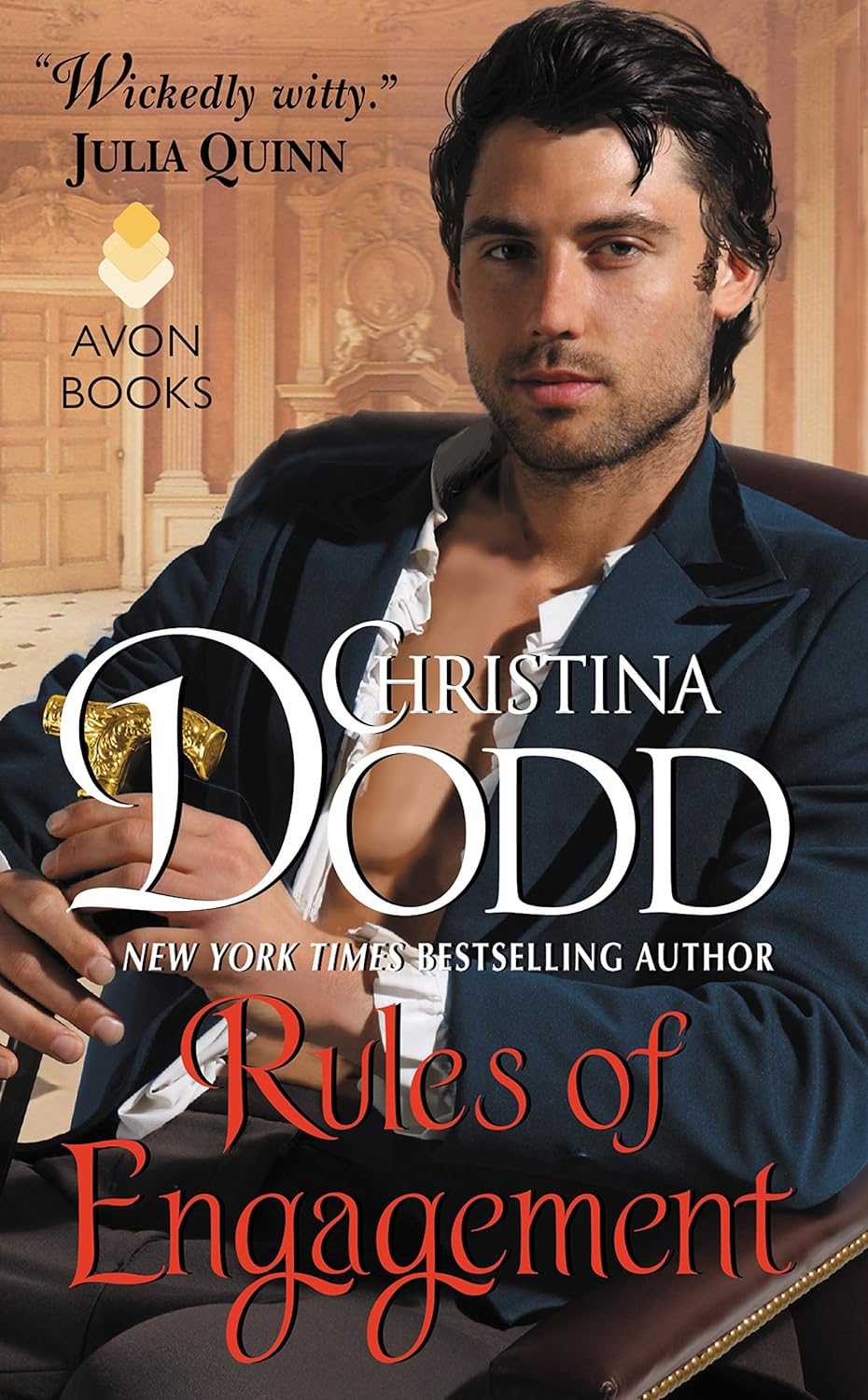
Rules of Engagement
Like Blythe and Linda (see Pandora’s Box), I enjoyed Rules of Engagement by Christina Dodd. A well-written, amusing, and sensual romance, it makes for fun reading, though its secondary suspense plot is irrelevant and extraneous.
Queen Victoria has demanded that the Earl of Kerrich demonstrate that he is a respectable family man. So he hires the Distinguished Academy of Governesses to find him an orphan and provide it a governess. His plan is that his apparent adoption of a waif will prove to the queen that he’s a family man at heart. Although Miss Pamela Lockhart thinks is scheme is cruel (he never intends to actually adopt the orphan), she takes the job because she needs the money.
Kerrich also states, with perfect seriousness, that he is tired of female servants falling in love with him and throwing themselves at him, so he wants his new governess to be old, plain, and without hopes. (Why this should keep her from falling in love with him is one of the several little things that didn’t quite make sense, but didn’t spoil my enjoyment of this book.) Young, lovely Pamela disguises herself as an old biddy (how she does this is another one of those little things), picks out a spunky orphan, and moves in.
Dodd does a great job of showing how the romance between these two people springs from the way their personalities work. Pamela is the daughter of a rake who has no use for men in general and for good-looking, arrogant noblemen like Kerrich in particular. She is dismayed to discover that she’s exactly as attracted to him as he had predicted his governess would be. But that’s nothing to the horror Kerrich experiences when he realizes that he is genuinely attracted to her, even though he is completely convinced by Pamela’s starchy old battleaxe routine. I don’t know how Dodd managed to make a hero as incredibly arrogant as Kerrich so charming, but it works delightfully. Their personalities strike each other in such a way that sparks fly, and they share one of the nicest, funniest, and most passionate first kisses I’ve read about in a long time.
Their love story is improved by secondary characters who are well-written and likable but who never steal the protagonists’ thunder. Kerrich’s grandfather, thank God, is not another comic-relief codger, but a cunning old shark, and the orphan, Beth, is smart and sympathetic.
This funny and sensual romance stumbles toward the end with a suspense subplot that serves no earthly purpose except to provide a climactic scene and cause one of our protagonists to be injured. It has nothing to do with bringing our hero and heroine together, and it has nothing to do with keeping them apart. It absolutely feels tacked on and artificial.
In this respect, Rules of Engagement is one of a rash of books I’ve read lately (like Mary Jo Putney’s The Burning Point and Andrea Pickens’ A Lady of Letters) that seem to feel obliged to stick a criminal conspiracy into the romance, so that there can be a made-for-TV-type climactic scene towards the end. The criminal subplot plot works really well where it’s an integral part of the plot, as with Putney’s Silk and Shadows, or Barbara Hazard’s The Wary Widow. In Dodd’s Rules of Engagement, as in too many other books, the criminal and the revelation scene at the end had nothing to do with anything that I cared about, and served only to make the book longer.
This is a relatively minor complaint on my part, one I wouldn’t worry about if I hadn’t read so many books lately that make the same mistake. In essence, Rules of Engagement is pure fun, and I recommend it.
Recent Comments