
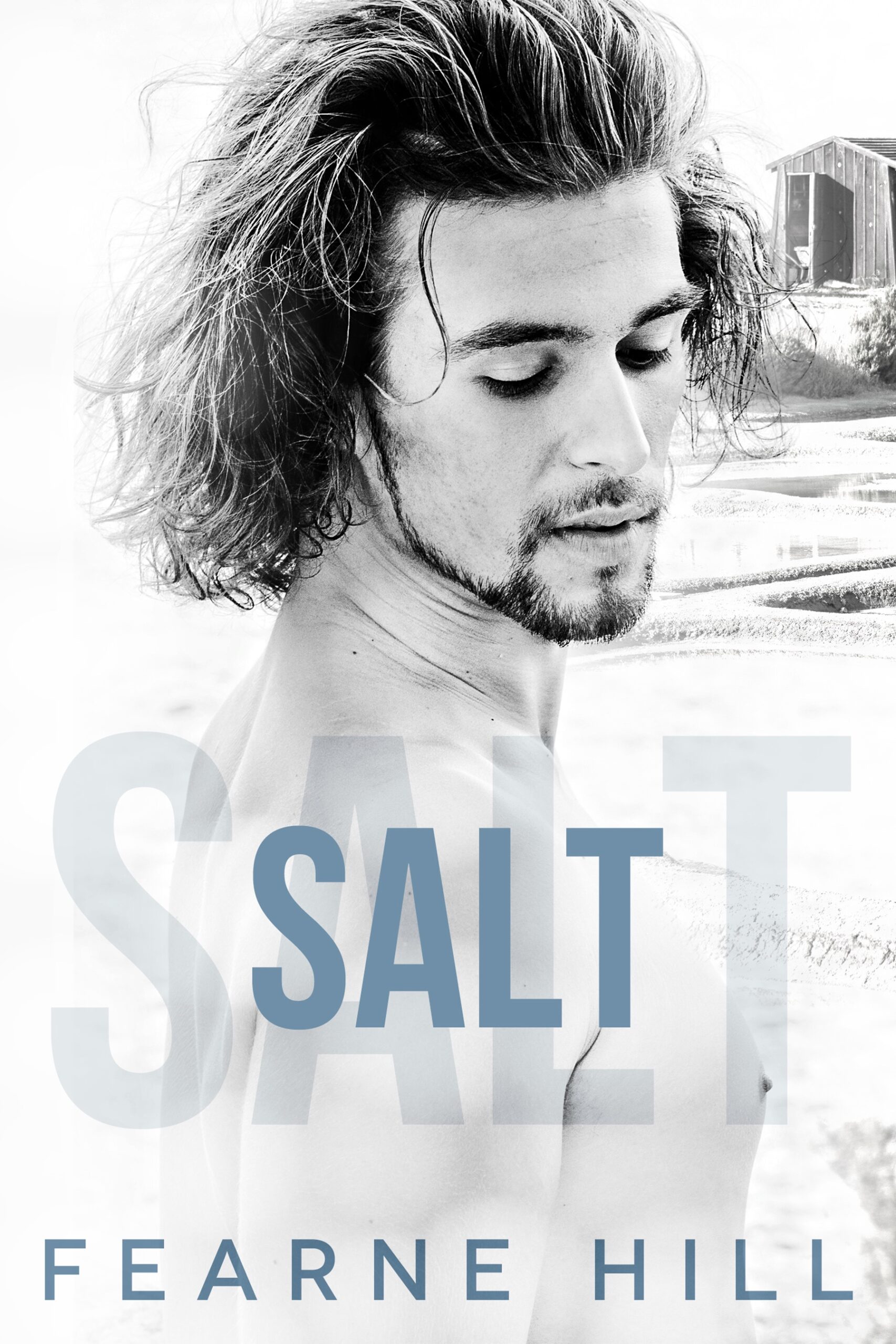
Salt
Fearne Hill’s Salt is book one in her new Island Love series of romances set on the beautiful Île de Ré off the western coast of France. It’s a gorgeous, slow-burn, May/December love story between a young French salt farmer and an Englishman who has come to the island to recuperate after an illness. The story deals with some sensitive topics, but as always with this author, the health and mental health issues are portrayed knowledgeably and sympathetically, the characters are likeable, the romance is heartfelt and very satisfying, and the whole thing is peppered with warmth, humour and insight.
Thirty-nine-year-old venture capitalist Charles Heyer has rented a house in the small village of Loix and retreated there in order to recuperate after having a breakdown. Thrown off balance by the sudden death (by suicide) of his beloved mother, Charles buried himself in his work as a kind of coping mechanism, but not pausing to properly process and grieve her loss meant he didn’t realise just how unwell he was becoming. Stress and overwork tipped his already fragile mental state over the edge into full-blown mania, and after spending several months in a psychiatric hospital, Charles has been advised to take at least three months to rest. He’s aware of the part his workaholic tendencies played in his illness and knows he can’t afford to go back to the way things were, but his business partner, Marcus, is subtly (or not so subtly – Charles can read between the lines of his frequent texts) pressuring him to return to work. Deep down, Charles wonders if he’ll ever be ready to go back to his old life, but Marcus has been single-handedly running their business for months, and the longer Charles stays away, the guiltier he feels.
Charles is walking back to the house late one afternoon when he notices an elderly man wandering around the village square looking lost, and goes over to ask if he needs any help. The man says he’s looking for Florian, who is drinking coffee at L’Escale; when the man doesn’t seem inclined to make use of Charles’ offered directions, he escorts him to the café himself. It’s not until the next day that he realises that Florian is the young man he’s seen working in the salt marshes on the edge of the village, and when Florian stops him to offer his thanks for helping his grandfather, Charles, momentarily dumbstruck by the man’s beauty, doesn’t immediately register Florian’s words of thanks. It’s been a very long time since anyone has turned his head quite like this – but then a teasing exchange follows about Charles’ good French but terrible accent, and when Florian invites him out for a drink – to say thank you properly – Charles is surprised to find himself not only agreeing to go, but for the first time in a long time, actually feeling like himself again.
Before Charles leaves the bar, Florian suggests he should visit the marsh for a tour – and is promptly teased by his friends afterwards – but there’s something about the elegant, reserved Englishman with the tired, grey eyes that really pushes all Florian’s buttons and makes him yearn to mess him up a little – or a lot.
The romance between Charles and Florian has the feel of a gentle slow-burn, and I was completely captivated by the development of the relationship between these two very different men. Florian is around ten years Charles’ junior, and his opposite in almost every way. Outgoing and naturally flirtatious where Charles is cautious and reserved, Florian’s contentedness and his ability to find pleasure in the most ordinary, everyday things are quite alien to Charles, who has never felt particularly comfortable in his own skin. Fearne Hill articulates Charles’ struggles incredibly well; the depth of his grief, guilt and loneliness are beautifully communicated, their gradual lifting as he rediscovers himself and begins to fall in love a palpable thing. Charles is upfront with Florian about his mental health and explains how his synasthaesia – a rare condition he inherited from his mother – impacts him (he generally ‘sees’ emotions as colours) and the part it played in his breakdown. I really appreciated that Charles doesn’t try to hide it and treats Florian like the grown man he is, talking openly about his illness, his time in hospital and his fears for the future. I liked the way Florian’s calm acceptance and unquestioning support give Charles back his sense of ‘personhood’, reminding him – for the first time in a long time – that he’s more than his illness, and that in return, he trusts Charles with his worries about his grandfather and about the future of the salt cooperative. They each provide something the other needs and hasn’t found elsewhere.
Of course, Charles and Florian’s island idyll can’t last, and the sudden intrusion of Charles’ past life into his present one explodes like a rock thrown into a millpond. The events that unfold around two-thirds of the way into the story are hard to read and hard to discuss without giving away too much; although it’s probably easy to guess what happens, and it’s exactly as heartbreaking and powerful and terrifying as you’d expect.
There’s a well-drawn set of secondary characters here, from Florian’s loveable Papi, who is, very sadly, in the early stages of dementia, to his good friends Jerome and Nico (whose book is up next), and the love between Florian and his grandfather, and the affection and camaraderie shared by Florian and his friends come across very strongly. There’s an interesting sub-plot, too, concerning the future of the island’s cooperative of salt producers, who have been offered a very large sum of money by a conglomerate that wants to buy them out, and I enjoyed the glimpses we’re given into the traditional methods of salt-farming employed on the island – the author has clearly done her homework on the subject!
Salt is funny, sad, tender, sexy and utterly compelling. Charles and Florian’s path towards a happy ending has quite a few bumps in it, but the journey is gratifying and deeply emotional, and their HEA is all the sweeter for being so hard won. Fearne Hill has been one of my must-read authors for quite a while now, and this book again shows her to be among the best writers of contemporary romance around.
Note: this story refers to the previous suicide of a parent and depicts an episode of acute phsychiatric illness (which includes suicidal ideation).
Recent Comments




Thanks for the great review, Caz. I’m intrigued by the setting— a salt farm is definitely new to me, and I love learning about new occupations and all that is involved. I really enjoyed Hill’s Two Tribes, so I will look forward to this one.
I hope you enjoy it – she’s one of the very few CR authors whose books I look forward to these days and who can be relied upon to do something a bit different.
On my TBR!
Great review! I agree with the general concensus that Hill is hitting her stride and writes books that break the (rather tired) contemporary m/m mold. I’ve given every book I’ve read by her a B, so she’s a very reliable author for me. This is on my TBR list, but I’m thinking it might not be one I read anytime soon with the level of angst centering around mental health issues. I’m getting a backlog of “angsty books” I really want to read, so I think I definitely need to go on a vacation by myself to a beautiful, restful Island and just read. :-D Think my husband will mind??
Just a small comment on the overall wonderful review of an author I appreciate a lot.
I am surprised that you call 29-39 a May-December romance. I would have expected 20-ies and 50-ies. Obviously, I am not up to date on where the ick- level is today.
Actually, I’ve almost always used the term May/Dec and age-gap interchangeably – I don’t remember ‘age-gap’ being a defined trope until fairly recently.
It’s completely arbitrary on my part – Mr Caz is 7 years older than I am, so that’s ‘normal’ to me!
I got curious and I found this quote about May-December romances (irl):
A May-December romance is a relationship with a significant age gap.
I think it’s interesting that 25% of m/m couples have 10 years or more between them, and 15% of f/f couples. It shows there’s still a stigma against it in heterosexual couples. Maybe because the male-female power imbalances make it feel more icky?
Or, that the age of childbearing doesn’t matter.
Almost every m/m couple I’m close to has an age gap of 10 to 20 years. In the f/f couples I know, there’s less of that.
Could be part of it, but it can’t totally be that. You’d think then it would be even more common in m/f couples because childbearing age is limited by the woman’s age, not the man’s. In other words, if the ability to have children was the push, then it seems more men marrying younger women would be more common, not less.
I also think large age gaps in m/f relationships still has a lot of baggage associated with it in real life. The women in these relationships are often judged as “golddiggers,” and the men as having a midlife crisis or being predatory, especially if the brides are very young. I believe you once said you didn’t care for large age gaps right? I think a lot of people feel that way. I’d have a much harder time reading about it in m/f books than in LGBTQ books, but for me it’s the possiblity gender-related power imbalances that makes me wary (which also bothers me a lot in m/f relationships with no age-gap).
For me, it’s all about the babies and growing old.
Yes, for me it is power imbalance, not age, that is the problem.
Here’s what I’ll say about that:
If a couple feels there isn’t a power imbalance, I tend to trust them. So, I don’t struggle with that as much.
I meant: I do not mind age gaps. They often signal of a power imbalance, which I mind. Older, richer, well connected, emotionally less needy/more stable… these were often part of older m/f romances with age gaps. So, when an age gap is present, I am happy when there is no power imbalance.
I need to be shown in the book that it is love, and for me, power imbalances nearly always negate love. So the sweet poor innocent who loves the older mafia boss while being utterly in his power may feel that this is a great romance, I do not.
Exactly!
Fearne Hill has become an auto-buy author for me and this book is on my Amazon wish list. The summary provided sounded a bit odd so I’m glad to now have a better understanding of the plot. It kind of reminds me of the Rossingley series, which I did love. Thanks for the review!
She’s getting better and better – and is one of the few authors of contemporaries who manages to find different angles and doesn’t just rehash all the tired old tropes.