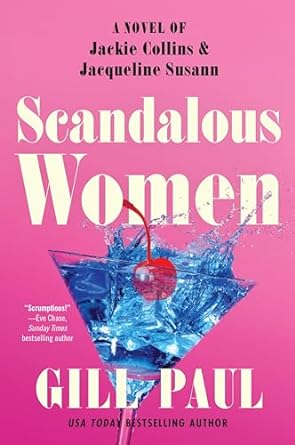
Scandalous Women
Spates of flat prose makes Scandalous Women a shade dull to get through, and that’s truly unfortunate. When it’s really cooking, it’s delicious to read, full of pungent remarks on both Jacqueline Susann and Jackie Collins, the world they live in. Interestingly, it’s not the two famous authoresses who make this book so unique.
Jacqueline Susann and Jackie Collins were the doyennes of smut – they burst through the door already opened by Harold Robbins (knowingly name dropped during the book), daring to tell stories about women who have sex and enjoy it – and sometimes the abusive jerks who deal it out. Soaked in champagne, musk and pills, Susann’s work would define the 1970s and 1960s just as Collins’ would define the 1980s. In that era, before on demand pornography just two clicks away, “Tacky Jackie” and her exuberant British doppelganger taught generations about sex – and had teenagers and adults worldwide trying to figure out who the two women were writing veiled smut about.
Being rich and famous authors did not make either woman’s life easier. Susann had an autistic son whom she institutionalized, but was buoyed by her marriage to Irving Mansfield. Jackie was dogged by stalkers, had a horrible first marriage, and coped with accusations from the press. In Scandalous Women, they manage to meet and create a transatlantic friendship.
The impetus for that friendship? Nancy White, a collegiate virgin recently moved to Manhattan to take up a role at a publishing house. The sexism is stifling, but friendship with Susann leads to Nancy’s sexual liberation. While Nancy acts as a bridge between Jackie and Jacqueline, the two women inspire Nancy to shake off her grief, strike out to become an editor of repute, and find love. But who will step forward to love Nancy: George, the handsome, globetrotting journalist who cares but keeps her at arm’s length? Or Steven, a too-good-to-be-true type with secrets?
Of all of the stories Scandalous Women gives us, it’s that of Nancy – the publishing company spinster who goes on a Susann heroine-like odyssey for independence and romance – who’s the most compelling character. It’s easy to love Jacqueline and Jackie, too, but Nancy takes the cake. Watching her mourn her mother, cope with the drug culture of the era and figure out who she is is pretty fantastic. I was disappointed by her semi-conventional ending, but for the 1970s the choice she makes is a downright revolutionary one.
The book does a decent job of tracking Susann and Collins during the 1970s, forging a realistic relationship between them and putting on a wonderful display of girl power. Money doesn’t mean anything when you’ve got the weight of the world on your shoulders, after all.
Yet sometimes the book lapses into “As You Know, Bob”-isms that grate the ears and mind. The author has to explain chunks of backstory and tries to do it in a reasonable manner, but sometimes paragraphs clonk to the ground. These two women would’ve never allowed such dull prose to be connected to their names! Also, and I must mention this because the book is about these two particular writers notorious for their once-considered-kinky writing – the sex scenes are disappointingly vanilla and tame.
But it’s the character portraits that save Scandalous Women from mediocrity, even if those portraits are a little hazy.
Recent Comments