
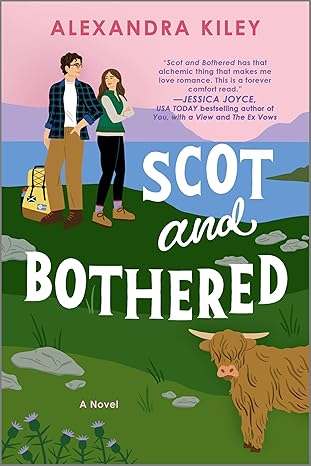
Scot and Bothered
In Scot and Bothered, Alexandra Kiley’s follow-up to 2024’s Kilt Trip, we meet Brooke Sinclair, who left the University of Edinburgh under a cloud seven years earlier and has only recently returned. She’s co-writing a memoir for her dear friend and erstwhile mentor, Mhairi McCallister, who founded the Skye Trail, a famous and gruelling eighty- mile hike on the Isle of Skye. When Mhairi decides that her memoir needs more emotion, she arranges for Brooke to hike the Trail with photographer Jack Sutherland.
Jack and Brooke have history. Seven years ago, Jack was a teaching assistant and Brooke a student at the University of Edinburgh, and when their affair imploded it destroyed both their careers. Both have been treading water ever since. Brooke blames Jack and thinks he betrayed her, while he is full of guilt and is keen to make his case to Brooke, something she denied him, back in the day. They agree to walk the Trail together, for Mhairi’s sake, but also for their own. The romance is dual timeline, so we also find out how they got together and then unravelled, and their past adventures in Edinburgh, complete with pining and chemistry, are some of the best parts of the book.
From the cover I’d expected this to be more of a romantic comedy, with a side of travel, but there’s depth, with an underlying exploration of regret. Brooke and Jack’s experience is not about a misunderstanding or miscommunication, it’s about a professional betrayal which changed the course of both their lives. They do the eighty-mile hike across the Isle of Skye and, during the trip, they face their demons and their pasts and find a way back to each other. There’s more of course; they also have professional challenges as neither has met their potential since their breakup, and secondary character Mhairi is important to the plot.
My reservations? The hike is definitely light on hiking – ten miles a day for eight days in Scottish weather would be quite the challenge and I expected to sense the cold in my bones, or feel the wind searing straight through me. I expected to feel their discomfort, their hunger, taste the dehydrated pseudo-food, suffer the blisters – but while doubtless they experience some of this, I didn’t perceive it. Skye is one of the world’s most beautiful and remote places but little of its awe is communicated to the reader.
The writing style is prosaic, almost pragmatic. Both main characters have such painful histories and a lot to disclose, so I was craving romantic and evocative language, but there was little of that. I didn’t feel their pain or their grief or their happiness for that matter – these were all plainly stated, which kept me at a distance from their experience.
If you enjoyed Alexandra’s first novel, Kilt Trip, you’ll probably like this one. But I liked the idea of this romance much more than the experience of reading it.
Recent Comments


Showing but not telling in a romance is utterly fatal to a book’s aim.
Again, why have publishers decided that romances should be heavily composed of tragedy. Yes, there’s, I’m sure, an HEA here but why does the reader have to wade through sorrow to get there?
Or is it because the bulk of the current batch of authors don’t know how to / aren’t skilled enough to be able to write meaningful emotion without turning to tragedy?
I don’t think so. Even in books by authors that are deft writers, we seem to be in a time where the belief is that angst is what readers want.