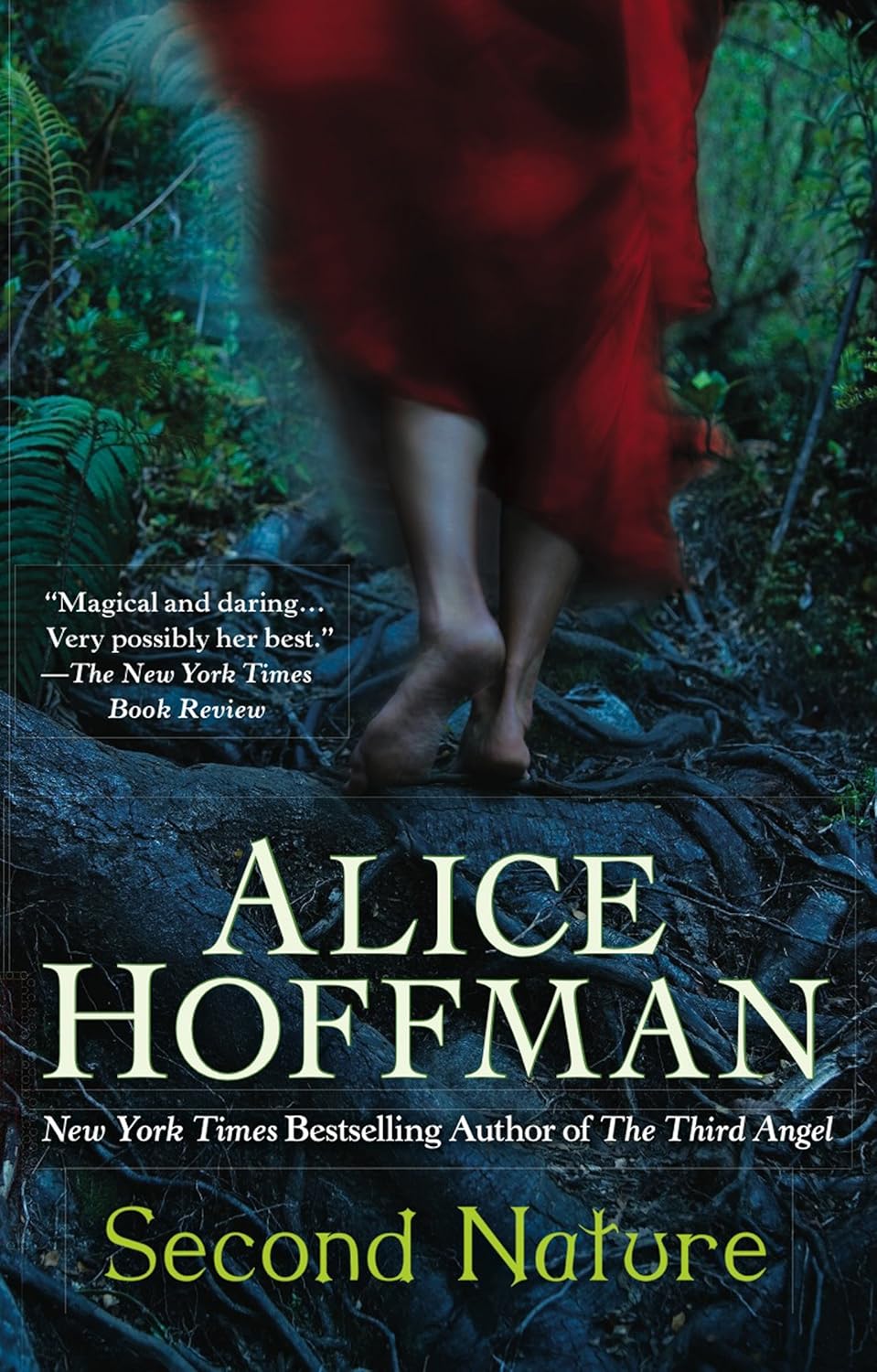
Second Nature
Alice Hoffman’s Second Nature is one of my all-time favorite books. It’s a lovely, lyrical story, a relatively short book that feels so much bigger, the type of tale that deserves to be read slowly and every word savored.
They called him the Wolf Man. He was found in the wilds of Northern Michigan by two hunters who thought they’d trapped a wolf. Instead, they discovered it was a man, one dressed in completely in furs who’d been living among the wolves as one of them. He was sent to a hospital in Manhattan where the doctors tried without success to get him to speak and the nurses watched him nervously, sure he was more animal than man. Finally the doctors concluded that he was beyond hope, his mind likely long gone, and arranged for him to be sent away to a state hospital.
Robin Moore never expected to save him. She had more than enough problems of her own. She’s separated from her husband, a police officer who cheated on her constantly until she could no longer pretend it wasn’t happening. She has a teenage son, Connor, who’s growing up all too soon. Her cantankerous grandfather can no longer care for himself, and with his housekeeper getting older herself, Robin has to make some tough decisions about what to do with him. She knows all about the Wolf Man though. Her brother is the main doctor on his case. She goes to meet with him on the afternoon the Wolf Man is set to be taken away, only to have something unexpected happen. When no one is looking, the Wolf Man does something he hasn’t since arriving at the hospital. He speaks to her, offering one simple plea: “Don’t let them take me someplace.” And in one moment that defies common sense, Robin tells the nurses she’s from the state hospital and takes the Wolf Man home with her.
The jacket copy of the original edition describes Second Nature as “a modern fairy tale,” and it’s perhaps best approached as such. It takes place in the real world and has a lot to say about people and human nature, but there’s also something magical about it, and I don’t mean in the supernatural sense. As with most, if not all, of Hoffman’s stories, it takes place in a kind of heightened reality. She writes in such a lovely style that imbues even the most mundane or normal emotions with so much feeling that they seem deeper, richer somehow. Everyday moments are illuminated into something more powerful and meaningful. She glosses over the details a more realistic story would cover, like Robin’s decision to take him home, the ease with which she removes him from the hospital, or his adaptation to life among people. That may bother more literal-minded readers, but it’s not really a criticism. Those kinds of concerns would only pierce the spell the author weaves. This isn’t a story that’s concerned with plausibility issues. The reality of the situation is irrelevant. It’s more focused on this man and the effect his arrival has on the lives of those around him. Through her fantastic premise, she’s able to communicate some very real emotions and experiences, while telling a fascinating story.
This is very much a character-rich tale that perfectly captures the lives of these people. Some characters are depicted in just a few lines that say all they need to while others have their life stories told in mesmerizing sections that are simply engrossing. As is the case in real life, everybody has a story, their own personal drama to enact. Robin’s lifelong best friend deals with her rebellious teenage daughter, who, unknown to them, is dating Connor, a relationship that could threaten the friendship between their mothers. Robin’s grandfather rails against his existence, trapped in an elderly body that doesn’t match the amount of life he feels inside. Stephen, as the Wolf Man’s name is revealed to be, adjusts to the stark differences between wolf and man, and deals with the strange, maddening feelings Robin inspires in him. The characters go about living their everyday lives. Meanwhile, there are indications that something darker is lurking beneath the surface, something looming that will change everything for all of them.
There are so many memorable scenes, like the sections that portray Stephen’s life among the wolves. The moment showing how he came to live with them, in particular, is amazing. There are passages of almost heartbreaking beauty, and turning points so keenly captured they’re breathtaking. I tried to find a good example, and wound up rereading the book more times than I intended to (not that that was any hardship). Many of them couldn’t be pulled out of context, but here’s one brief taste of her prose:
“Nothing could be done once people fell in love, really; there was nothing anyone could say. Let a chart be printed up, predicting doom and disaster, and unfurled on the kitchen table. Let it be made out of steel and lead, and still it would burn up like an old piece of parchment. Every time she saw Stephen from her kitchen window, Robin felt some ridiculous, incurable hope inside her. Every time she set out the cobalt-blue dinner plates and the silverware, every time she kissed him, every time she saw the way he looked at her, it happened all over again. Who would choose to stop that? Who would even try?”
Second Nature is a bittersweet story. This is fiction, not romance, and it doesn’t end in happily ever after. At the same time, I’ve never found the ending depressing in all the times I’ve read this book. While it would be nice to imagine happy endings for everyone involved, the way the characters’ lives resolve has a certain rightness. This really is a wonderful book, full of beautiful writing, poignant emotion and memorable characters. There are few books I can claim to have enjoyed more. It is, in every sense of the word, a keeper.
Recent Comments